The sample copy of this report is available for access.
The Europe Machine Translation Market is expected to reach USD 1179.8 million by 2031, growing at a CAGR of 20.5% during (2026 - 2033).
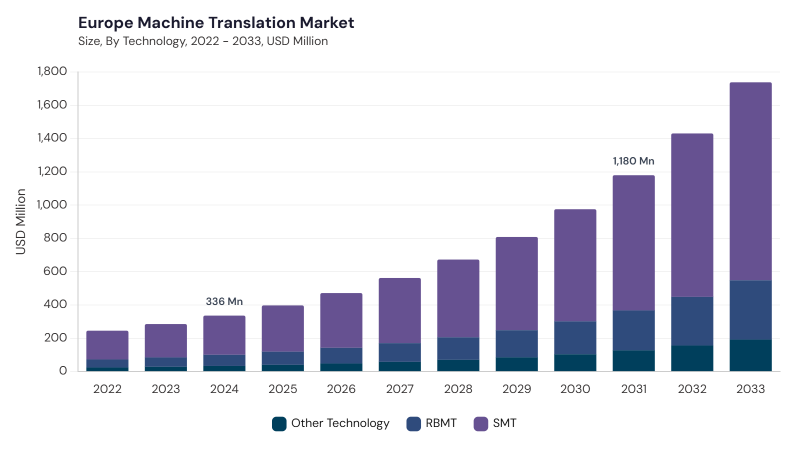
The Europe Machine Translation Market evolved from early rule-based computational linguistics systems toward statistical and increasingly sophisticated neural translation technologies. Initial platforms relied on handcrafted linguistic rules and bilingual dictionaries, while statistical machine translation introduced data-driven processing through aligned language corpora. Neural machine translation later transformed the regional landscape by improving contextual understanding, fluency, and consistency across Europe’s diverse languages. The market has consequently progressed toward an AI-driven ecosystem combining neural models, large language technologies, cloud infrastructure, domain adaptation, and human post-editing to support complex multilingual communication requirements.
Neural machine translation, large language models, human-AI collaboration, regulatory compliance, and multilingual digital transformation are shaping current market development. Enterprises and public institutions increasingly require context-aware translation systems capable of handling diverse languages, specialized terminology, real-time content, and sensitive information. Integration with cloud platforms, workflow automation, translation management systems, and domain-specific language models is improving scalability and operational efficiency. At the same time, GDPR-related privacy requirements, data sovereignty considerations, and quality expectations are strengthening demand for secure, customizable, and human-supervised translation environments.
Based on Technology, the market is segmented into SMT, RBMT, and Other Technology. The SMT market dominated the Europe Machine Translation Market by Technology in 2025, and would continue to be a dominant market till 2033; thereby, achieving a market value of USD 812.3 million by 2031, growing at a CAGR of 20.1 % during the forecast period. The RBMT market is expected to witness a CAGR of 20.9% during (2026 - 2033).
SMT uses bilingual corpora and statistical probabilities to generate translations and remains relevant across legacy workflows, document translation, and environments where established data resources support efficient processing. RBMT relies on explicit linguistic rules and dictionaries, providing predictable terminology and controlled linguistic behavior for technical, legal, medical, and other precision-oriented content. Other Technology includes neural machine translation, transformer architectures, hybrid approaches, adaptive models, and large language technologies that improve fluency, contextual interpretation, multilingual scalability, and domain-specific performance. These newer technologies increasingly support real-time communication, automated localization, quality estimation, and integrated human-machine workflows.
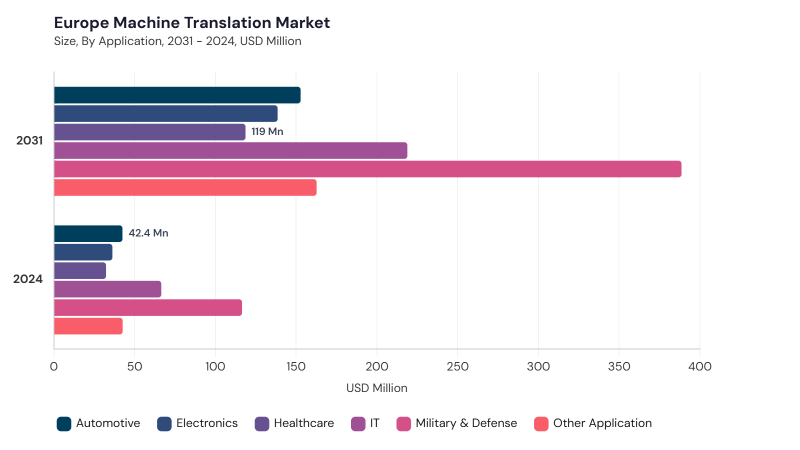
Based on Application, the market is segmented into Military & Defense, IT, Automotive, Electronics, Healthcare, and Other Application. Military & Defense uses machine translation for secure multilingual communication, intelligence processing, operational documentation, and analysis of foreign-language information. IT relies on MT for software localization, technical documentation, customer support, knowledge bases, cloud applications, and multilingual digital services.
Automotive applications include engineering documentation, regulatory materials, digital cockpit interfaces, service information, and connected mobility platforms, while Electronics uses MT for technical catalogs, product instructions, software interfaces, compliance materials, and manufacturing communication. Healthcare applies machine translation to clinical information, patient communication, regulatory documentation, telemedicine, and multilingual healthcare access. Other Application includes public administration, legal services, education, media, gaming, publishing, tourism, finance, and cross-border commerce.
Free Valuable Insights: The Worldwide Machine Translation Market is projected to reach USD 6370.7 Million billion by 2033, at a CAGR of 20.7%
Based on Country, the market is segmented into Germany, UK, France, Russia, Spain, Italy, and Rest of Europe. The Germany market dominated the Europe Machine Translation Market by Country in 2025, and would continue to be a dominant market till 2033; thereby, achieving a market value of USD 243.0 million by 2031, growing at a CAGR of 18.9 % during the forecast period. The UK market is expected to witness a CAGR of 19.4% during (2026 - 2033). Additionally, The France market is expected to witness a CAGR of 21.2% during (2026 - 2033).
Across Europe, machine translation adoption is being shaped by neural AI, domain-specific customization, cloud integration, regulatory compliance, localization, and hybrid human-machine workflows. Germany emphasizes AI-driven neural models, translation management integration, and specialized engines for industrial, legal, automotive, and medical applications, while the UK focuses on adaptive models, human post-editing, real-time translation, sentiment analysis, and industry-specific language systems. France is advancing neural translation, digital customer experience, multimodal capabilities, and collaborative AI development, whereas Russia emphasizes Russian-language neural optimization, e-commerce integration, proprietary language models, and human-assisted translation. Spain is strengthening localized neural systems, regional-language adaptation, human-in-the-loop workflows, and scalable cloud deployment, while Italy focuses on domain-specific translation, collective intelligence, on-device processing, dialect adaptation, and privacy-conscious deployment. Rest of Europe continues to develop secure neural platforms, multimodal translation, domain customization, hybrid deployment, and broader coverage for less-represented European languages.

By Technology
By Application
By Country
Set to reach $1179.8 Million by 2031, growing at 20.5% CAGR during 2026-2033.
Germany leads with $243.0 million by 2031, growing at 18.9% CAGR during 2026-2033.
Rising enterprise cloud adoption and AI-driven workloads are the main catalysts.
SMT technology reaches $812.3 million by 2031, growing at 20.1% CAGR during 2026-2033.
The UK market is expected to witness a CAGR of 19.4% during 2026-2033.
The France market is expected to witness a CAGR of 21.2% during 2026-2033.
Our team of dedicated experts can provide you with attractive expansion opportunities for your business.




 Unique Offerings