The sample copy of this report is available for access.
The LAMEA Used Car Market is expected to reach USD 200.9 billion by 2029, growing at a CAGR of 7% during (2026 - 2033).
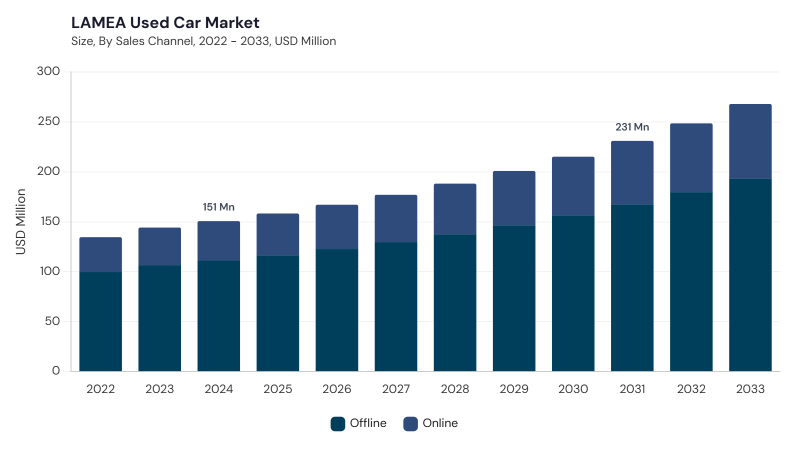
The LAMEA Used Car Market evolved from fragmented local trading, private sales, and informal dealership networks into a progressively professionalized secondary automotive ecosystem. Rising motorization, urbanization, middle-class income growth, and demand for affordable personal mobility expanded the customer base, while digital listings, vehicle-history access, and smartphone adoption improved market transparency. Regulatory attention to vehicle safety, emissions, and consumer protection further encouraged structured inspection and documentation practices. Fintech-enabled credit, digital payments, online marketplaces, and data-driven pricing are now helping transition the market toward more formal, secure, and efficient transactions across diverse regional economies.
Digitalization, environmental regulation, alternative-powertrain adoption, and improving financing access are shaping current market development. Online marketplaces, mobile applications, AI-enabled pricing, virtual showrooms, vehicle-condition diagnostics, and embedded financing are widening consumer reach and improving transaction transparency. Growing emissions awareness is encouraging cleaner and newer used vehicles, while hybrid and electric models are gradually entering resale channels in selected urban markets. At the same time, advanced inspection protocols, warranties, fintech partnerships, logistics services, and localized digital platforms are strengthening buyer confidence and supporting the gradual modernization of the regional used-car ecosystem.
Based on Vendor Type, the market is segmented into Organized and Unorganized. The Organized market dominated the LAMEA Used Car Market by Vendor Type in 2025, and would continue to be a dominant market till 2033; thereby, achieving a market value of USD 103.1 billion by 2029, growing at a CAGR of 7.2 % during the forecast period. The Unorganized market is expected to witness a CAGR of 6.7% during (2026 - 2033).
Organized vendors include formal dealerships, franchise outlets, certified pre-owned programs, and digitally integrated retailers offering standardized inspections, warranties, financing, servicing, and ownership documentation. These vendors appeal strongly to consumers seeking greater reliability, transparency, and after-sales support. Unorganized vendors include private sellers, independent dealers, small garages, and informal marketplaces that compete through flexible negotiation, lower prices, and locally accessible inventory. Their presence remains substantial across rural and semi-urban areas where formal retail coverage, financing access, and certification infrastructure remain comparatively limited.
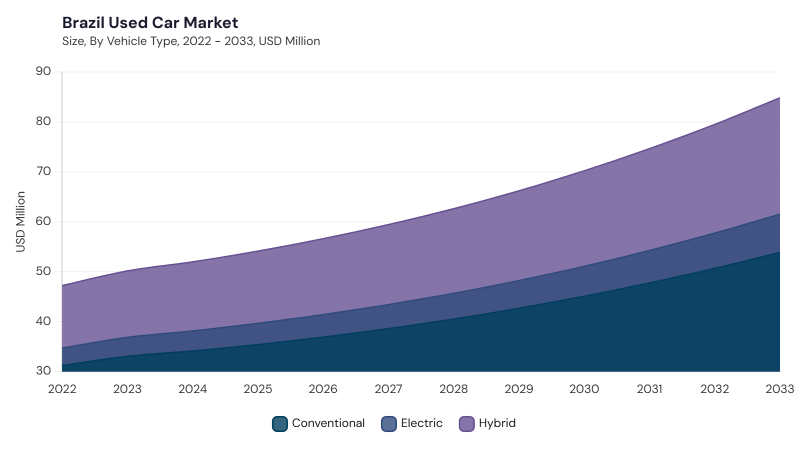
Based on Vehicle Type, the market is segmented into Conventional, Hybrid, and Electric. The Conventional market dominated the LAMEA Used Car Market by Vehicle Type in 2025, and would continue to be a dominant market till 2033; thereby, achieving a market value of USD 130.0 billion by 2029, growing at a CAGR of 6.6 % during the forecast period. The Hybrid market is expected to witness a CAGR of 7.4% during (2026 - 2033). The Electric market is expected to witness a CAGR of 9% during (2026 - 2033).
Conventional vehicles include gasoline- and diesel-powered passenger cars, SUVs, pickups, and commercial vehicles that remain widely preferred for repairability, infrastructure compatibility, and lower acquisition costs. Hybrid vehicles are gradually expanding as fuel-cost concerns, urban congestion, and interest in lower emissions increase demand for efficient mobility without complete dependence on charging infrastructure. Electric vehicles remain a smaller category but are developing in selected Gulf, Latin American, and urban African markets where charging investment and sustainability initiatives are advancing. Battery condition, charging access, residual value, climate conditions, and after-sales capabilities remain important factors affecting adoption.
Based on Fuel Type, the market is segmented into Petrol, Diesel, and Other Fuel Type. The Petrol market dominated the LAMEA Used Car Market by Fuel Type in 2025, and would continue to be a dominant market till 2033; thereby, achieving a market value of USD 124.5 billion by 2029, growing at a CAGR of 6.5 % during the forecast period. The Diesel market is expected to witness a CAGR of 7.4% during (2026 - 2033). Additionally, The Other Fuel Type market is expected to witness highest CAGR of 8.6% during (2026 - 2033).
Petrol vehicles remain widely used for daily mobility because of affordability, service availability, and compatibility with existing fueling infrastructure. Diesel maintains an important position among pickups, utility vehicles, commercial fleets, agricultural applications, and long-distance users requiring torque, durability, and operating efficiency. Other Fuel Type includes hybrid, electric, CNG, LPG, and other alternative-powertrain vehicles whose role is gradually expanding as governments promote cleaner transport and urban sustainability. Charging networks, battery technology, environmental incentives, fuel infrastructure, and regional policy differences continue to influence adoption across this segment.
Based on Sales Channel, the market is segmented into Offline and Online. Offline channels include physical dealerships, independent lots, brokers, and direct person-to-person sales where buyers can inspect vehicles, negotiate pricing, access financing, and verify documentation. Online channels include digital marketplaces, classified platforms, dealer websites, and mobile applications that facilitate vehicle discovery, comparison, virtual inspection, financing, and increasingly digital transaction processes.
Smartphone adoption, digital payments, AI-based assessments, vehicle-history tools, and remote financing are supporting online expansion, while infrastructure limitations and concerns regarding fraud and vehicle authenticity continue to preserve strong demand for physical interaction.
Based on Size, the market is segmented into Compact Car, SUV, and Mid-Sized. Compact Car serves urban commuters, younger consumers, and lower- to middle-income households seeking affordable ownership, easier parking, and lower operating costs. SUV maintains a significant position due to demand for passenger space, higher ground clearance, road versatility, family utility, and suitability for varied terrain and climate conditions.
Mid-Sized vehicles address families, professionals, and business users seeking more cabin comfort and intercity capability without the higher costs associated with larger vehicles. Financing access, fuel costs, road conditions, emissions requirements, and evolving consumer lifestyles continue to influence demand across all three size categories.
Free Valuable Insights: Used Car Market Size Worth USD 2955.0 Billion billion by 2033
Based on Country, the market is segmented into Brazil, Argentina, UAE, Saudi Arabia, South Africa, Nigeria, and Rest of LAMEA. The Brazil market dominated the LAMEA Used Car Market by Country in 2025, and would continue to be a dominant market till 2033; thereby, achieving a market value of USD 66.1 billion by 2029, growing at a CAGR of 5.9 % during the forecast period. The Argentina market is expected to witness a CAGR of 7.8% during (2026 - 2033). Additionally, The UAE market is expected to witness a CAGR of 4.9% during (2026 - 2033).
Across LAMEA, used-car demand is being reshaped by digital marketplaces, financing innovation, vehicle certification, electrification, and affordability-driven mobility needs. Brazil emphasizes online platforms, AI-based pricing, virtual inspections, EV and hybrid resale, financing, and technology-enabled inventory management, while Argentina focuses on digital marketplaces, flexible financing, AI-supported pricing, regulatory compliance, and localized dealership networks. The UAE is advancing AI valuation, virtual inspections, integrated financing, certified vehicles, digital platforms, and flexible ownership models, whereas Saudi Arabia emphasizes AI pricing, blockchain-supported verification, electrified vehicles, localized supply chains, and technology-enabled retail. South Africa focuses on affordability, digital marketplaces, AI-based pricing, financing, warranties, and regional expansion, while Nigeria emphasizes imported used vehicles, digital listings, vehicle inspections, financing partnerships, and affordability. Rest of LAMEA continues to develop online platforms, fintech-enabled credit, AI valuation, certified inspections, sustainable vehicle practices, and localized digital ecosystems.

By Vendor Type
By Vehicle Type
By Fuel Type
By Sales Channel
By Size
By Country
Set to reach $200.9 Billion by 2029, growing at 7% CAGR during 2026-2033.
Brazil leads with $66.1 billion by 2029, growing at 5.9% CAGR during 2026-2033.
The organized vendor type dominates, reaching $103.1 billion by 2029 at 7.2% CAGR during 2026-2033.
Conventional vehicles reach $130.0 billion by 2029, with a 6.6% CAGR during 2026-2033.
The UAE market is expected to witness a CAGR of 4.9% during 2026-2033.
The electric vehicle segment is expected to witness a CAGR of 9% during 2026-2033.
Our team of dedicated experts can provide you with attractive expansion opportunities for your business.




 Unique Offerings