The sample copy of this report is available for access.
The Asia Pacific Used Car Market is expected to reach USD 979.8 billion by 2030, growing at a CAGR of 5.7% during (2026 - 2033).
The Asia Pacific Used Car Market evolved from fragmented transactions involving local dealers and individual sellers into a progressively organized and technology-enabled automotive resale ecosystem. Rising vehicle ownership, urbanization, certified pre-owned programs, inspection standards, and regulatory development gradually strengthened formal market participation. Digital marketplaces and smartphone-based platforms further transformed vehicle discovery, pricing, financing, and transaction transparency, while vehicle-history reporting and data analytics improved buyer confidence. The market now combines traditional dealerships, informal sellers, organized retailers, online platforms, embedded financial services, and technology-supported vehicle assessment across both mature and emerging economies.
Digitalization, electrification, certification, and cross-border vehicle trade are shaping current market development. Smartphone-based marketplaces, AI-enabled pricing, virtual inspections, vehicle-history tools, and integrated financing are expanding consumer access and supporting more transparent purchasing experiences. Growing environmental awareness and stricter emissions requirements are also increasing the availability and acceptance of used hybrid and electric vehicles, requiring stronger battery assessment and servicing capabilities. At the same time, improved trade frameworks, standardized inspection practices, financing innovation, and data-driven inventory management are helping sellers align vehicle supply with diverse demand patterns across Asia Pacific.
Based on Vendor Type, the market is segmented into Organized and Unorganized. The Organized market dominated the Asia Pacific Used Car Market by Vendor Type in 2025, and would continue to be a dominant market till 2033; thereby, achieving a market value of USD 500.2 billion by 2030, growing at a CAGR of 5.9 % during the forecast period. The Unorganized market is expected to witness a CAGR of 5.4% during (2026 - 2033).
Organized vendors include dealership networks, certified pre-owned retailers, formal retail chains, and digital platforms offering standardized inspections, warranties, financing, servicing, and documentation support. Their adoption is strongest among buyers seeking greater reliability, quality assurance, and structured after-sales services. Unorganized vendors include individual sellers, neighborhood dealers, independent traders, and informal intermediaries competing through flexible negotiation, locally available inventory, and lower transaction costs. These channels remain important across price-sensitive, rural, and semi-urban markets where formal financing, certification, and organized retail infrastructure are less developed.
Based on Vehicle Type, the market is segmented into Conventional, Hybrid, and Electric. The Conventional market dominated the Asia Pacific Used Car Market by Vehicle Type in 2025, and would continue to be a dominant market till 2033; thereby, achieving a market value of USD 626.8 billion by 2030, growing at a CAGR of 5.3 % during the forecast period. The Hybrid market is expected to witness a CAGR of 6.1% during (2026 - 2033). The Electric market is expected to witness a CAGR of 7.3% during (2026 - 2033).
Conventional vehicles include gasoline- and diesel-powered compact cars, sedans, SUVs, multipurpose vehicles, pickup trucks, and light commercial vehicles that remain attractive for affordability and familiar servicing requirements. Hybrid vehicles benefit from strong existing fleets in markets such as Japan and increasing availability across China, South Korea, Australia, and Southeast Asia, offering fuel efficiency without complete reliance on charging infrastructure. Electric vehicles are progressively entering resale channels as new-EV adoption expands, particularly in China and other technologically advanced markets. Battery degradation, charging access, residual value, technology obsolescence, and certification remain important considerations influencing used EV adoption.
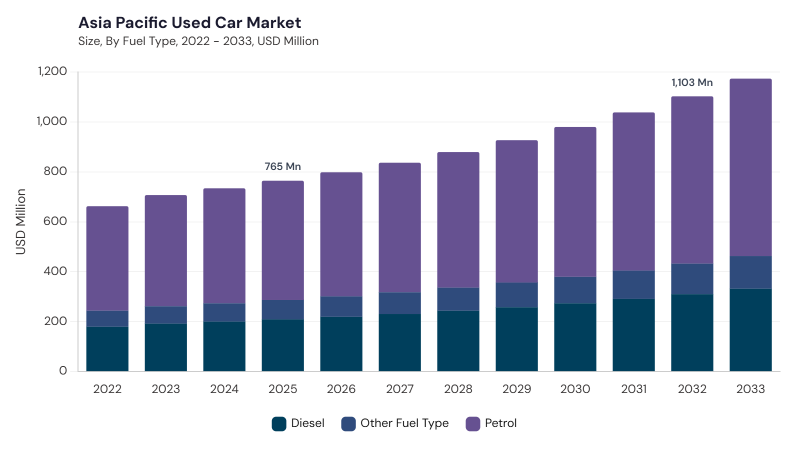
Based on Fuel Type, the market is segmented into Petrol, Diesel, and Other Fuel Type. The Petrol market dominated the Asia Pacific Used Car Market by Fuel Type in 2025, and would continue to be a dominant market till 2033; thereby, achieving a market value of USD 600.4 billion by 2030, growing at a CAGR of 5.2 % during the forecast period. The Diesel market is expected to witness a CAGR of 6.1% during (2026 - 2033). Additionally, The Other Fuel Type market is expected to witness highest CAGR of 6.9% during (2026 - 2033).
Petrol vehicles remain widely used for urban and suburban mobility due to affordable acquisition, extensive refueling networks, familiar maintenance, and broad availability across body styles. Diesel retains relevance among utility vehicles, pickups, commercial models, agricultural applications, and long-distance transportation where torque, durability, and operating efficiency are important. Other Fuel Type includes electric, hybrid, hydrogen, and other alternative-powertrain vehicles whose presence is expanding as environmental policies, charging infrastructure, technology improvements, and clean-mobility incentives strengthen. Battery performance, infrastructure availability, and differing regulatory frameworks continue to shape adoption across regional markets.
Based on Sales Channel, the market is segmented into Offline and Online. Offline channels include physical dealerships, independent retailers, auctions, franchised outlets, and authorized used-car dealers that provide face-to-face negotiations, inspections, financing, certification, and after-sales support.
Online channels include digital marketplaces, manufacturer-certified portals, online auctions, and app-based platforms that enable vehicle browsing, price comparison, financing, history verification, and increasingly complete digital transactions. AI recommendations, virtual tours, digital inspections, online loan approvals, cashless payments, and home delivery are strengthening online adoption, particularly among younger and digitally connected consumers.
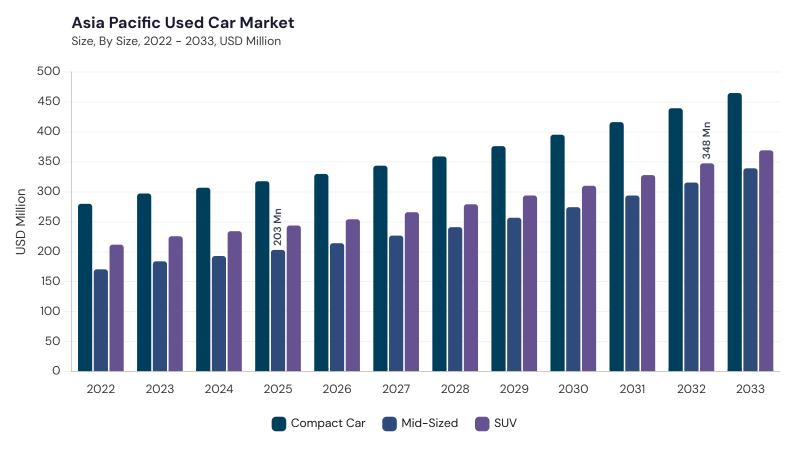
Based on Size, the market is segmented into Compact Car, SUV, and Mid-Sized. Compact Car remains attractive to younger consumers, city commuters, and price-sensitive households seeking lower purchase and operating costs, easier maneuverability, and fuel efficiency. SUV maintains a significant presence as rising household incomes, crossover availability, ground-clearance requirements, passenger space, and lifestyle preferences support demand across developing and mature markets.
Mid-Sized vehicles serve families, professionals, fleet users, and intercity travelers seeking greater comfort and passenger capacity without moving into larger premium categories. Financing availability, hybridization, connected features, emissions standards, and shifting consumer preferences continue to influence demand across these size categories.
Free Valuable Insights: Used Car Market is Predicted to reach USD 2955.0 Billion billion by 2033, at a CAGR of 5.3%
Based on Country, the market is segmented into China, Japan, India, South Korea, Australia, Malaysia, and Rest of Asia Pacific. The China market dominated the Asia Pacific Used Car Market by Country in 2025, and would continue to be a dominant market till 2033; thereby, achieving a market value of USD 362.0 billion by 2030, growing at a CAGR of 4.3 % during the forecast period. The Japan market is expected to witness a CAGR of 4.6% during (2026 - 2033). Additionally, The India market is expected to witness a CAGR of 6.3% during (2026 - 2033).
Across Asia Pacific, used-car activity is increasingly shaped by digital retailing, certified vehicle programs, financing innovation, electrification, and improved transaction transparency. China emphasizes AI-based pricing, virtual inspections, blockchain-enabled provenance, EV battery assessment, financing, and integrated online-offline retail, while Japan focuses on digital auctions, certification, hybrid and electric inventory, export capabilities, and advanced vehicle assessment. India is advancing organized marketplaces, standardized inspections, AI-based pricing, financing, warranties, and expansion into tier-2 and tier-3 cities, whereas South Korea emphasizes online platforms, AI appraisal, blockchain vehicle histories, electrified vehicles, and fintech-enabled financing. Australia focuses on digital valuation, vehicle-history reporting, omnichannel retail, SUVs and utility vehicles, and expanding hybrid and EV resale capabilities, while Malaysia emphasizes online marketplaces, automated appraisal, digital financing, sustainability-oriented inventory, and vehicle diagnostics. Rest of Asia Pacific continues to develop AI-powered platforms, certification, vehicle financing, cross-border trade, electrified inventory, and localized digital sales models.

By Vendor Type
By Vehicle Type
By Fuel Type
By Sales Channel
By Size
By Country
Set to reach $979.8 Billion by 2030, growing at 5.7% CAGR during 2026-2033.
China leads with a market value of USD 362.0 billion by 2030, growing at a CAGR of 4.3% during 2026-2033.
Rising demand for electric vehicles, with the electric segment expected to witness a CAGR of 7.3% during 2026-2033.
Organized segment to achieve USD 500.2 billion by 2030, growing at a CAGR of 5.9% during 2026-2033.
India is expected to witness a CAGR of 6.3% during 2026-2033.
Petrol segment to achieve USD 600.4 billion by 2030, growing at a CAGR of 5.2% during 2026-2033.
Our team of dedicated experts can provide you with attractive expansion opportunities for your business.




 Unique Offerings