The sample copy of this report is available for access.
The Europe Used Car Market is expected to reach USD 631.3 billion by 2031, growing at a CAGR of 4.8% during (2026 - 2033).
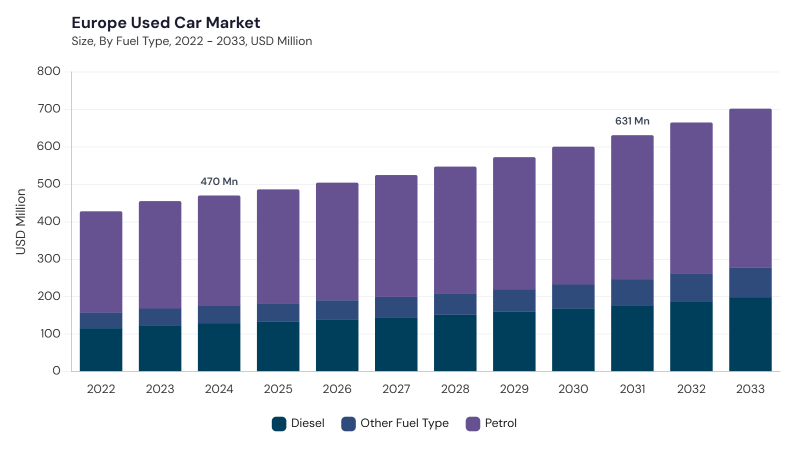
The Europe Used Car Market evolved from informal private transactions and localized dealership activity into a structured secondary automotive ecosystem supported by professional retailers, certification programs, vehicle-history reporting, and digital marketplaces. Increasing regulatory emphasis on emissions, vehicle safety, and consumer protection gradually strengthened quality assurance and transaction transparency. Online platforms, digital valuation tools, connectivity technologies, and data analytics further transformed vehicle discovery, pricing, inspection, and cross-border commerce. The market now operates through a hybrid model combining physical dealerships, organized retail networks, independent sellers, digital platforms, and technology-enabled vehicle assessment.
Electrification, digital retailing, regulatory compliance, and transaction transparency are shaping current market development. Growing availability of used electric and hybrid vehicles is encouraging dealers to strengthen battery diagnostics, EV valuation, servicing, and certification capabilities. AI-driven pricing, demand forecasting, virtual inspections, online financing, and vehicle-history tools are improving inventory management and customer engagement across digital channels. Stricter emissions requirements and low-emission mobility policies are also influencing resale values and vehicle circulation, while certification programs, warranties, flexible financing, and omnichannel sales models increasingly differentiate sellers across European markets.
Based on Vendor Type, the market is segmented into Organized and Unorganized. The Organized market dominated the Europe Used Car Market by Vendor Type in 2025, and would continue to be a dominant market till 2033; thereby, achieving a market value of USD 323.1 billion by 2031, growing at a CAGR of 5.1 % during the forecast period. The Unorganized market is expected to witness a CAGR of 4.6% during (2026 - 2033).
Organized vendors include franchised dealerships, certified pre-owned programs, multi-location retailers, and digitally integrated dealer networks offering standardized inspections, warranties, financing, trade-ins, vehicle histories, and after-sales services. Unorganized vendors include independent dealers, small local lots, private sellers, and informal marketplaces that compete primarily through negotiable pricing, localized inventory, and access to older vehicles. Regulatory compliance, vehicle certification, emissions documentation, and digital transparency increasingly favor organized sellers, while unorganized channels remain relevant among cost-sensitive consumers seeking flexible transactions.
Based on Vehicle Type, the market is segmented into Conventional, Hybrid, and Electric. The Conventional market dominated the Europe Used Car Market by Vehicle Type in 2025, and would continue to be a dominant market till 2033; thereby, achieving a market value of USD 402.4 billion by 2031, growing at a CAGR of 4.4 % during the forecast period. The Hybrid market is expected to witness a CAGR of 5.3% during (2026 - 2033). The Electric market is expected to witness a CAGR of 6.4% during (2026 - 2033).
Conventional vehicles include petrol- and diesel-powered passenger cars, vans, SUVs, and light commercial vehicles supported by established servicing networks and broad spare-parts availability. Hybrid vehicles are gaining acceptance among consumers seeking lower fuel consumption and emissions while retaining long-distance flexibility, including mild, full, and plug-in hybrid configurations. Electric vehicles are progressively entering resale channels through lease returns, fleet replacement, and private ownership cycles. Battery condition, remaining driving range, charging compatibility, software functionality, residual values, and certification increasingly influence purchasing decisions across the electrified used-vehicle segment.
Based on Fuel Type, the market is segmented into Petrol, Diesel, and Other Fuel Type. The Petrol market dominated the Europe Used Car Market by Fuel Type in 2025, and would continue to be a dominant market till 2033; thereby, achieving a market value of USD 385.4 billion by 2031, growing at a CAGR of 4.4 % during the forecast period. The Diesel market is expected to witness a CAGR of 5.3% during (2026 - 2033). Additionally, The Other Fuel Type market is expected to witness highest CAGR of 6.1% during (2026 - 2033).
Petrol vehicles remain widely available across compact cars, family vehicles, and light SUVs and are supported by established fueling and maintenance infrastructure. Diesel retains relevance among long-distance motorists, commercial users, larger vehicles, and consumers prioritizing fuel efficiency and torque, although tighter emissions requirements and urban restrictions increasingly influence older diesel resale demand. Other Fuel Type includes electric, hybrid, LPG, and emerging alternative-powertrain vehicles whose secondary-market presence is expanding as Europe progresses toward cleaner mobility. Charging infrastructure, incentives, battery warranties, emissions policies, and technological advancements continue to shape this category.
Based on Sales Channel, the market is segmented into Offline and Online. Offline channels include traditional dealerships, independent used-car lots, physical auctions, and manufacturer-backed certified pre-owned outlets offering direct inspection, financing, warranties, and after-sales support. Online channels include dedicated marketplaces, digital retailer platforms, OEM-certified websites, and auction portals that support remote vehicle discovery, comparison, valuation, history verification, financing, and transaction processing.
AI recommendations, virtual tours, 360-degree imaging, digital documentation, e-registration, and home delivery are strengthening online adoption, while omnichannel approaches increasingly connect digital research with physical validation and delivery.
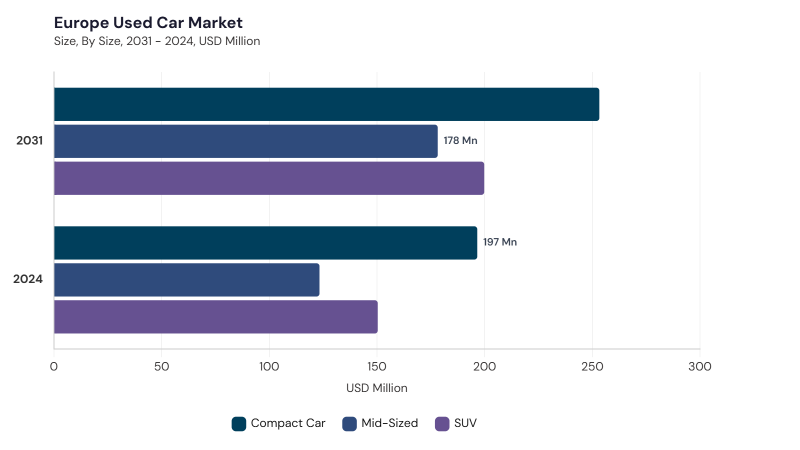
Based on Size, the market is segmented into Compact Car, SUV, and Mid-Sized. Compact Car appeals to urban commuters, younger buyers, and cost-conscious consumers seeking affordability, fuel efficiency, lower operating expenses, and easier maneuverability. SUV maintains a significant presence as crossovers and sport utility vehicles increasingly enter secondary ownership, supported by family utility, cargo capacity, elevated seating, and broader lifestyle appeal.
Mid-Sized vehicles serve buyers seeking greater passenger comfort, motorway capability, and practicality without moving into larger vehicle formats. Electrification, emissions requirements, hybrid powertrains, online retailing, and changing urban mobility preferences continue to influence demand across these size categories.
Free Valuable Insights: The Worldwide Used Car Market is projected to reach USD 2955.0 Billion billion by 2033, at a CAGR of 5.3%
Based on Country, the market is segmented into Germany, UK, France, Russia, Spain, Italy, and Rest of Europe. The Germany market dominated the Europe Used Car Market by Country in 2025, and would continue to be a dominant market till 2033; thereby, achieving a market value of USD 123.7 billion by 2031, growing at a CAGR of 3.4 % during the forecast period. The UK market is expected to witness a CAGR of 3.9% during (2026 - 2033). Additionally, The France market is expected to witness a CAGR of 5.6% during (2026 - 2033).
Across Europe, used-car activity is being reshaped by digital marketplaces, electrification, certified pre-owned programs, regulatory compliance, financing innovation, and greater vehicle-history transparency. Germany emphasizes digital platforms, AI-based pricing, EV availability, flexible ownership, and data-driven inventory management, while the UK focuses on online retailing, CPO programs, hybrid and electric vehicles, financing integration, and advanced inspection technologies. France is advancing digital marketplaces, EV and hybrid resale, AI-enabled damage assessment, financing, and emissions compliance, whereas Russia emphasizes affordability, digital verification, AI-based inspection, financing partnerships, and localized omnichannel models. Spain focuses on digital sales, EV adoption, financing, certified programs, and sustainability, while Italy emphasizes electrified vehicles, digital valuation, circular-economy practices, flexible financing, and localized customer strategies. Rest of Europe continues to develop online marketplaces, vehicle certification, electrified inventory, AI-based pricing, cross-border trade, and standardized transparency mechanisms.

By Vendor Type
By Vehicle Type
By Fuel Type
By Sales Channel
By Size
By Country
Set to reach $631.3 Billion by 2031, growing at 4.8% CAGR during 2026-2033.
Germany leads with $123.7 billion by 2031, growing at a CAGR of 3.4% during the forecast period.
Rising demand for electric vehicles, with a 6.4% CAGR during 2026-2033, drives growth.
Organized segment hits $323.1 billion by 2031 at 5.1% CAGR during 2026-2033.
The UK market is expected to witness a CAGR of 3.9% during 2026-2033.
Petrol market achieves $385.4 billion by 2031, growing at a 4.4% CAGR during the forecast period.
Our team of dedicated experts can provide you with attractive expansion opportunities for your business.




 Unique Offerings