The sample copy of this report is available for access.
The LAMEA Probiotic Drinks Market is expected to reach USD 2333.2 million by 2029, growing at a CAGR of 10.1% during (2026 - 2033).
The LAMEA Probiotic Drinks Market evolved from traditional fermented dairy and plant-based beverages into a more structured functional beverage category supported by microbiology, fermentation technology, and scientific validation. Early products relied on indigenous fermentation practices, while advances in strain selection, freeze-drying, microencapsulation, and quality control improved probiotic stability and commercial scalability. Growing awareness of digestive wellness and immunity further expanded adoption beyond niche health-oriented consumers. Current development increasingly emphasizes dairy and non-dairy formulations, targeted probiotic strains, longer shelf life, cleaner ingredient profiles, culturally relevant flavors, and products designed for diverse climatic and dietary conditions across Latin America, the Middle East, and Africa.
Health awareness, sustainability, digital commerce, personalized nutrition, and advanced delivery technologies are shaping current market development. Manufacturers are increasingly integrating multi-strain probiotics, prebiotics, botanicals, plant-based ingredients, and other functional components to address digestive health, immunity, and broader wellness requirements. Microencapsulation, strain stabilization, fermentation optimization, and improved packaging are strengthening probiotic viability under challenging regional storage conditions. E-commerce, mobile platforms, localized sourcing, and cleaner labels are also expanding accessibility and differentiation. At the same time, regulatory fragmentation, high production and distribution costs, limited cold-chain infrastructure, price sensitivity, low consumer awareness, and cultural differences continue to influence broader adoption.
Based on Format, the market is segmented into Refrigerated and Shelf-Stable. The Refrigerated market dominated the LAMEA Probiotic Drinks Market by Format in 2025, and would continue to be a dominant market till 2033; thereby, achieving a market value of USD 1625.5 million by 2029, growing at a CAGR of 9.8 % during the forecast period. The Shelf-Stable market is expected to witness a CAGR of 10.8% during (2026 - 2033).
Refrigerated probiotic drinks include yogurt-based beverages, kefir, fermented dairy products, and chilled plant-based formulations that require controlled temperatures to preserve live cultures and maintain sensory quality. These products are particularly relevant in urban and higher-income markets where refrigeration infrastructure is stronger. Shelf-Stable products provide longer storage, easier transportation, and broader geographic reach through heat-resistant strains, microencapsulation, freeze-drying, and ambient packaging. Their importance is increasing in areas where refrigeration remains fragmented, helping manufacturers target semi-urban, rural, and underserved consumers with more accessible functional beverage formats.
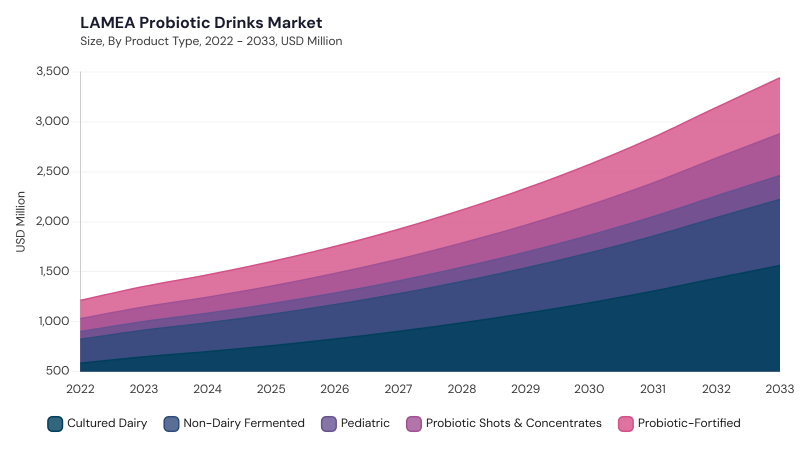
Based on Product Type, the market is segmented into Cultured Dairy, Non-Dairy Fermented, Probiotic-Fortified, Probiotic Shots & Concentrates, and Pediatric. The Cultured Dairy market dominated the LAMEA Probiotic Drinks Market by Product Type in 2025, and would continue to be a dominant market till 2033; thereby, achieving a market value of USD 1082.5 million by 2029, growing at a CAGR of 9.5 % during the forecast period. The Non-Dairy Fermented market is expected to witness a CAGR of 9.8% during (2026 - 2033). The Pediatric market is expected to witness a CAGR of 10.9% during (2026 - 2033).
Cultured Dairy includes yogurt drinks, kefir, buttermilk, and related fermented milk products that combine familiar consumption patterns with probiotic functionality. Non-Dairy Fermented products use fruits, vegetables, legumes, and other plant-derived substrates to address lactose intolerance, vegan preferences, and demand for locally relevant ingredients. Probiotic-Fortified beverages incorporate added probiotic strains into juices, waters, and herbal beverages, while Probiotic Shots & Concentrates provide compact and convenient formats for targeted health applications. Pediatric products focus on age-appropriate strains, gentle formulations, palatable flavors, and digestive and immune support for infants and children.
Based on Distribution Channel, the market is segmented into Supermarkets & Hypermarkets, Online Retail, Health & Specialty Stores, Convenience Stores, and Other Distribution Channel. Supermarkets & Hypermarkets provide broad product visibility, promotional opportunities, cold-chain infrastructure, and access to both mainstream and premium probiotic beverages. Health & Specialty Stores serve wellness-oriented consumers seeking clinically supported, natural, organic, and specialized formulations, while Online Retail is expanding through smartphone adoption, digital marketplaces, home delivery, subscription models, and direct-to-consumer engagement.
Convenience Stores support portable, single-serve, and impulse consumption formats in high-traffic locations. Other Distribution Channel includes pharmacies, fitness centers, vending machines, foodservice outlets, independent grocers, and traditional retail networks that extend product availability beyond modern trade.
Free Valuable Insights: Probiotic Drinks Market Size Worth USD 38.7 Billion billion by 2033
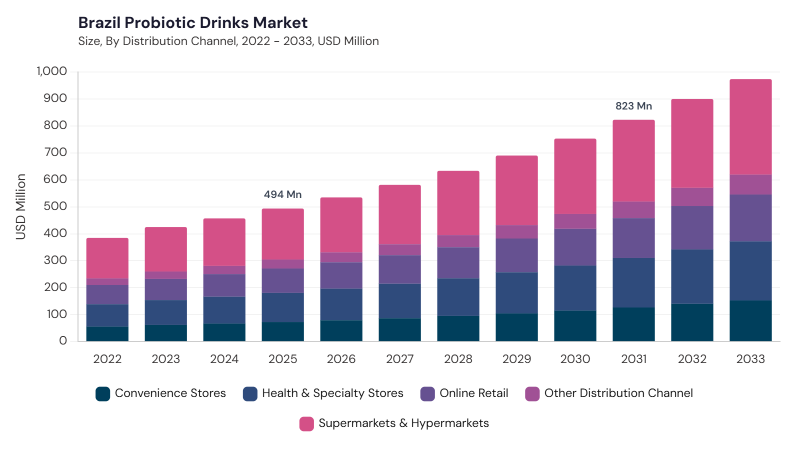
Based on Country, the market is segmented into Brazil, Argentina, UAE, Saudi Arabia, South Africa, Nigeria, and Rest of LAMEA. The Brazil market dominated the LAMEA Probiotic Drinks Market by Country in 2025, and would continue to be a dominant market till 2033; thereby, achieving a market value of USD 690.1 million by 2029, growing at a CAGR of 8.9 % during the forecast period. The Argentina market is expected to witness a CAGR of 11.4% during (2026 - 2033). Additionally, The UAE market is expected to witness a CAGR of 8.9% during (2026 - 2033).
Across LAMEA, probiotic drink consumption is being shaped by functional wellness, localized ingredients, plant-based alternatives, regulatory development, and digital retail. Brazil emphasizes non-dairy formulations, tropical ingredients, clean-label products, reduced sugar, and scientifically validated probiotic claims, while Argentina focuses on postbiotics, targeted health outcomes, natural ingredients, advanced fermentation, and improved shelf stability. The UAE emphasizes personalized wellness, halal-aligned formulations, clean-label processing, functional fortification, and nonthermal technologies, whereas Saudi Arabia focuses on plant-based alternatives, bioactive ingredients, transparent labeling, clinical validation, and localized product development. South Africa is advancing strain-specific products, plant-based formulations, personalized nutrition, synbiotics, and improved delivery technologies, while Nigeria emphasizes localized ingredients, controlled fermentation, fortified products, scalable processing, and culturally relevant flavors. Rest of LAMEA continues to develop clean-label formulations, advanced encapsulation, personalized nutrition, natural ingredients, localized tastes, and commercially scalable probiotic products adapted to regional infrastructure and consumer needs.

By Format
By Product Type
By Distribution Channel
By Country
Set to reach $2333.2 Million by 2029, growing at 10.1% CAGR during 2026-2033.
Brazil leads with $690.1 million by 2029, growing at 8.9% CAGR during the forecast period.
Rising demand for Refrigerated products, reaching $1625.5 million by 2029 at 9.8% CAGR during 2026-2033.
Cultured Dairy hits $1082.5 million by 2029, growing at 9.5% CAGR during the forecast period.
The UAE market is expected to witness a CAGR of 8.9% during 2026-2033.
The Pediatric segment is expected to witness a CAGR of 10.9% during 2026-2033.
Our team of dedicated experts can provide you with attractive expansion opportunities for your business.




 Unique Offerings