The sample copy of this report is available for access.
The Asia Pacific Probiotic Drinks Market is expected to reach USD 11.9 billion by 2030, growing at a CAGR of 8.8% during (2026 - 2033).
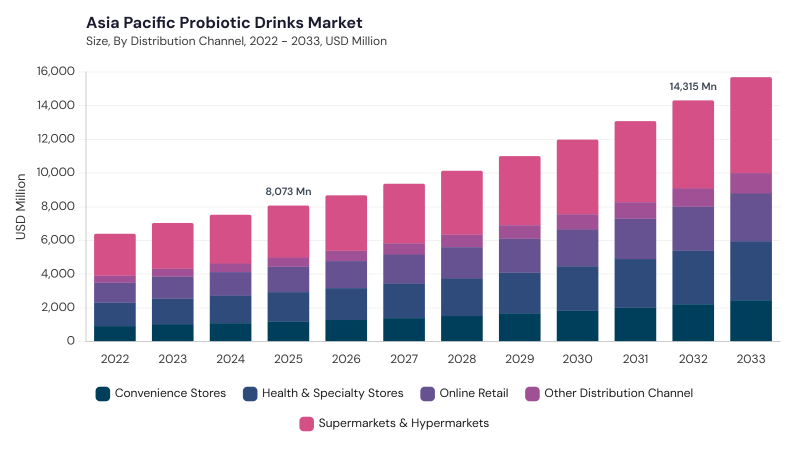
The Asia Pacific Probiotic Drinks Market evolved from traditional fermented beverages and dairy-based cultured products into a sophisticated functional beverage category supported by microbiome science, biotechnology, and modern food processing. Advances in strain selection, fermentation control, encapsulation, preservation, and quality monitoring improved probiotic stability and enabled standardized commercial production. The market progressively expanded beyond conventional dairy into non-dairy, plant-based, fortified, concentrated, and shelf-stable formats. Current development increasingly emphasizes scientifically validated strains, localized formulations, multifunctional health benefits, preventive wellness, sustainable ingredients, convenient consumption formats, and products aligned with diverse dietary and cultural preferences across the region.
Rising health awareness, plant-based nutrition, personalized wellness, advanced fermentation technologies, and expanding retail infrastructure are shaping current market development. Manufacturers are increasingly combining probiotics with prebiotics, vitamins, minerals, adaptogens, botanicals, and other functional ingredients to support digestive health, immunity, metabolic wellness, and broader preventive nutrition. Microencapsulation, nonthermal processing, aseptic packaging, digital quality control, and improved strain preservation are strengthening product efficacy and shelf life. E-commerce, modern retail, mobile commerce, and localized product development are also improving accessibility. At the same time, regulatory fragmentation, high production costs, imported ingredient dependence, uneven cold-chain infrastructure, consumer education gaps, and price sensitivity continue to influence adoption.
Based on Format, the market is segmented into Refrigerated and Shelf-Stable. The Refrigerated market dominated the Asia Pacific Probiotic Drinks Market by Format in 2025, and would continue to be a dominant market till 2033; thereby, achieving a market value of USD 8.2 billion by 2030, growing at a CAGR of 8.5 % during the forecast period. The Shelf-Stable market is expected to witness a CAGR of 9.5% during (2026 - 2033).
Refrigerated probiotic drinks include yogurt beverages, kefir, cultured milk products, and other live-culture formulations requiring controlled temperatures to maintain probiotic viability and freshness. These products are particularly relevant in urban markets with advanced retail infrastructure and strong consumer demand for premium functional beverages. Shelf-Stable products offer longer storage, easier transportation, and broader geographic accessibility through strain stabilization, microencapsulation, aseptic packaging, and improved fermentation technologies. Their role is strengthening in markets with uneven refrigeration infrastructure, where ambient formats enable wider penetration and lower distribution complexity.
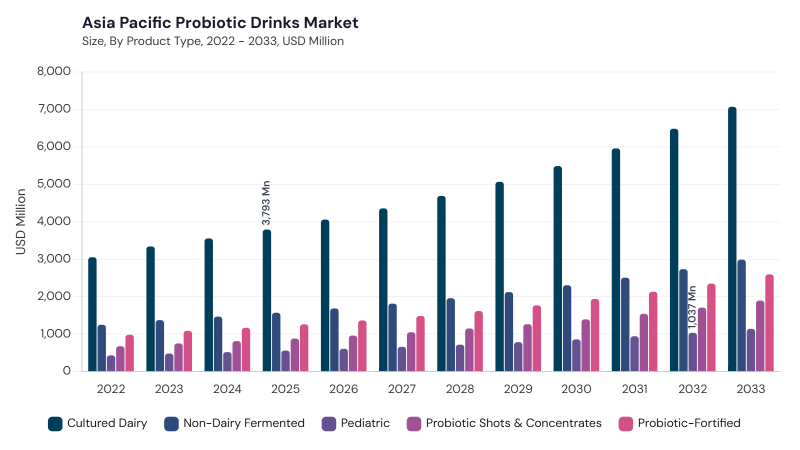
Based on Product Type, the market is segmented into Cultured Dairy, Non-Dairy Fermented, Probiotic-Fortified, Probiotic Shots & Concentrates, and Pediatric. The Cultured Dairy market dominated the Asia Pacific Probiotic Drinks Market by Product Type in 2025, and would continue to be a dominant market till 2033; thereby, achieving a market value of USD 5.4 billion by 2030, growing at a CAGR of 8.3 % during the forecast period. The Non-Dairy Fermented market is expected to witness a CAGR of 8.5% during (2026 - 2033). The Pediatric market is expected to witness a CAGR of 9.4% during (2026 - 2033).
Cultured Dairy includes yogurt drinks, fermented milk beverages, kefir, and related products delivering established probiotic strains alongside conventional dairy nutrition. Non-Dairy Fermented products use soy, coconut, rice, grains, and other plant-derived substrates to address lactose intolerance, vegan diets, and sustainability preferences. Probiotic-Fortified beverages incorporate added cultures into juices, teas, waters, and other functional formats, while Probiotic Shots & Concentrates offer convenient, small-volume wellness solutions for targeted consumption. Pediatric products address child-specific digestive and immune-health requirements through age-appropriate strains, suitable flavors, controlled formulations, and careful attention to safety and dosing.
Based on Distribution Channel, the market is segmented into Supermarkets & Hypermarkets, Online Retail, Health & Specialty Stores, Convenience Stores, and Other Distribution Channel. Supermarkets & Hypermarkets provide broad access, promotional visibility, cold-chain support, and extensive product selection across dairy, plant-based, fortified, and shelf-stable formats. Health & Specialty Stores attract consumers seeking premium, clinically supported, natural, and wellness-oriented formulations, while Online Retail is expanding through mobile commerce, subscriptions, direct-to-consumer platforms, and rapid-delivery models.
Convenience Stores support single-serve and on-the-go consumption in densely populated urban areas. Other Distribution Channel includes pharmacies, wellness centers, traditional retailers, foodservice operators, institutional outlets, specialty kiosks, and direct-sales models that extend product accessibility across diverse regional markets.
Free Valuable Insights: Probiotic Drinks Market is Predicted to reach USD 38.7 Billion billion by 2033, at a CAGR of 8.3%
Based on Country, the market is segmented into China, Japan, India, South Korea, Singapore, Malaysia, and Rest of Asia Pacific. The China market dominated the Asia Pacific Probiotic Drinks Market by Country in 2025, and would continue to be a dominant market till 2033; thereby, achieving a market value of USD 2.9 billion by 2030, growing at a CAGR of 6.7 % during the forecast period. The Japan market is expected to witness a CAGR of 8.2% during (2026 - 2033). Additionally, The India market is expected to witness a CAGR of 9.6% during (2026 - 2033).
Across Asia Pacific, probiotic drink consumption is being shaped by digestive wellness, functional beverage innovation, plant-based alternatives, regulatory development, and localized product strategies. China emphasizes multifunctional beverages, plant-derived formulations, digital consumer engagement, advanced fermentation, and personalized health positioning, while Japan focuses on scientifically validated strains, clean-label products, multifunctional wellness, digital engagement, and advanced delivery technologies. India is advancing natural formulations, plant-based alternatives, localized flavors, scientific substantiation, and broader distribution beyond major cities, whereas South Korea emphasizes clean-label products, advanced encapsulation, postbiotics, functional hybrids, and targeted health benefits. Singapore focuses on personalized nutrition, sustainable fermentation, transparent labeling, precision health, and biotechnology-enabled formulations, while Malaysia emphasizes microbiome-driven personalization, local bioactives, halal-aligned opportunities, digital traceability, and advanced quality assurance. Rest of Asia Pacific continues to develop clinically supported formulations, clean-label products, personalized nutrition, sustainable packaging, advanced manufacturing, and localized probiotic beverages adapted to varied regional preferences.

By Format
By Product Type
By Distribution Channel
By Country
Set to reach $11.9 Billion by 2030, growing at 8.8% CAGR during 2026-2033.
China leads with a market value of USD 2.9 billion by 2030, growing at 6.7% CAGR during the forecast period.
Rising demand for refrigerated formats, reaching USD 8.2 billion by 2030, is a key growth driver.
Cultured Dairy segment will achieve USD 5.4 billion by 2030, growing at 8.3% CAGR during the forecast period.
India is expected to witness a CAGR of 9.6% during 2026-2033, indicating strong growth potential.
Shelf-Stable segment is expected to witness a CAGR of 9.5% during 2026-2033.
Our team of dedicated experts can provide you with attractive expansion opportunities for your business.




 Unique Offerings