The sample copy of this report is available for access.
The LAMEA Mobile Forensics Market is expected to reach USD 845.2 million by 2029, growing at a CAGR of 12.3% during (2026 - 2033).
The LAMEA Mobile Forensics Market evolved from basic extraction of call logs, messages, and contacts toward advanced forensic suites capable of analyzing smartphones, encrypted content, application data, biometric records, cloud information, and social media artifacts. Early use was primarily linked to law enforcement and criminal investigations, while rapid mobile penetration across Latin America, the Middle East, and Africa expanded the need for stronger digital evidence capabilities. As Android, iOS, mobile payments, and app-based communication became more complex, forensic solutions shifted toward cryptographic analysis, real-time data capture, and multi-platform evidence recovery. The market now supports law enforcement, corporate cybersecurity, fraud detection, compliance, and digital investigation workflows through integrated hardware, software, services, and cloud-enabled forensic capabilities.
Mobile payment growth, digital wallets, mobile malware, spyware, AI-enabled analytics, and localized forensic development are shaping current market progress. Investigators increasingly require tokenized transaction analysis, biometric-data handling, encrypted application recovery, real-time threat identification, cloud data acquisition, and tools adapted to local languages, networks, and device usage patterns. Governments and enterprises are strengthening cybercrime response, digital evidence preservation, and investigative modernization, while regional innovation hubs are encouraging locally optimized forensic solutions. However, regulatory fragmentation, privacy compliance complexity, high tool and infrastructure costs, limited skilled professionals, device diversity, inconsistent connectivity, and fragmented operating-system environments continue to influence adoption across LAMEA.
Based on Component, the market is segmented into Hardware, Software, and Services. The Hardware market dominated the LAMEA Mobile Forensics Market by Component in 2025, and would continue to be a dominant market till 2033; thereby, achieving a market value of USD 342.3 million by 2029, growing at a CAGR of 11.7 % during the forecast period. The Software market is expected to witness a CAGR of 12.7% during (2026 - 2033). The Services market is expected to witness a CAGR of 12.5% during (2026 - 2033).
Hardware includes forensic workstations, extraction devices, write blockers, secure storage systems, connectivity equipment, and physical acquisition tools used to preserve evidence integrity while examining diverse mobile devices. Software holds a substantial position as investigators require platforms for deleted-file recovery, communication decoding, application activity examination, timeline reconstruction, data visualization, and AI-assisted analytics. Services include forensic consulting, technical training, specialist examinations, incident response, implementation support, evidence interpretation, and expert assistance in complex investigations. Growing cybercrime, expanding digital financial ecosystems, limited internal expertise, and stricter evidence-handling requirements are strengthening demand across all component categories.
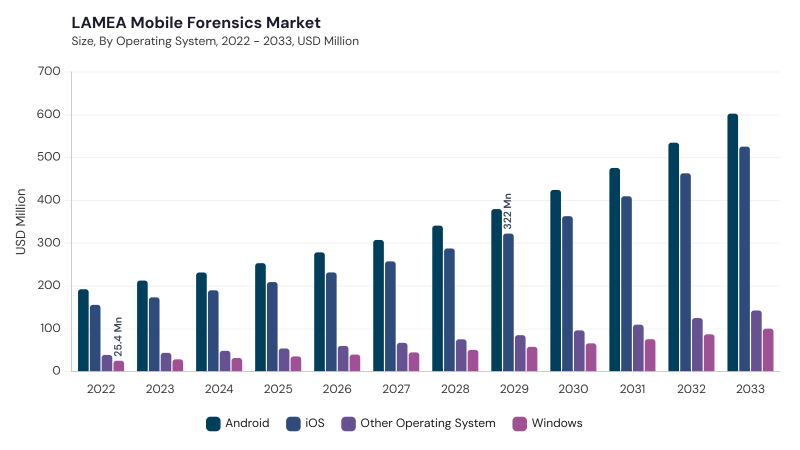
Based on Operating System, the market is segmented into Android, iOS, Windows, and Other Operating System. The Android market dominated the LAMEA Mobile Forensics Market by Operating System in 2025, and would continue to be a dominant market till 2033; thereby, achieving a market value of USD 379.7 million by 2029, growing at a CAGR of 11.7 % during the forecast period. The iOS market is expected to witness a CAGR of 12.4% during (2026 - 2033). The Other Operating System market is expected to witness a CAGR of 13.2% during (2026 - 2033).
Android forensics requires broad extraction compatibility due to multiple device brands, customized interfaces, operating-system versions, firmware variations, messaging platforms, cloud backups, and encrypted application environments. iOS holds a substantial position as Apple devices are increasingly examined in corporate, financial, government, and high-value investigative cases requiring advanced handling of Secure Enclave, full-disk encryption, iCloud backups, and sandboxed applications. Windows represents the smallest share, although legacy Windows mobile devices and enterprise-associated endpoints continue to require compatible recovery methods in selected investigations. Other Operating System includes open-source variants, proprietary platforms, specialized industrial devices, IoT-linked mobile systems, and less common operating environments requiring customized forensic workflows.
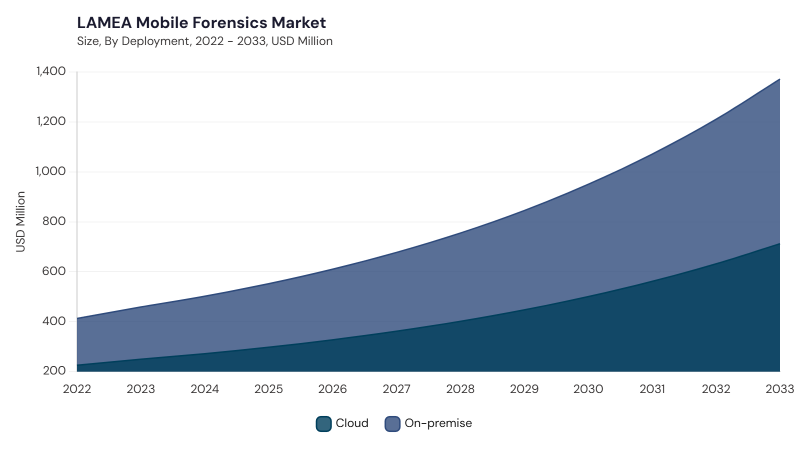
Based on Deployment, the market is segmented into Cloud and On-premise. The Cloud market dominated the LAMEA Mobile Forensics Market by Deployment in 2025, and would continue to be a dominant market till 2033; thereby, achieving a market value of USD 447.1 million by 2029, growing at a CAGR of 11.7 % during the forecast period. The On-premise market is expected to witness a CAGR of 12.9% during (2026 - 2033).
Cloud deployment supports scalable processing, remote investigation workflows, centralized evidence access, collaborative analysis, cloud data retrieval, and reduced dependence on extensive physical forensic infrastructure at every location. It is becoming more relevant as mobile synchronization, online storage, cloud-connected applications, and remote work expand the range of evidence sources beyond the seized handset. On-premise deployment remains important for defense organizations, government authorities, law enforcement bodies, and high-security enterprises requiring direct evidence control, local storage, secure infrastructure, offline operation, and sovereignty-sensitive processing. Hybrid approaches are gaining relevance as organizations combine controlled evidence management with scalable analytical resources.
Based on Type, the market is segmented into Mobile Operating System, Cloud & Backup, Mobile Network, SIM Card, and Other Type. Mobile Operating System forensics supports examination of handset-based communications, fraudulent applications, mobile banking activity, messaging records, and user-device interactions within broader investigations. Cloud & Backup forensics extends investigations to account information, synchronized records, remotely stored evidence, and backup data while requiring clear documentation of source limits, gaps, and accessibility constraints.
Mobile Network forensics addresses telecommunications evidence, provider-derived records, SIM-box fraud contexts, communications infrastructure, and subscriber activity patterns. SIM Card forensics supports subscriber identification, card-device relationships, mobile-money fraud cases, and communication-linked investigations. Other Type includes supplementary mobile-linked evidence sources such as connected devices, removable storage, and specialist digital artifacts that support case reconstruction when properly separated from general computer or server forensics.
Based on End Use, the market is segmented into Law Enforcement Agencies, Government & Defense Agencies, Corporate Enterprises, Forensic Laboratories, and Other End Use. Law Enforcement Agencies use mobile forensic tools to extract, preserve, and analyze call records, messages, location data, application content, and device activity while supporting court-admissible evidence workflows. Government & Defense Agencies use mobile forensics for national security, intelligence operations, cyber investigations, counterterrorism, classified communications analysis, and examination of compromised devices.
Corporate Enterprises apply these tools to data breaches, insider incidents, fraud detection, unauthorized disclosure, BYOD risk, compliance audits, and intellectual property protection. Forensic Laboratories provide specialist device examination, evidence validation, technical analysis, report preparation, expert testimony, and advanced recovery support. Other End Use includes legal practices, insurance companies, private investigators, cybersecurity consultancies, and other users applying mobile evidence in civil, commercial, or specialized investigations.
Free Valuable Insights: Mobile Forensics Market Size Worth USD 9.6 Billion billion by 2033
Based on Country, the market is segmented into Brazil, Argentina, UAE, Saudi Arabia, South Africa, Nigeria, and Rest of LAMEA. The Brazil market dominated the LAMEA Mobile Forensics Market by Country in 2025, and would continue to be a dominant market till 2033; thereby, achieving a market value of USD 199.5 million by 2029, growing at a CAGR of 10.8 % during the forecast period. The Argentina market is expected to witness a CAGR of 13.9% during (2026 - 2033). Additionally, The UAE market is expected to witness a CAGR of 11.3% during (2026 - 2033).
Across LAMEA, mobile forensics adoption reflects differences in digital crime exposure, regulatory maturity, forensic infrastructure, mobile payment adoption, cybersecurity investment, and local device ecosystems. Brazil emphasizes encrypted messaging analysis, cloud and social media extraction, AI-based automation, Portuguese-language localization, and compliance with national data protection requirements, while Argentina focuses on encrypted-device access, AI and ML-driven data sorting, law-enforcement collaboration, real-time acquisition, and localized regulatory alignment. The UAE prioritizes advanced extraction, cloud retrieval, AI-enabled analysis, auditability, secure reporting, and solutions aligned with local privacy and evidence-handling expectations, whereas Saudi Arabia emphasizes AI-driven workflows, cybersecurity compliance, IoT-linked evidence, blockchain-supported chain-of-custody, and localized forensic platforms. South Africa focuses on AI analytics, cloud-centric mobile forensics, cyber-enabled fraud, standardized practices, and regional collaboration, while Nigeria emphasizes mobile money investigations, virtual asset regulation, biometric verification, local-language support, cloud forensics, and blockchain analytics. Rest of LAMEA continues to advance decryption technologies, cloud-integrated forensics, AI-assisted evidence triage, localized training, multilingual support, and interoperable platforms suited to diverse economic and regulatory conditions.

By Component
By Operating System
By Deployment
By Type
By End Use
By Country
Set to reach $845.2 Million by 2029, growing at 12.3% CAGR during 2026-2033.
Brazil leads with $199.5 million by 2029, growing at a CAGR of 10.8% during the forecast period.
The cloud deployment segment will reach $447.1 million by 2029, growing at 11.7% CAGR during 2026-2033.
The hardware segment will achieve $342.3 million by 2029, growing at a CAGR of 11.7% during the forecast period.
Argentina is expected to witness a CAGR of 13.9% during 2026-2033.
The iOS segment is expected to witness a CAGR of 12.4% during 2026-2033.
Our team of dedicated experts can provide you with attractive expansion opportunities for your business.




 Unique Offerings
