The sample copy of this report is available for access.
The Asia Pacific Mobile Forensics Market is expected to reach USD 1746.1 million by 2030, growing at a CAGR of 11.8% during (2026 - 2033).
The Asia Pacific Mobile Forensics Market evolved from limited and manually intensive mobile data extraction toward advanced investigative platforms capable of handling smartphones, encrypted communications, cloud synchronization, app data, and complex mobile ecosystems. Early tools focused mainly on basic data retrieval from mobile phones, while the rise of smartphones and diverse operating systems created demand for more sophisticated acquisition, decoding, and analysis methods. Hardware and software innovation progressively enabled automated and real-time evidence acquisition while preserving evidentiary integrity. The market now supports comprehensive forensic workflows across evidence preservation, analysis, reporting, and compliance, shaped by rapid mobile adoption, cybercrime growth, and regional legal requirements.
AI and machine learning integration, regulatory standardization, cloud-based evidence acquisition, device encryption, and multi-source investigation workflows are shaping current market development. Investigators increasingly require automated pattern recognition, multilingual data analysis, cloud and backup access, secure evidence handling, audit trails, broad device compatibility, and forensic tools that can correlate handset, network, SIM, cloud, and supplementary evidence. Growth in mobile payments, super-apps, mobile-first services, cyber fraud, financial scams, identity theft, and app-based communication is expanding the complexity of mobile evidence across Asia Pacific. However, high tool costs, fragmented regulations, privacy concerns, uneven forensic infrastructure, limited skilled workforce availability, device heterogeneity, encryption barriers, and interoperability challenges continue to influence adoption.
Based on Component, the market is segmented into Hardware, Software, and Services. The Hardware market dominated the Asia Pacific Mobile Forensics Market by Component in 2025, and would continue to be a dominant market till 2033; thereby, achieving a market value of USD 701.1 million by 2030, growing at a CAGR of 11.3 % during the forecast period. The Software market is expected to witness a CAGR of 12.2% during (2026 - 2033). The Services market is expected to witness a CAGR of 12% during (2026 - 2033).
Hardware enables secure physical interaction with smartphones, tablets, and connected devices through data acquisition tools, write blockers, hardware dongles, extraction kits, and laboratory equipment used for evidence preservation. Software holds a substantial position as investigators require tools for decoding application data, recovering deleted information, analyzing complex mobile file systems, generating reports, and supporting AI-assisted evidence categorization. Services include consulting, managed analytics, forensic laboratory outsourcing, training, incident response, technical assistance, and expert support for organizations lacking specialized in-house capabilities. Rising cybercrime, device complexity, regional language diversity, and limited forensic expertise are strengthening demand across all component categories.
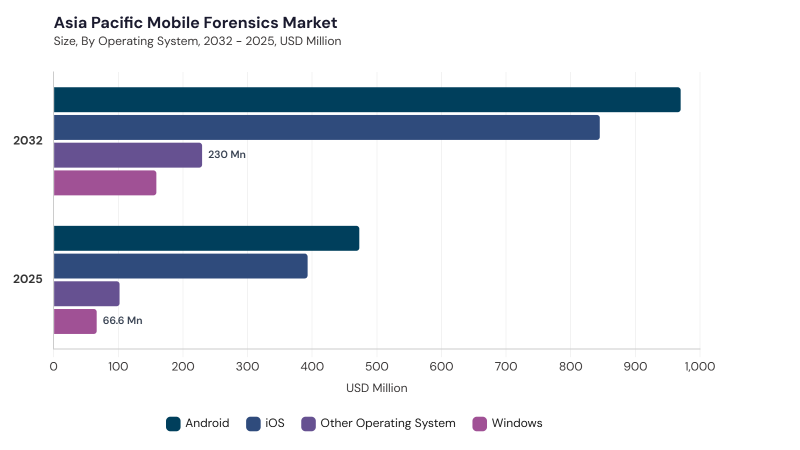
Based on Operating System, the market is segmented into Android, iOS, Windows, and Other Operating System. The Android market dominated the Asia Pacific Mobile Forensics Market by Operating System in 2025, and would continue to be a dominant market till 2033; thereby, achieving a market value of USD 777.1 million by 2030, growing at a CAGR of 11.2 % during the forecast period. The iOS market is expected to witness a CAGR of 11.9% during (2026 - 2033). The Other Operating System market is expected to witness a CAGR of 12.6% during (2026 - 2033).
Android forensics requires broad platform support because of diverse manufacturers, customized interfaces, chipsets, operating-system versions, app environments, encrypted messaging, biometrics, and regional application usage. iOS holds a substantial position due to premium Apple device adoption and the need for specialized techniques to manage strong encryption, secure enclave protections, two-factor authentication, deleted files, and encrypted app data. Windows represents the smallest share, while selected enterprise, government, industrial, and legacy devices still require compatible evidence-recovery capabilities. Other Operating System includes KaiOS, Tizen, proprietary platforms, feature-phone systems, smartwatches, and IoT-linked devices that require customized tools and lightweight evidence extraction methods.
Based on Deployment, the market is segmented into Cloud and On-premise. The Cloud market dominated the Asia Pacific Mobile Forensics Market by Deployment in 2025, and would continue to be a dominant market till 2033; thereby, achieving a market value of USD 915.8 million by 2030, growing at a CAGR of 11.3 % during the forecast period. The On-premise market is expected to witness a CAGR of 12.4% during (2026 - 2033).
Cloud deployment supports remote evidence analysis, centralized storage, cross-jurisdictional collaboration, scalable processing, AI-enabled data correlation, and faster access to forensic resources without continuous expansion of dedicated laboratory infrastructure. It is increasingly relevant as mobile backups, synchronized applications, and remotely hosted information expand the investigative scope beyond physical devices. On-premise deployment remains important for defense, intelligence, police, government, and large enterprise users requiring direct control over sensitive evidence, custody procedures, secure infrastructure, and local data governance. Hybrid architectures are gaining relevance as investigators combine scalable processing with controlled evidence storage and stricter data-protection requirements.
Based on Type, the market is segmented into Mobile Operating System, Cloud & Backup, Mobile Network, SIM Card, and Other Type. Mobile Operating System forensics connects handset evidence into meaningful timelines by interpreting messages, emails, device-derived records, application artifacts, and available location information. Cloud & Backup forensics complements device examination by bringing account-related evidence, synchronized records, backup data, and remote information into the same analytical environment while distinguishing recovered content from unavailable or duplicated records.
Mobile Network forensics examines telecommunications records, subscriber-linked communications, and provider-derived information relevant to scams, fraud, and criminal activity. SIM Card forensics supports analysis of subscriber identifiers, card-device relationships, and communication account links. Other Type includes supplementary mobile-linked devices, damaged-device recovery contexts, connected-device sources, and specialized evidence that strengthens broader case reconstruction.
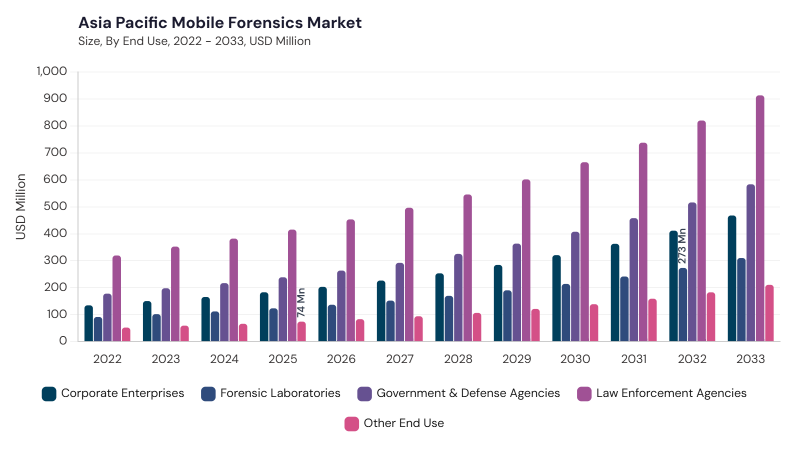
Based on End Use, the market is segmented into Law Enforcement Agencies, Government & Defense Agencies, Corporate Enterprises, Forensic Laboratories, and Other End Use. Law Enforcement Agencies require reliable, legally admissible tools for retrieving, preserving, and analyzing call logs, messages, multimedia, location information, app data, and other mobile evidence across diverse devices. Government & Defense Agencies use mobile forensics for intelligence analysis, national security, counterintelligence, cyber defense, compromised-device examination, and sensitive communications investigations.
Corporate Enterprises apply mobile forensics to incident response, employee investigations, information leakage, fraud assessment, BYOD risk, and compliance monitoring. Forensic Laboratories provide specialist evidence recovery, deep technical examination, encryption handling, data carving, validation, and expert reporting. Other End Use includes academic institutions, private investigation firms, legal users, cybersecurity organizations, and NGOs using forensic tools for research, training, civil cases, and specialized investigations.
Free Valuable Insights: Mobile Forensics Market is Predicted to reach USD 9.6 Billion billion by 2033, at a CAGR of 11.1%
Based on Country, the market is segmented into China, Japan, India, South Korea, Singapore, Malaysia, and Rest of Asia Pacific. The China market dominated the Asia Pacific Mobile Forensics Market by Country in 2025, and would continue to be a dominant market till 2033; thereby, achieving a market value of USD 488.5 million by 2030, growing at a CAGR of 9.8 % during the forecast period. The Japan market is expected to witness a CAGR of 10.9% during (2026 - 2033). Additionally, The India market is expected to witness a CAGR of 12.5% during (2026 - 2033).
Across Asia Pacific, mobile forensics adoption reflects differences in mobile-device usage, cybercrime exposure, legal frameworks, forensic infrastructure, data-governance requirements, and digital investigation maturity. China emphasizes AI-driven methods, encrypted messaging analysis, WeChat and social media evidence, cloud synchronization, regulatory compliance, and localized forensic platforms, while Japan focuses on AI-enhanced analysis, privacy-centric frameworks, BYOD-related evidence handling, cybersecurity integration, and localized device support. India prioritizes AI-enabled evidence extraction, government digitalization, cybercrime response, multilingual support, cloud-based platforms, blockchain-assisted chain-of-custody, and forensic training. South Korea emphasizes real-time analysis, 5G-linked data complexity, privacy-compliant methods, encrypted data handling, and integration with investigative workflows, whereas Singapore focuses on cloud forensics, AI and machine learning, audit-ready frameworks, multilingual data processing, secure chain-of-custody, and mature public-private forensic use. Malaysia emphasizes encrypted communication analysis, mobile payment fraud, IoT-linked evidence, AI-driven analytics, cloud services, and localized training, while Rest of Asia Pacific continues to advance cloud-integrated forensics, encryption-focused tools, localized threat intelligence, AI-powered platforms, and multi-device compatibility across diverse markets.

By Component
By Operating System
By Deployment
By Type
By End Use
By Country
Set to reach $1746.1 Million by 2030, growing at 11.8% CAGR during 2026-2033.
China leads with $488.5 million by 2030, growing at 9.8% CAGR during 2026-2033.
Android systems dominate, reaching $777.1 million by 2030 at 11.2% CAGR during 2026-2033.
Cloud segment reaches $915.8 million by 2030, growing at 11.3% CAGR during 2026-2033.
India is expected to grow at a 12.5% CAGR during 2026-2033.
Software segment is expected to grow at a 12.2% CAGR during 2026-2033.
Our team of dedicated experts can provide you with attractive expansion opportunities for your business.




 Unique Offerings
