The LAMEA Kimchi Market is expected to reach USD 370.8 million by 2029, growing at a CAGR of 5.4% during (2026 - 2033).
The LAMEA Kimchi Market evolved from a niche ethnic food category associated mainly with Korean immigrant communities into an increasingly recognized fermented-food segment across Latin America, the Middle East, and Africa. Traditional fermentation initially dominated production, while controlled fermentation systems, improved refrigeration, cold-chain logistics, and modern packaging progressively enhanced consistency, shelf life, and commercial scalability. Rising awareness of probiotic foods and Korean cuisine broadened consumer interest beyond expatriate populations. Producers increasingly adapt spice levels, vegetables, and formulations to local preferences while maintaining Korean culinary characteristics. The market now combines traditional fermentation, localized product development, health-oriented positioning, digital distribution, and expanding modern retail networks.
Health and wellness, localization, halal-compliant offerings, digital commerce, artisanal premiumization, and regional distribution expansion are shaping current market development. Consumers increasingly seek probiotic-rich, organic, low-sodium, clean-label, and culturally adapted kimchi, prompting manufacturers to diversify recipes and packaging formats. Korean food export initiatives and distributor partnerships are improving access across Latin America, the Middle East, and emerging African markets, while halal-focused formulations strengthen opportunities in Muslim-majority countries. E-commerce, social media, traceability technologies, and improved cold-chain systems are widening consumer reach. However, regulatory fragmentation, high production and logistics costs, raw-material constraints, limited consumer familiarity, and inconsistent refrigerated infrastructure continue to influence market penetration.
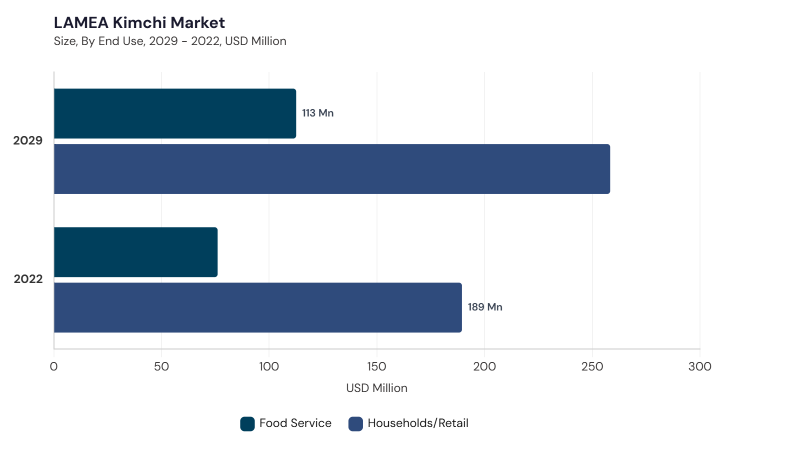
Based on End Use, the market is segmented into Households/Retail and Food Service. The Households/Retail market dominated the LAMEA Kimchi Market by End Use in 2025, and would continue to be a dominant market till 2033; thereby, achieving a market value of USD 258.3 million by 2029, growing at a CAGR of 5 % during the forecast period. The Food Service market is expected to witness a CAGR of 6.2% during (2026 - 2033).
Households/Retail demand is strengthening through supermarkets, specialty ethnic retailers, online platforms, and other consumer channels offering convenient packaged kimchi for home consumption. Health awareness, probiotic positioning, localized flavors, smaller pack sizes, and improved refrigeration are supporting adoption across varied income groups. Food Service includes Korean and Asian restaurants, hotels, catering businesses, institutional kitchens, and fusion dining concepts using kimchi as a side dish or culinary ingredient. Expansion of Korean cuisine, tourism, contemporary dining, and experimentation with fermented and spicy ingredients is creating additional professional applications across LAMEA.
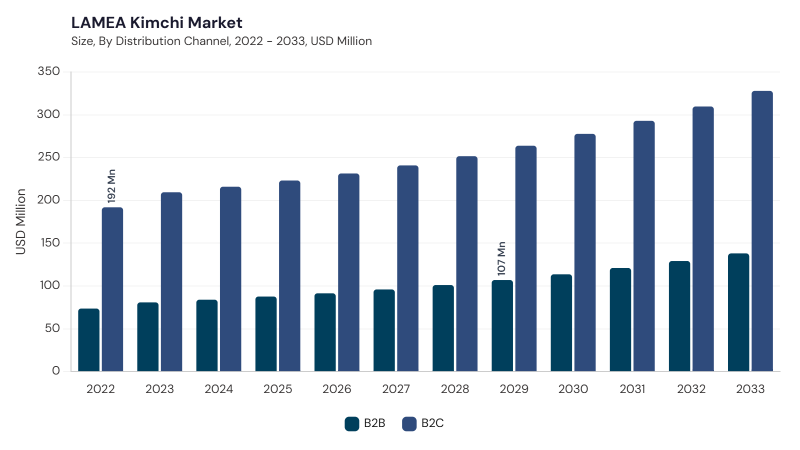
Based on Distribution Channel, the market is segmented into B2C and B2B. The B2C market dominated the LAMEA Kimchi Market by Distribution Channel in 2025, and would continue to be a dominant market till 2033; thereby, achieving a market value of USD 263.8 million by 2029, growing at a CAGR of 5.1 % during the forecast period. The B2B market is expected to witness a CAGR of 6.1% during (2026 - 2033).
B2C distribution encompasses supermarkets, premium grocery stores, Asian specialty outlets, gourmet retailers, online marketplaces, and dedicated Korean-food channels serving household consumers. Smaller jars, pouches, refrigerated formats, localized recipes, ingredient transparency, and appropriate certifications support consumer trial in developing markets. B2B includes restaurants, hotels, caterers, importers, wholesalers, food manufacturers, and institutional operators requiring dependable supply, larger quantities, consistent quality, and refrigerated logistics. Restaurant exposure and fusion applications can also increase broader product familiarity, while stronger importer relationships and foodservice distribution networks support commercial expansion.
Based on B2C, the market is segmented into Hypermarkets/Supermarkets, Online, Specialty Food Stores, and Other B2C. Hypermarkets/Supermarkets provide spicy, mild, fusion, organic, and low-sodium products across varied price points while supporting promotions and broader mainstream visibility. Online channels are expanding through digital grocery ecosystems, marketplaces, delivery services, and direct-to-consumer models that improve access to imported, artisanal, and specialty products.
Specialty Food Stores serve consumers seeking authentic recipes, premium ingredients, traditional fermentation, and specialized Asian products. Other B2C includes independent grocers, gourmet shops, farmers’ markets, food festivals, street vendors, and delivery services that support product discovery, experiential consumption, local flavors, and smaller artisanal producers.
Based on Product, the market is segmented into Baechu, Kkakdugi, Chonggak, and Other Product. Baechu serves as the principal entry point for many consumers due to its familiar kimchi profile, versatility, and association with probiotic fermented foods. Kkakdugi, prepared from cubed radish, appeals to consumers seeking distinctive texture and stronger product variety while gaining use in Korean and fusion dining.
Chonggak remains a more specialized whole-radish variant oriented toward consumers seeking traditional and artisanal preparations. Other Product includes Bossam, Nabak, alternative vegetable recipes, and localized fusion products designed around regional ingredients, varied spice preferences, plant-based consumption, convenience, and culinary experimentation.
Free Valuable Insights: Kimchi Market Size Worth USD 7.9 Billion billion by 2033
Based on Country, the market is segmented into Brazil, Argentina, UAE, Saudi Arabia, South Africa, Nigeria, and Rest of LAMEA. The Brazil market dominated the LAMEA Kimchi Market by Country in 2025, and would continue to be a dominant market till 2033; thereby, achieving a market value of USD 79.8 million by 2029, growing at a CAGR of 3.8 % during the forecast period. The Argentina market is expected to witness a CAGR of 7% during (2026 - 2033). Additionally, The UAE market is expected to witness a CAGR of 4.5% during (2026 - 2033).
Across LAMEA, kimchi adoption reflects differences in culinary familiarity, health awareness, retail infrastructure, religious requirements, and localization needs. Brazil emphasizes probiotic positioning, local ingredient sourcing, sustainable packaging, digital retail, and fusion cuisine, while Argentina focuses on controlled fermentation, cold-chain improvement, localized vegetables, cleaner labeling, and cultural integration. The UAE combines functional-food positioning, localized flavors, low-sodium and vegan options, advanced refrigerated logistics, and e-commerce, whereas Saudi Arabia emphasizes halal-oriented market access, functional nutrition, locally adapted formulations, sustainable packaging, and modern grocery distribution. South Africa focuses on health-oriented products, local sourcing, milder flavors, sustainability, and cold-chain development, while Nigeria emphasizes localized ingredients, probiotic positioning, e-commerce, modern retail, and strengthened refrigeration. Rest of LAMEA continues to develop health-focused, locally adapted, digitally distributed, clean-label, and technologically improved kimchi products suited to diverse consumer and infrastructure conditions.

By Country
Set to reach $370.8 Million by 2029, growing at 5.4% CAGR during 2026-2033.
Brazil leads with $79.8 million by 2029, growing at a CAGR of 3.8% during the forecast period.
Rising demand in the Food Service segment, expected to grow at a CAGR of 6.2% during 2026-2033.
Expected to reach $258.3 million by 2029, growing at a CAGR of 5% during the forecast period.
The UAE market is expected to witness a CAGR of 4.5% during 2026-2033.
The B2C market will reach $263.8 million by 2029, growing at a CAGR of 5.1% during the forecast period.
Our team of dedicated experts can provide you with attractive expansion opportunities for your business.




 Unique Offerings
