The Asia Pacific Kimchi Market is expected to reach USD 3.9 billion by 2030, growing at a CAGR of 4.8% during (2026 - 2033).

The Asia Pacific Kimchi Market evolved from centuries-old Korean fermentation traditions into a diversified commercial food category distributed across regional markets. Traditional household and artisanal production gradually incorporated controlled fermentation environments, starter cultures, mechanized processing, improved refrigeration, and modern packaging to enhance consistency, safety, and shelf stability. Industrialization accelerated alongside urbanization and demand for convenient foods, while biotechnology and quality-control technologies further strengthened product development. Growing recognition of fermented foods and Korean cuisine has expanded kimchi consumption beyond its traditional base, positioning the category at the intersection of cultural authenticity, functional nutrition, modern processing, and increasingly diversified consumer preferences.
Health-oriented consumption, product localization, convenient packaging, sustainability, and digital distribution are shaping current market development. Consumers increasingly seek probiotic-rich, clean-label, organic, low-sodium, plant-based, and naturally fermented kimchi, encouraging manufacturers to refine microbial profiles and nutritional positioning. Ready-to-eat formats, portioned packs, fusion recipes, and locally adapted flavors are responding to urban lifestyles and varying regional tastes. Advances in fermentation monitoring, cold-chain logistics, automated manufacturing, traceability, and e-commerce are improving scalability and market reach. However, fragmented regulations, high ingredient and production costs, supply-chain complexity, cultural sensitivities, quality-control challenges, and uneven refrigerated infrastructure continue to influence expansion across Asia Pacific.
Based on End Use, the market is segmented into Households/Retail and Food Service. The Households/Retail market dominated the Asia Pacific Kimchi Market by End Use in 2025, and would continue to be a dominant market till 2033; thereby, achieving a market value of USD 2.7 billion by 2030, growing at a CAGR of 4.4 % during the forecast period. The Food Service market is expected to witness a CAGR of 5.6% during (2026 - 2033).
Households/Retail demand is strengthened by urbanization, health awareness, ready-to-serve formats, expanding modern grocery networks, and growing online accessibility. Consumers increasingly seek traditional, premium, low-sodium, organic, and locally adapted varieties suited to home meals and convenient consumption. Food Service includes Korean restaurants, hotels, catering operators, institutional dining, and pan-Asian or fusion concepts using kimchi across traditional and contemporary dishes. Expanding Korean cultural influence, culinary experimentation, tourism, and demand for probiotic and fermented ingredients are broadening professional applications and introducing kimchi to new consumer groups.
Based on Distribution Channel, the market is segmented into B2C and B2B. The B2C market dominated the Asia Pacific Kimchi Market by Distribution Channel in 2025, and would continue to be a dominant market till 2033; thereby, achieving a market value of USD 2.7 billion by 2030, growing at a CAGR of 4.5 % during the forecast period. The B2B market is expected to witness a CAGR of 5.4% during (2026 - 2033).
B2C distribution encompasses supermarkets, hypermarkets, convenience stores, specialty retailers, traditional markets, online marketplaces, grocery-delivery platforms, and direct brand channels offering products across varied formats and price points. Refrigerated merchandising, portioned packaging, family packs, digital commerce, and product variety strengthen household accessibility. B2B serves restaurants, hotels, caterers, institutional foodservice providers, wholesalers, meal-kit companies, food processors, and prepared-food manufacturers requiring bulk formats, consistent quality, and dependable supply. Expanding Korean restaurants and increasing use of kimchi in noodles, frozen meals, sauces, snacks, meal kits, and fusion dishes are widening commercial demand.
Based on B2C, the market is segmented into Hypermarkets/Supermarkets, Online, Specialty Food Stores, and Other B2C. Hypermarkets/Supermarkets support high-volume household purchasing through wide assortments, promotional activity, family-sized packs, and growing availability of health-oriented and localized formulations. Online channels are expanding through mobile commerce, grocery-delivery applications, brand storefronts, and digital marketplaces that improve access to artisanal, organic, premium, and niche products.
Specialty Food Stores serve consumers seeking authentic recipes, regional preparations, traditional fermentation, and premium ingredients. Other B2C includes convenience outlets, traditional markets, pop-up formats, independent retailers, and other localized channels, benefiting from portable packaging, urban lifestyles, and demand for quick-access fermented-food options.
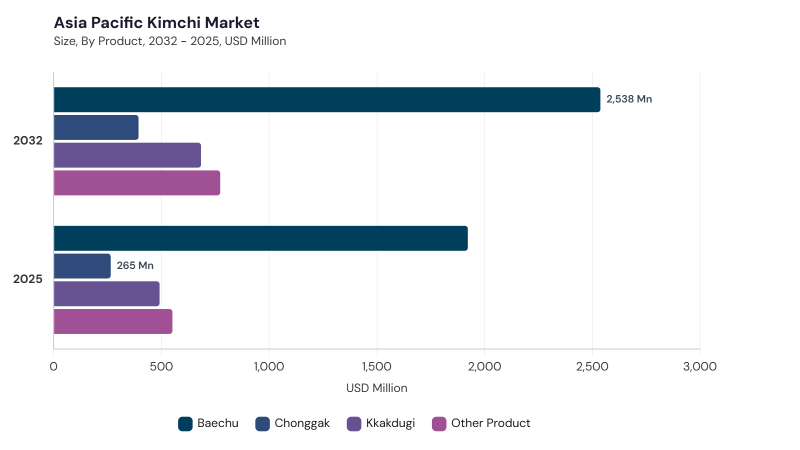
Based on Product, the market is segmented into Baechu, Kkakdugi, Chonggak, and Other Product. Baechu remains the foundational napa cabbage variety, benefiting from established consumption, probiotic positioning, broad culinary versatility, and improved fermentation and packaging technologies. Kkakdugi offers a distinctive cubed-radish texture and refreshing flavor, supporting demand across household and restaurant applications, while Chonggak serves consumers seeking traditional whole-radish preparations, stronger fermentation characteristics, and heritage-focused products.
Other Product includes cucumber, water kimchi, mustard leaf, mixed-vegetable, seafood-based, and fusion variants that respond to changing tastes, plant-based preferences, regional ingredient availability, and demand for innovative fermented-food experiences.
Free Valuable Insights: Kimchi Market is Predicted to reach USD 7.9 Billion billion by 2033, at a CAGR of 5.1%
Based on Country, the market is segmented into China, Japan, India, South Korea, Australia, Malaysia, and Rest of Asia Pacific. The South Korea market dominated the Asia Pacific Kimchi Market by Country in 2025, and would continue to be a dominant market till 2033; thereby, achieving a market value of USD 2.1 billion by 2030, growing at a CAGR of 3.8 % during the forecast period. The Japan market is expected to witness a CAGR of 3.7% during (2026 - 2033). Additionally, The India market is expected to witness a CAGR of 7.7% during (2026 - 2033).
Across Asia Pacific, kimchi adoption reflects differences in culinary traditions, health awareness, localization needs, retail maturity, regulation, and technological readiness. China emphasizes natural fermentation, premium formulations, product standardization, e-commerce, and localized flavor development, while Japan focuses on milder taste profiles, umami enhancement, reduced sodium, functional benefits, and advanced quality control. India combines probiotic positioning with localized spices, vegan and low-sodium variants, improved cold-chain logistics, and broader digital retail access, whereas South Korea emphasizes cultural authenticity, premiumization, fermentation R&D, automation, and export-oriented product development. Australia focuses on clean-label, organic, additive-free products, local ingredients, sustainable packaging, and mainstream retail expansion, while Malaysia emphasizes halal compliance, localized flavors, health positioning, cold-chain technology, and convenient packaged formats. Rest of Asia Pacific continues to develop functional, localized, sustainably packaged, digitally distributed, and technologically refined kimchi products adapted to diverse regional preferences.

By Country
Set to reach $3.9 Billion by 2030, growing at 4.8% CAGR during 2026-2033.
South Korea leads with $2.1 billion by 2030, growing at a CAGR of 3.8% during the forecast period.
Households/Retail segment hits $2.7 billion by 2030, growing at a CAGR of 4.4% during the forecast period.
The Food Service segment is expected to witness a CAGR of 5.6% during 2026-2033.
The India market is expected to witness a CAGR of 7.7% during 2026-2033.
The B2C market is expected to reach $2.7 billion by 2030, growing at a CAGR of 4.5% during the forecast period.
Our team of dedicated experts can provide you with attractive expansion opportunities for your business.




 Unique Offerings
