“Global Kimchi Market to reach a market value of USD 7914.78 Million by 2033 growing at a CAGR of %”
The Global Kimchi Market is expected to reach USD 7.9 billion by 2033, growing at a CAGR of 5.1% during (2026 - 2033).
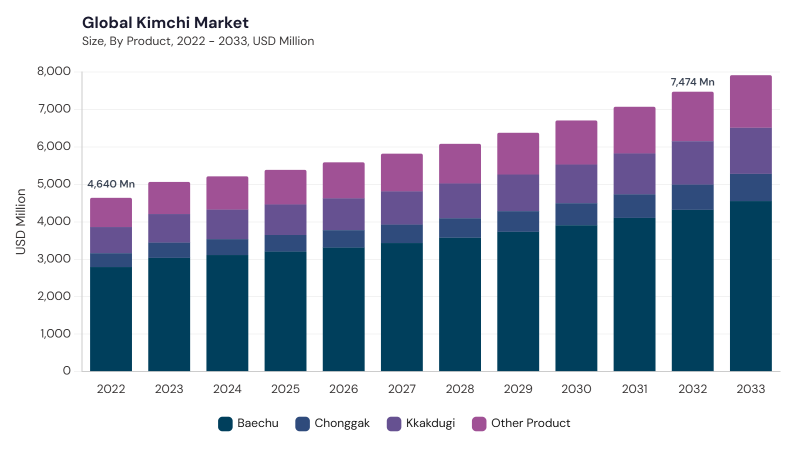
Growing consumer interest in fermented foods, Korean cuisine, digestive wellness, probiotic-rich products, bold international flavors, convenient side dishes, and functional nutrition is driving the Kimchi Market across households, foodservice outlets, restaurants, and retail channels. Adoption is further strengthened by demand for plant-based foods, natural ingredients, clean-label formulations, vegan variants, premium packaging, improved shelf life, e-commerce availability, and diversified kimchi formats such as napa cabbage, radish, cucumber, green onion, mustard leaf, and other vegetable-based varieties.
Growth in the Kimchi Market is driven by increasing consumer preference for fermented foods, probiotic nutrition, gut-health-oriented diets, and global Korean food culture. Kimchi is moving beyond traditional consumption in Korea and diaspora communities toward broader household, retail, foodservice, and prepared-food applications. Manufacturers are expanding product ranges through vegan kimchi, low-sodium formulations, organic variants, premium products, shelf-stable formats, canned kimchi, bulk foodservice packs, online-exclusive offerings, and localized flavor profiles. Advancements in fermentation control, pH monitoring, cold-chain logistics, modified packaging, and non-thermal processing are improving consistency, safety, freshness, and global distribution potential.
The competitive environment is moderately consolidated and authenticity-driven, with large Korean food manufacturers, specialist kimchi producers, fresh-food companies, packaged-food groups, and regional manufacturers competing across retail and foodservice channels. Daesang Corporation, CJ CheilJedang, and Pulmuone hold strong positions through dedicated kimchi brands, fermentation expertise, international distribution, local or export-oriented production, and K-Food brand platforms. Ourhome, Dongwon F&B, Hansung Food, Sempio, Daekwang F&G, Ottogi, and Cosmos Food add depth through foodservice supply, Korean meal ecosystems, traditional kimchi specialization, canned and seasoning formats, export operations, packaged-food portfolios, and U.S.-based kimchi manufacturing.
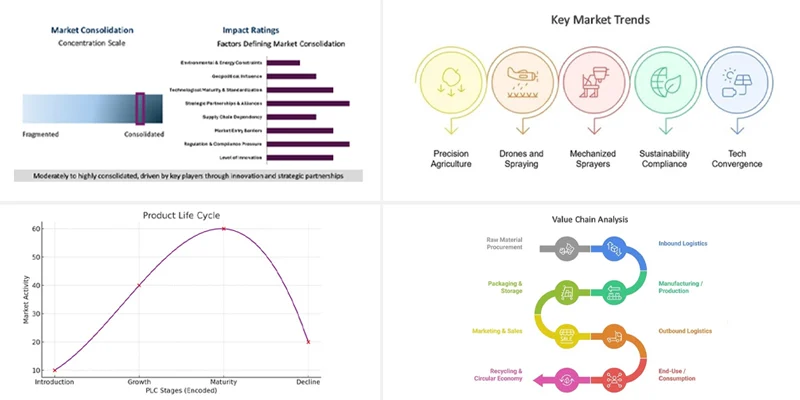


The global Kimchi Market reflects a moderately consolidated but still diverse competitive landscape, where major Korean food companies, specialist kimchi manufacturers, local producers, foodservice suppliers, and emerging international brands compete across fresh, refrigerated, packaged, canned, foodservice, and export-oriented formats. Daesang Corporation maintains strong visibility through Jongga, fermentation expertise, international distribution, localized production, and kimchi-focused consumer engagement. CJ CheilJedang strengthens the market through bibigo, proprietary lactic-acid-bacteria technology, U.S. manufacturing expansion, and its global K-Food ecosystem. Pulmuone differentiates through Korean-origin production, smart-factory fermentation control, Nasoya distribution, vegan and traditional kimchi variants, and U.S. retail access.
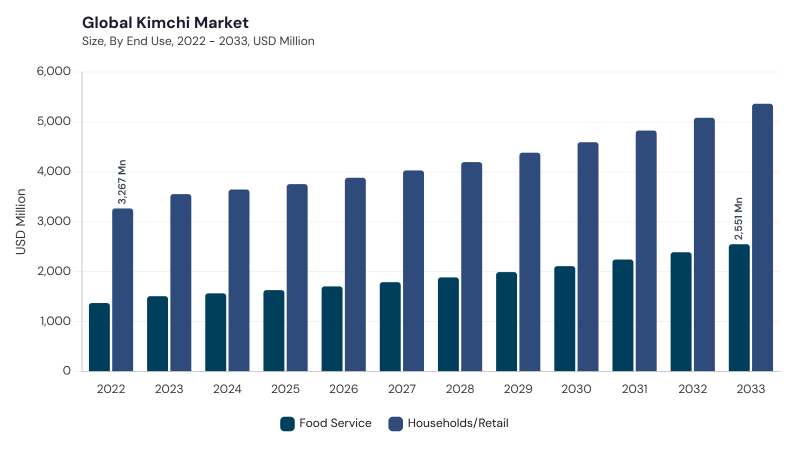
Based on End Use, the market is segmented into Households/Retail and Food Service. The Households/Retail market dominated the Global Kimchi Market by End Use in 2025, and would continue to be a dominant market till 2033; thereby, achieving a market value of USD 5.3 billion by 2033, growing at a CAGR of 4.7 % during the forecast period. The Food Service market is expected to witness a CAGR of 5.9% during (2026 - 2033).
Households/Retail remains the leading end-use segment as kimchi is increasingly consumed as a daily side dish, fermented health food, ready-to-eat accompaniment, and versatile cooking ingredient. Demand is supported by home cooking trends, Korean cuisine popularity, rising interest in gut health, and expanding availability of packaged kimchi in supermarkets, specialty stores, Asian grocery outlets, and online channels. Manufacturers are widening household appeal through refrigerated, shelf-stable, organic, vegan, mild, spicy, portion-controlled, and premium offerings. Food Service holds a meaningful position as Korean restaurants, Asian dining concepts, hotels, caterers, institutional kitchens, and fusion restaurants use kimchi as a side dish, condiment, ingredient, and flavor enhancer. Standardized bulk packaging, consistent fermentation quality, foodservice-grade supply, and growing use in soups, stews, fried rice, sandwiches, burgers, noodles, and fusion menus are strengthening commercial demand.
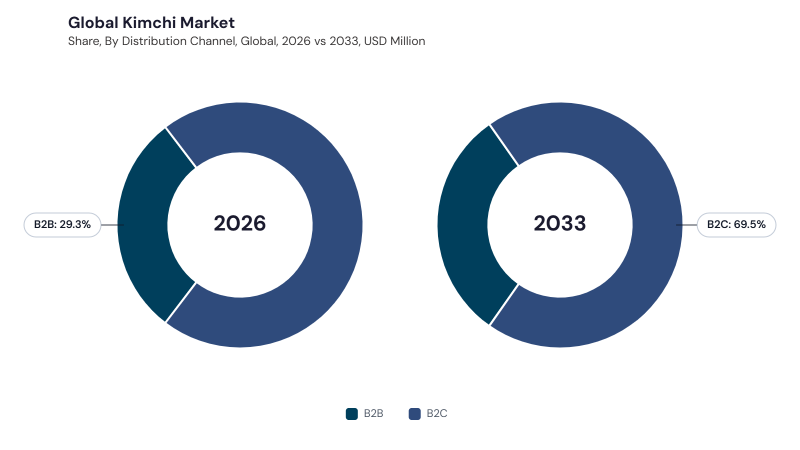
Based on Distribution Channel, the market is segmented into B2C and B2B. The B2C market dominated the Global Kimchi Market by Distribution Channel in 2025, and would continue to be a dominant market till 2033; thereby, achieving a market value of USD 5.4 billion by 2033, growing at a CAGR of 4.8 % during the forecast period.The B2B market is expected to witness a CAGR of 5.7% during (2026 - 2033).
B2C remains the dominant distribution channel because household consumers purchase kimchi through supermarkets, hypermarkets, specialty food stores, Asian grocery outlets, online grocery platforms, convenience formats, and direct-to-consumer channels. This channel benefits from rising retail visibility, broader brand assortment, packaging improvements, refrigerated merchandising, digital grocery access, and growing consumer experimentation with fermented foods. B2B supports restaurants, hotels, catering companies, food processors, institutional kitchens, wholesalers, and prepared-food manufacturers that procure kimchi in larger volumes. Commercial buyers prioritize consistent flavor, fermentation stability, bulk packaging, predictable specifications, competitive procurement costs, and reliable refrigerated supply. Expansion of Korean cuisine, fusion foodservice menus, meal kits, sauces, snacks, frozen meals, and prepared-food applications is increasing the role of B2B distribution.
Based on B2C, the market is segmented into Hypermarkets/Supermarkets, Online, Specialty Food Stores, and Other B2C. Hypermarkets/Supermarkets remain the leading B2C format due to broad consumer access, chilled-food infrastructure, strong merchandising capacity, competitive pricing, and expanding placement of kimchi in international, fermented-food, and fresh-food sections. Online is gaining strong momentum through digital grocery platforms, direct-to-consumer brands, subscription models, product discovery, temperature-controlled delivery, and access to specialty kimchi varieties beyond local store availability.
Specialty Food Stores serve consumers seeking authentic Korean recipes, artisanal products, premium ingredients, region-specific varieties, and differentiated fermentation profiles. Other B2C includes convenience stores, independent grocers, farmers’ markets, ethnic shops, food co-operatives, and local retail formats that support niche discovery, localized sales, and experimental kimchi varieties.
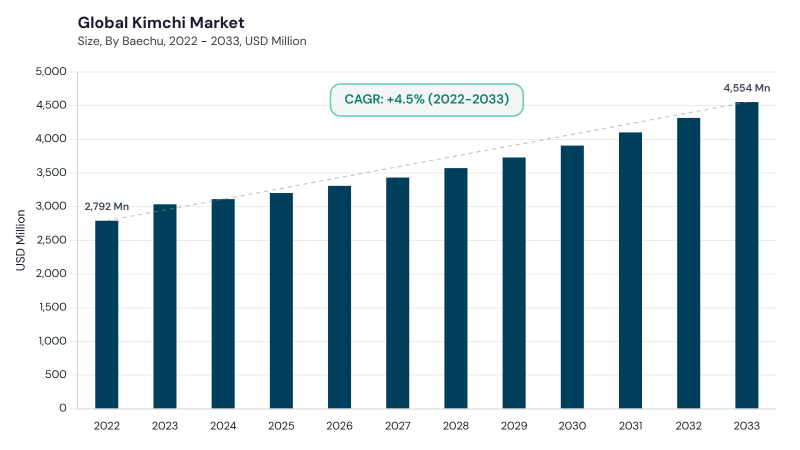
Based on Product, the market is segmented into Baechu, Kkakdugi, Chonggak, and Other Product. The Baechu market dominated the Global Kimchi Market by Product in 2025, and would continue to be a dominant market till 2033; thereby, achieving a market value of USD 4.5 billion by 2033, growing at a CAGR of 4.7 % during the forecast period. The Kkakdugi market is expected to witness a CAGR of 5.5% during (2026 - 2033). Additionally, The Chonggak market is expected to witness highest CAGR of 6.5% during (2026 - 2033).
Baechu remains the leading product segment as napa cabbage kimchi is the most recognized and widely consumed form, serving as a traditional side dish, cooking ingredient, and entry point for new consumers exploring Korean cuisine. Its broad commercial availability, familiar sensory profile, and compatibility with retail and foodservice applications support its leadership. Kkakdugi represents an important radish-based segment, valued for its cubed texture, crisp bite, refreshing flavor, and strong pairing with soups, stews, grilled dishes, and Korean meals. Chonggak serves a more traditional and specialty demand base through whole young radish preparations, distinctive texture, and culturally rooted appeal. Other Product includes cucumber kimchi, green onion kimchi, mustard leaf kimchi, chive kimchi, dried radish kimchi, fusion-style kimchi, and other vegetable-based variants that help manufacturers diversify portfolios and address local taste preferences.
Free Valuable Insights: Kimchi Market Size to reach $7.9 Billion by 2033
Region-wise, the Kimchi Market is analyzed across North America, Europe, Asia Pacific, and LAMEA. The Asia Pacific market dominated the Global Kimchi Market by Region in 2025, and would continue to be a dominant market till 2033; thereby, achieving a market value of USD 4.6 billion by 2033, growing at a CAGR of 4.8 % during the forecast period. The North America market is expected to witness a CAGR of 5.4% during (2026 - 2033). Additionally, The Europe market is expected to witness a CAGR of 5.9% during (2026 - 2033).
Asia Pacific leads the global market due to deeply established consumption traditions, strong production capacity, extensive retail penetration, cultural familiarity with fermented vegetable products, and South Korea’s central role in kimchi manufacturing and export activity. North America is expanding through growing Korean cuisine exposure, Asian food retail, health-focused fermented-food demand, broader supermarket availability, e-commerce growth, and local production initiatives in the US. Europe is supported by rising interest in probiotic foods, ethical and organic products, specialty Asian retail, sustainable packaging, and increasing inclusion of kimchi in mainstream and fusion food applications. LAMEA is developing through rising exposure to Korean food culture, urban retail modernization, foodservice experimentation, e-commerce access, halal-oriented opportunities in selected markets, and gradual consumer education around fermented foods.
| Report Attribute | Details |
|---|---|
| Market size value in 2026 | USD 5.5 billion |
| Market size forecast in 2033 | USD 7.9 billion |
| Base Year | 2025 |
| Historical Period | 2022 to 2024 |
| Forecast Period | 2026 to 2033 |
| Revenue Growth Rate | CAGR of 5.1% from 2026 to 2033 |
| Number of Pages | XX |
| Tables | XX |
| Report Coverage | Market Trends, Revenue Estimation and Forecast, Segmentation Analysis, Regional and Country Breakdown, Competitive Landscape, Market Share Analysis, Company Profiling, Companies Strategic Developments, SWOT Analysis, Product Life Cycle Analysis, Value Chain Analysis, Market Consolidation Analysis, Key Customer Criteria, Pandemic Impact Analysis, and Winning Imperatives |
| Segments Covered | End Use, Distribution Channel, Product, and Geography |
| Country Scope |
|
| Companies Included | Daesang Corporation; CJ CheilJedang Corporation; Pulmuone; Ourhome Co., Ltd.; Dongwon F&B Co., Ltd.; Hansung Food; Sempio Foods Company; Daekwang F&G; Ottogi Corporation; Cosmos Food Co., Inc. |
By Geography
The kimchi market is valued at USD 5.5 billion in 2026.
The Households/Retail segment leads, reaching USD 5.3 billion by 2033.
Daesang Corporation, CJ CheilJedang Corporation, Pulmuone, Ourhome Co., Ltd., and Dongwon F&B Co., Ltd. are key players.
Asia Pacific leads with a market value of USD 4.6 billion by 2033.
Rising global demand for traditional fermented foods and technological advancements in fermentation boost market growth.
The Baechu segment leads, achieving a market value of USD 4.5 billion by 2033.
Our team of dedicated experts can provide you with attractive expansion opportunities for your business.






 Unique Offerings
