The sample copy of this report is available for access.
The LAMEA Digital Holography Market is expected to reach USD 1.1 billion by 2029, growing at a CAGR of 23.4% during (2026 – 2033).
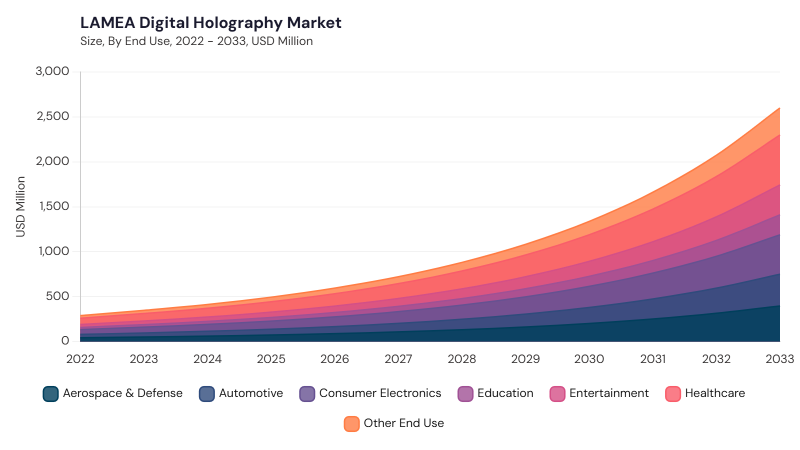
The LAMEA Digital Holography Market developed from early optical imaging and holography techniques that focused on capturing interference patterns and reconstructing three-dimensional visuals. Early usage remained concentrated in academic research, scientific laboratories, security applications, and specialized imaging environments due to limited infrastructure and high system complexity. As digital sensors, laser technologies, computational algorithms, and image processing capabilities advanced, holography gradually moved from analog experimentation toward digital reconstruction and practical deployment. This transition enabled better image resolution, faster processing, and broader use across healthcare, manufacturing, defense, education, and commercial visualization.
The LAMEA Digital Holography Market is being shaped by healthcare modernization, industrial automation, security authentication needs, immersive visualization, and growing interest in smart digital infrastructure. Organizations are using digital holography for biomedical imaging, clinical diagnostics, defect inspection, product authentication, remote collaboration, education, cultural preservation, and engineering visualization. Demand is supported by healthcare infrastructure investments, manufacturing quality requirements, defense modernization, digital learning programs, and growing adoption of AI-enabled imaging tools. Vendors are focusing on compact holographic systems, advanced optical processing, AI-integrated reconstruction, modular software platforms, localized deployment, and cost-efficient product models.
Based on Offering, the market is segmented into Hardware and Software. The Hardware market dominated the LAMEA Digital Holography Market by Offering in 2025, and would continue to be a dominant market till 2033; thereby, achieving a market value of USD 644.5 million by 2029, growing at a CAGR of 22.9 % during the forecast period. The Software market is expected to witness a CAGR of 24.2% during (2026 - 2033).
Hardware leads due to growing demand for holographic displays, optical sensors, laser systems, spatial light modulators, imaging devices, and visualization equipment across healthcare, defense, research, and industrial sectors. These systems provide the physical foundation for capturing, reconstructing, projecting, and analyzing holographic images in real-world environments. Software remains important as users require image reconstruction platforms, visualization tools, AI-enabled analytics, real-time rendering, data interpretation, and user-interface solutions. Software adoption is also supported by cloud-based holographic workflows, remote collaboration tools, predictive image analysis, and the need for flexible platforms that can integrate with existing diagnostic, laboratory, manufacturing, and training systems.
Based on Dimension, the market is segmented into Two Dimensional (2D) and Three Dimensional (3D). The Two Dimensional (2D) market dominated the LAMEA Digital Holography Market by Dimension in 2025, and would continue to be a dominant market till 2033; thereby, achieving a market value of USD 580.3 million by 2029, growing at a CAGR of 23 % during the forecast period. The Three Dimensional (3D) market is expected to witness a CAGR of 23.9% during (2026 - 2033).
Two Dimensional (2D) leads due to its use in laboratory diagnostics, surface inspection, academic research, security visualization, document verification, and basic industrial imaging where practical and cost-efficient solutions remain preferred. It offers easier deployment, lower system complexity, and strong compatibility with established optical imaging infrastructure. Three Dimensional (3D) is gaining demand as organizations require volumetric visualization, immersive displays, depth-based imaging, and advanced simulation capabilities. Its adoption is supported by medical diagnostics, engineering design, defense visualization, cultural preservation, AR/VR-enabled collaboration, automotive prototyping, and advanced industrial quality control.
Based on Application, the market is segmented into Holographic Microscopy, Holographic Imaging, Holographic Telepresence, and Other Application. The Holographic Microscopy market dominated the LAMEA Digital Holography Market by Application in 2025, and would continue to be a dominant market till 2033; thereby, achieving a market value of USD 353.7 million by 2029, growing at a CAGR of 22.5 % during the forecast period. The Holographic Imaging market is expected to witness a CAGR of 23.6% during (2026 - 2033). Additionally, The Holographic Telepresence market is expected to witness highest CAGR of 24.1% during (2026 - 2033).
Holographic Microscopy leads due to growing use in biomedical research, clinical diagnostics, pathology studies, pharmaceutical development, microbiology, and non-invasive cellular imaging. This application helps laboratories and medical institutions capture high-resolution biological sample data without extensive staining or destructive preparation. Holographic Imaging supports precision inspection, defect detection, non-destructive testing, scientific visualization, product authentication, and industrial quality assurance. Holographic Telepresence and Other Application areas add demand through immersive communication, remote education, healthcare consultations, corporate collaboration, security systems, cultural preservation, museum displays, engineering visualization, and specialized commercial use cases.
Based on End Use, the market is segmented into Healthcare, Consumer Electronics, Aerospace & Defense, Automotive, Entertainment, Education, and Other End Use. Healthcare leads due to increasing use of digital holography in diagnostic imaging, medical research, surgical visualization, telemedicine, medical training, and non-invasive biological analysis.
Consumer Electronics supports market growth through interactive displays, AR/VR-linked devices, holographic interfaces, wearable technologies, and immersive digital experiences. Aerospace & Defense, Automotive, Entertainment, Education, and Other End Use areas add demand through mission planning, surveillance, military training, vehicle design, advanced driver displays, live holographic projection, virtual classrooms, STEM learning, industrial inspection, security printing, cultural preservation, and commercial product visualization.
Free Valuable Insights: Digital Holography Market Size Worth USD 22.3 Billion billion by 2033
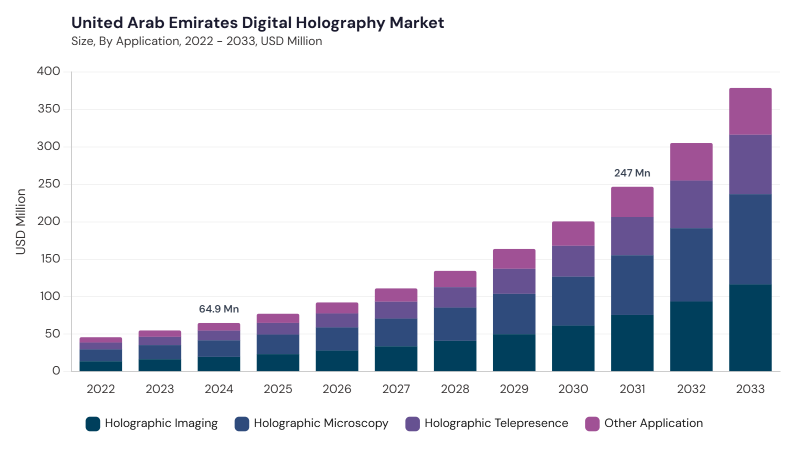
Based on Country, the market is segmented into Brazil, Argentina, UAE, Saudi Arabia, South Africa, Nigeria, and Rest of LAMEA. The Brazil market dominated the LAMEA Digital Holography Market by Country in 2025, and would continue to be a dominant market till 2033; thereby, achieving a market value of USD 248.3 million by 2029, growing at a CAGR of 21.7 % during the forecast period. The Argentina market is expected to witness a CAGR of 24.9% during (2026 - 2033). Additionally, The UAE market is expected to witness a CAGR of 22.3% during (2026 - 2033).
Brazil leads due to rising use of immersive marketing, healthcare visualization, AR-integrated holography, education applications, and sustainable digital imaging solutions. Argentina supports market growth through authentication technologies, cultural heritage preservation, interactive displays, packaging security, and AI-enhanced holographic processing. The UAE contributes through smart city initiatives, AI-powered holographic systems, immersive retail, healthcare visualization, and public-sector digital transformation. Saudi Arabia, South Africa, and Nigeria add momentum through Vision-linked digital health projects, 5G-enabled visualization, holographic communication, security authentication, educational tools, and localized technology development, while Rest of LAMEA benefits from non-destructive testing, biomedical imaging, industrial inspection, and portable holographic systems.

By Offering
By Dimension
By Application
By End Use
By Country
Set to reach $1.1 Billion by 2029, growing at 23.4% CAGR during 2026-2033.
Brazil leads with $248.3 million by 2029, growing at 21.7% CAGR during the forecast period.
Rising demand for holographic microscopy, achieving $353.7 million by 2029 at 22.5% CAGR.
Hardware segment to reach $644.5 million by 2029, growing at 22.9% CAGR during the forecast period.
UAE market is expected to witness a CAGR of 22.3% during 2026-2033.
Two-dimensional segment to reach $580.3 million by 2029, growing at 23% CAGR during the forecast period.
Our team of dedicated experts can provide you with attractive expansion opportunities for your business.




 Unique Offerings