The sample copy of this report is available for access.
The Asia Pacific Digital Holography Market is expected to reach USD 3.3 billion by 2030, growing at a CAGR of 22.6% during (2026 – 2033).
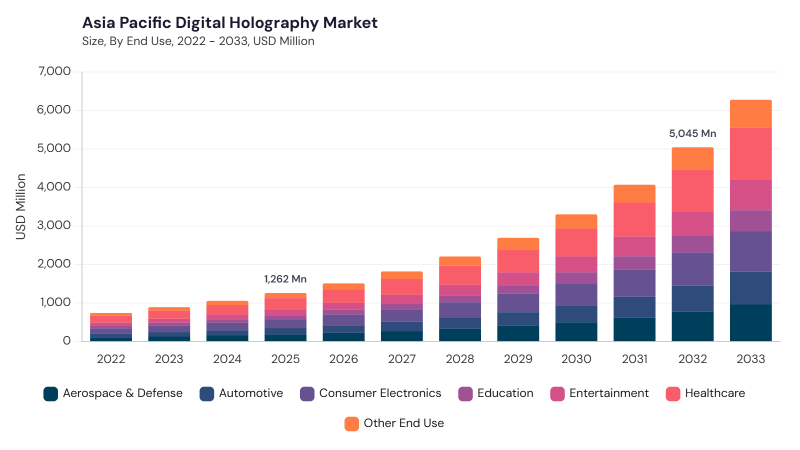
The Asia Pacific Digital Holography Market evolved from early optical holography and wavefront reconstruction work that was initially used for scientific visualization, security markings, and specialized imaging. Early development depended on lasers, optical sensors, and digital processing systems that gradually enabled holographic images to be captured, reconstructed, and transmitted with greater accuracy. As computational holography, high-definition displays, and digital imaging systems improved, the technology expanded beyond research settings into healthcare, industrial inspection, communication, and entertainment applications. The region’s strong electronics, telecom, photonics, and manufacturing base accelerated this transition.
The Asia Pacific Digital Holography Market is being shaped by healthcare imaging demand, industrial automation, metaverse-linked visualization, consumer electronics innovation, and high-speed communication infrastructure. Organizations are using digital holography for biomedical imaging, semiconductor inspection, holographic telepresence, advanced displays, security authentication, education, and immersive entertainment. Demand is supported by government digitalization programs, smart city initiatives, electronics manufacturing capacity, healthcare modernization, and growing investment in AI-powered visualization. Vendors are focusing on compact optical hardware, AI-based hologram optimization, glasses-free 3D displays, cloud-connected platforms, scalable production, and industry-specific customization.
Based on Offering, the market is segmented into Hardware and Software. The Hardware market dominated the Asia Pacific Digital Holography Market by Offering in 2025, and would continue to be a dominant market till 2033; thereby, achieving a market value of USD 1.9 billion by 2030, growing at a CAGR of 22 % during the forecast period. The Software market is expected to witness a CAGR of 23.3% during (2026 - 2033).
Hardware leads due to strong demand for laser sources, optical sensors, spatial light modulators, holographic displays, projection systems, specialized cameras, and imaging equipment. These components support holographic capture, reconstruction, display, and measurement across healthcare, electronics, semiconductor, automotive, aerospace, and industrial automation applications. Software remains important as users require rendering platforms, reconstruction algorithms, AI-powered image processing, simulation tools, data compression, and visualization software. Software adoption is also supported by cloud computing, machine learning, AR/VR integration, SaaS models, and the need to convert raw holographic data into actionable insights across diverse Asia Pacific industries.
Based on Dimension, the market is segmented into Two Dimensional (2D) and Three Dimensional (3D). The Two Dimensional (2D) market dominated the Asia Pacific Digital Holography Market by Dimension in 2025, and would continue to be a dominant market till 2033; thereby, achieving a market value of USD 1.8 billion by 2030, growing at a CAGR of 22.1 % during the forecast period. The Three Dimensional (3D) market is expected to witness a CAGR of 23% during (2026 - 2033).
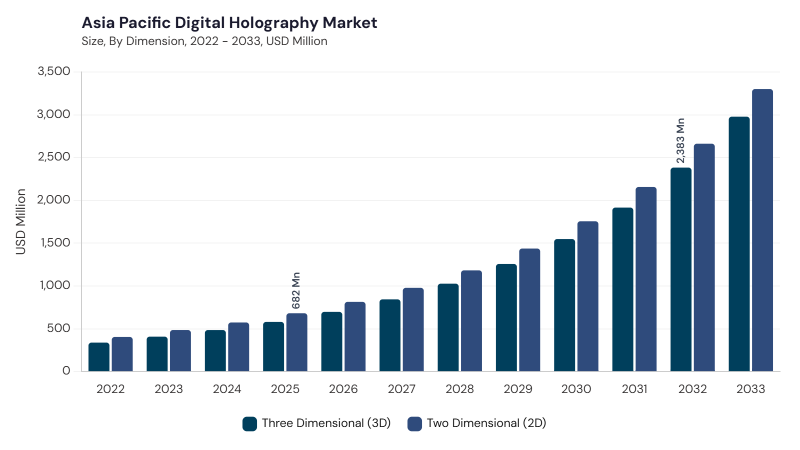
Two Dimensional (2D) leads due to its broad use in electronics inspection, biomedical laboratories, industrial quality control, semiconductor analysis, and surface defect detection. It remains preferred in high-volume production environments because it offers practical imaging, faster processing, lower complexity, and cost-efficient deployment. Three Dimensional (3D) is gaining demand as users require volumetric visualization, spatial depth, immersive display, and interactive holographic experiences. Its adoption is supported by surgical planning, smart manufacturing, AR/VR applications, advanced training, digital entertainment, defense simulation, and next-generation holographic display technologies.
Based on Application, the market is segmented into Holographic Microscopy, Holographic Imaging, Holographic Telepresence, and Other Application. The Holographic Microscopy market dominated the Asia Pacific Digital Holography Market by Application in 2025, and would continue to be a dominant market till 2033; thereby, achieving a market value of USD 1.1 billion by 2030, growing at a CAGR of 21.6 % during the forecast period. The Holographic Imaging market is expected to witness a CAGR of 22.8% during (2026 - 2033). Additionally, The Holographic Telepresence market is expected to witness highest CAGR of 23.2% during (2026 - 2033).
Holographic Microscopy leads due to growing use in biotechnology research, pharmaceutical development, pathology, cellular analysis, and non-invasive biomedical imaging. This application helps laboratories and healthcare institutions capture high-resolution sample data without extensive labeling or destructive preparation. Holographic Imaging supports semiconductor inspection, precision measurement, industrial process optimization, cultural visualization, defect analysis, and advanced manufacturing quality control. Holographic Telepresence and Other Application areas add demand through immersive collaboration, virtual events, remote education, healthcare communication, security authentication, holographic data storage, cultural exhibitions, and specialized scientific research.
Based on End Use, the market is segmented into Healthcare, Consumer Electronics, Aerospace & Defense, Automotive, Entertainment, Education, and Other End Use. Healthcare leads due to increasing use of holographic imaging in diagnostics, surgical planning, medical education, biomedical research, telemedicine, and minimally invasive visualization.
Consumer Electronics supports growth through holographic displays, smart devices, glasses-free 3D interfaces, AR/VR products, and interactive consumer technologies. Aerospace & Defense, Automotive, Entertainment, Education, and Other End Use areas add demand through mission simulation, maintenance visualization, holographic head-up displays, vehicle prototyping, live event projection, gaming, virtual classrooms, industrial research, retail visualization, and telecommunications-based holographic communication.
Free Valuable Insights: Digital Holography Market is Predicted to reach USD 22.3 Billion billion by 2033, at a CAGR of 21.9%
Based on Country, the market is segmented into China, Japan, India, South Korea, Singapore, Malaysia, and Rest of Asia Pacific. The China market dominated the Asia Pacific Digital Holography Market by Country in 2025, and would continue to be a dominant market till 2033; thereby, achieving a market value of USD 1.0 billion by 2030, growing at a CAGR of 20.6 % during the forecast period. The Japan market is expected to witness a CAGR of 21.8% during (2026 - 2033). Additionally, The India market is expected to witness a CAGR of 23.5% during (2026 - 2033).
China leads due to strong digital innovation programs, domestic manufacturing scale, AI-integrated holography, smart city deployment, consumer electronics activity, and expanding use of holographic imaging across industrial and security applications. Japan supports market growth through advanced medical imaging, compact display development, AI-enabled holographic platforms, and strong R&D in precision visualization technologies. India is advancing through localized holographic systems, AI-based computational imaging, environmental monitoring applications, and rising demand for portable imaging tools. South Korea, Singapore, and Malaysia add momentum through 5G/6G development, contactless holographic interfaces, AR/VR integration, security printing, industrial inspection, and healthcare innovation, while Rest of Asia Pacific benefits from NDT, medical imaging, and interactive display adoption.

By Offering
By Dimension
By Application
By End Use
By Country
Set to reach $3.3 Billion by 2030, growing at 22.6% CAGR during 2026-2033.
China leads with $1.0 billion by 2030, growing at a CAGR of 20.6% during the forecast period.
Rising adoption in holographic microscopy, reaching $1.1 billion by 2030 at 21.6% CAGR during the forecast period.
Hardware segment to achieve $1.9 billion by 2030, growing at 22% CAGR during the forecast period.
Japan is expected to witness a CAGR of 21.8% during 2026-2033.
Holographic telepresence market to witness highest CAGR of 23.2% during 2026-2033.
Our team of dedicated experts can provide you with attractive expansion opportunities for your business.




 Unique Offerings