The sample copy of this report is available for access.
The LAMEA Data Center Accelerator Market is expected to reach USD 5.0 billion by 2029, growing at a CAGR of 26.9% during (2026 - 2033).
The LAMEA Data Center Accelerator Market is developing from a smaller installed base than North America, Europe, and Asia Pacific, but the region is entering a stronger investment cycle as cloud computing, artificial intelligence, sovereign digital infrastructure, and HPC gain importance. Earlier adoption was concentrated among telecom operators, financial institutions, universities, government research bodies, energy companies, and large enterprises requiring specialized computing. Public cloud expansion improved GPU access across Brazil, UAE, Saudi Arabia, and South Africa. Generative AI is now increasing demand for high-density accelerated computing across governments, cloud providers, data center operators, and technology companies.
Sovereign AI infrastructure, cloud-based accelerator consumption, and high-density data center investment are shaping current market development. The UAE and Saudi Arabia are emerging as major AI infrastructure investment centers, while Brazil leads Latin America’s diversified cloud and enterprise demand base. South Africa remains a stronger sub-Saharan data center hub, whereas Nigeria represents an earlier-stage but high-potential digital market. However, accelerator costs, imported semiconductor dependence, cooling requirements, power availability, technical-skill gaps, uneven digital infrastructure, and limited high-density data center capacity continue to influence adoption across LAMEA.
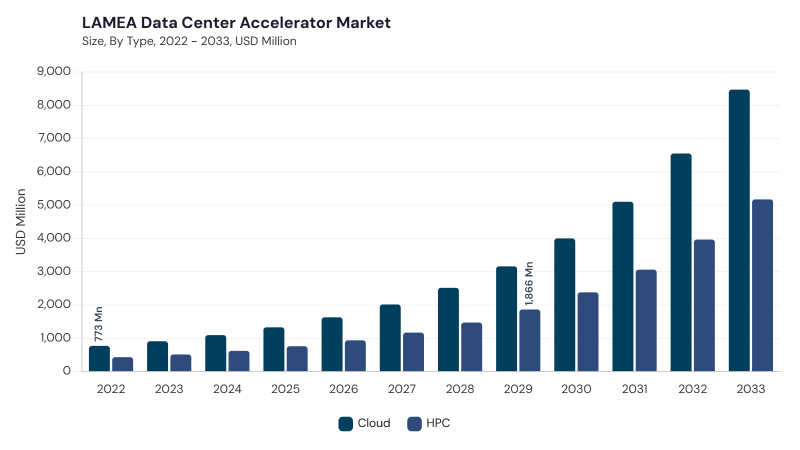
Based on Type, the market is segmented into Cloud and HPC. The Cloud market dominated the LAMEA Data Center Accelerator Market by Type in 2025, and would continue to be a dominant market till 2033; thereby, achieving a market value of USD 3.1 billion by 2029, growing at a CAGR of 26.5 % during the forecast period. The HPC market is expected to witness a CAGR of 27.6% during (2026 - 2033).
Cloud enables enterprises, startups, banks, telecom operators, researchers, retailers, and software developers to access GPU and specialized AI resources without directly purchasing expensive infrastructure. It supports model training, inference, experimentation, and scalable AI workloads while reducing capital intensity. HPC maintained a promising presence due to specialized use in oil and gas exploration, geospatial analysis, scientific modeling, academic research, engineering, and energy applications. As AI and HPC converge, both models increasingly require GPUs, CPUs, high-speed networking, cooling, storage, and mature software support.
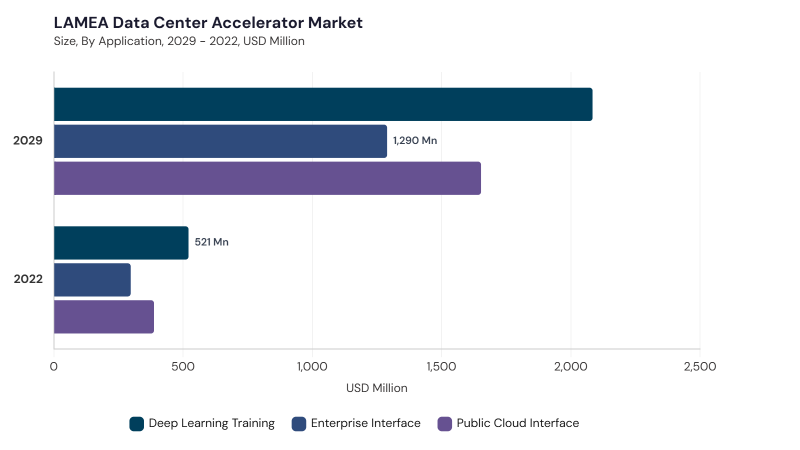
Based on Application, the market is segmented into Deep Learning Training, Public Cloud Interface, and Enterprise Interface. Deep Learning Training requires parallel computing, HBM, fast networking, distributed-training software, and scalable accelerator clusters, especially for sovereign AI and large technology initiatives.
Public Cloud Interface held a substantial share as fintech, telecom, e-commerce, government, education, and digital service providers increasingly use hosted GPU resources and managed AI platforms. Enterprise Interface retained a promising presence as banks, energy companies, telecom operators, retailers, healthcare users, and government organizations adopt dedicated or hybrid infrastructure for sensitive data, operational analytics, cybersecurity, and business-critical AI workloads.
Based on Processor, the market is segmented into GPU, FPGA, CPU, and ASIC. GPUs remain central because they support AI training, inference, simulation, analytics, and cloud-based accelerator consumption with strong software ecosystems and high-performance computing capability. FPGA achieved a significant share due to configurable architecture suited to telecom, network acceleration, real-time processing, cybersecurity, and specialized workloads.
CPU demonstrated a considerable presence as the general-purpose and orchestration layer within mixed-processor environments. ASIC constituted a promising segment as demand gradually develops for workload-specific hardware offering stronger processing efficiency, optimized power use, and cost benefits in predictable inference workloads.
Free Valuable Insights: Data Center Accelerator Market Size Worth USD 137.0 Billion billion by 2033
Based on Country, the market is segmented into Brazil, Argentina, UAE, Saudi Arabia, South Africa, Nigeria, and Rest of LAMEA. The Brazil market dominated the LAMEA Data Center Accelerator Market by Country in 2025, and would continue to be a dominant market till 2033; thereby, achieving a market value of USD 1.1 billion by 2029, growing at a CAGR of 25.2 % during the forecast period. The Argentina market is expected to witness a CAGR of 27.9% during (2026 - 2033). Additionally, The UAE market is expected to witness a CAGR of 25.8% during (2026 - 2033).
Across LAMEA, data center accelerator adoption varies with cloud maturity, AI investment, digital infrastructure, power availability, and enterprise technology demand. Brazil remains the principal Latin American demand center, supported by banking, telecom, e-commerce, cloud services, research, and enterprise AI, while Argentina relies more on cloud-based acceleration, software talent, universities, fintech, and research workloads. The UAE is moving rapidly toward sovereign AI, large-scale compute, cloud partnerships, and high-density AI infrastructure, whereas Saudi Arabia emphasizes national digital transformation, smart-city programs, Arabic-language AI, cloud expansion, and energy-sector computing. South Africa leads sub-Saharan accelerator infrastructure through cloud, finance, telecom, mining, research, and enterprise AI. Nigeria remains earlier stage but offers long-term potential through fintech, telecom, digital commerce, startups, and cloud-based GPU consumption. Rest of LAMEA will grow unevenly through cloud access, telecom modernization, government digitalization, and regional data center investment.

By Type
By Application
By Processor
By Country
Set to reach $5.0 Billion by 2029, growing at 26.9% CAGR during 2026-2033.
Brazil leads with a market value of USD 1.1 billion by 2029, growing at a CAGR of 25.2% during 2026-2033.
Rising adoption of cloud-based solutions, with the Cloud segment reaching USD 3.1 billion by 2029.
Cloud segment hits USD 3.1 billion by 2029, growing at a CAGR of 26.5% during 2026-2033.
The UAE market is expected to witness a CAGR of 25.8% during 2026-2033.
The HPC market is expected to witness a CAGR of 27.6% during 2026-2033.
Our team of dedicated experts can provide you with attractive expansion opportunities for your business.




 Unique Offerings
