The sample copy of this report is available for access.
The Europe Data Center Accelerator Market is expected to reach USD 17.6 billion by 2031, growing at a CAGR of 24.1% during (2026 - 2033).
Europe Data Center Accelerator Market evolved from the region’s established base in high-performance computing, scientific research, industrial engineering, telecommunications, automotive technology, financial services, and public-sector digital infrastructure. Early adoption was linked to supercomputing centers, universities, research institutions, and engineering organizations where GPUs and FPGAs supported compute-heavy workloads. Cloud computing and artificial intelligence broadened accelerator use across commercial infrastructure, while deep learning increased demand for parallel processing. Generative AI and sovereign computing initiatives are now strengthening investment in GPU-rich systems, AI-optimized data centers, high-bandwidth memory, and high-speed networking.
Sovereign AI infrastructure, AI-HPC convergence, and energy-efficient computing are shaping current market development. Europe’s AI Factories and planned AI Gigafactories are expanding access to advanced compute for researchers, startups, SMEs, industrial companies, and public institutions. Accelerator infrastructure is increasingly designed to support scientific simulations, generative AI, industrial workloads, and cloud services within common environments. However, high infrastructure costs, power availability, energy pricing, semiconductor supply-chain dependence, rapid hardware cycles, and shortage of AI software skills continue to influence deployment. Competition increasingly depends on accelerator access, cloud availability, software compatibility, data sovereignty, system integration, and energy efficiency.
Based on Type, the market is segmented into Cloud and HPC. The Cloud market dominated the Europe Data Center Accelerator Market by Type in 2025, and would continue to be a dominant market till 2033; thereby, achieving a market value of USD 10.9 billion by 2031, growing at a CAGR of 23.7 % during the forecast period. The HPC market is expected to witness a CAGR of 24.7% during (2026 - 2033).
Cloud infrastructure enables enterprises, startups, developers, and AI companies to access accelerator capacity without building expensive high-density computing facilities. It supports training, fine-tuning, inference, analytics, and engineering workloads that fluctuate over time. HPC sustained a promising presence due to Europe’s strong base in supercomputing, academic research, climate modeling, industrial engineering, computational science, and AI-enabled scientific discovery. As AI and HPC converge, both segments increasingly require GPUs, CPUs, HBM, high-speed networking, advanced cooling, and mature software environments. Regional initiatives supporting digital sovereignty and shared AI infrastructure are further strengthening adoption across both computing models.
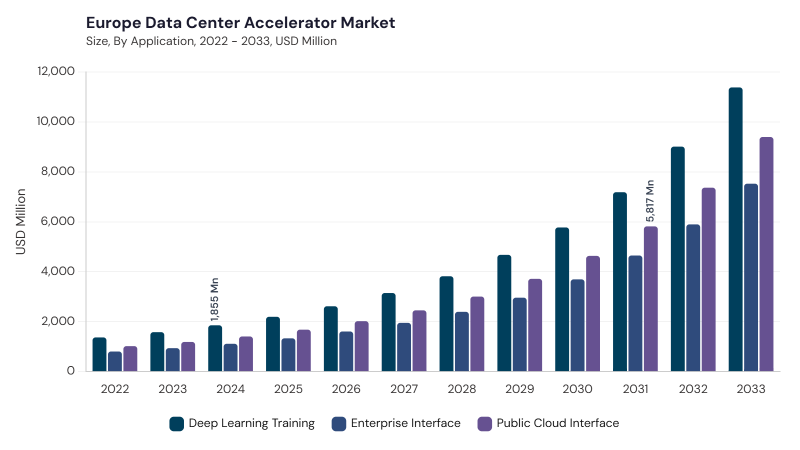
Based on Application, the market is segmented into Deep Learning Training, Public Cloud Interface, and Enterprise Interface. Deep Learning Training requires large-scale parallel compute, HBM, fast networking, cluster scalability, and distributed training software to support generative AI, scientific foundation models, computer vision, mobility systems, and industry-specific AI.
Public Cloud Interface secured a significant share as organizations use accelerator-enabled cloud resources, managed AI platforms, containers, and flexible infrastructure to reduce direct hardware investment. Enterprise Interface maintained a promising presence as businesses adopt private, hybrid, or controlled accelerator environments for cybersecurity, data governance, analytics, digital twins, product development, and automation. Europe’s AI regulatory landscape and focus on responsible data management continue to shape application choices.
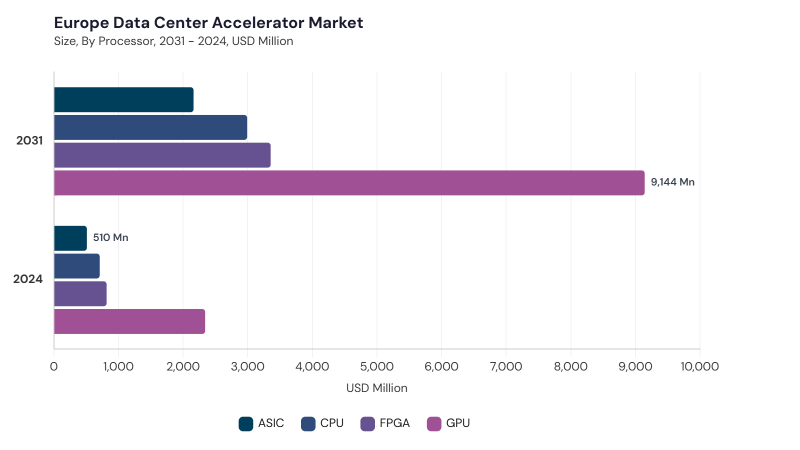
Based on Processor, the market is segmented into GPU, FPGA, CPU, and ASIC. GPUs remain central to European AI and HPC infrastructure because they combine parallel processing, HBM, high-speed interconnects, and mature software support for training and inference. FPGA held a substantial share due to configurable architecture, low-latency processing, telecommunications use, industrial computing, and specialized inference applications.
CPU maintained a considerable presence as the general-purpose processing and orchestration layer within heterogeneous data center systems. ASIC represented a promising segment as interest grows in purpose-built silicon for specialized workloads, energy-sensitive inference, and cloud or technology environments seeking stronger workload efficiency. Europe’s focus on efficiency, resilience, and sovereign computing will influence the processor mix.
Free Valuable Insights: The Worldwide Data Center Accelerator Market is projected to reach USD 137.0 Billion billion by 2033, at a CAGR of 24.8%
Based on Country, the market is segmented into Germany, UK, France, Russia, Spain, Italy, and Rest of Europe. The Germany market dominated the Europe Data Center Accelerator Market by Country in 2025, and would continue to be a dominant market till 2033; thereby, achieving a market value of USD 3.5 billion by 2031, growing at a CAGR of 22.4 % during the forecast period. The UK market is expected to witness a CAGR of 23% during (2026 - 2033). Additionally, The France market is expected to witness a CAGR of 24.9% during (2026 - 2033).
Across Europe, data center accelerator adoption varies with AI infrastructure scale, HPC maturity, industrial digitalization, cloud availability, sovereign compute priorities, and power economics. Germany emphasizes industrial AI, manufacturing, automotive workloads, HammerHAI, JUPITER, heterogeneous accelerators, and energy-efficient infrastructure, while the UK focuses on AI Research Resource expansion, Isambard-AI, Dawn, SMEs, academia, and public-sector compute access. France prioritizes sovereign AI, AI Factory France, aerospace, healthcare, defense, energy, robotics, finance, and public supercomputing. Russia remains shaped by AI/HPC demand, domestic computing capability, software adaptation, and hardware-access constraints. Spain focuses on EuroHPC AI infrastructure, BSC AIF, 1HealthAI, cloud growth, and renewable-energy-linked data center investment. Italy emphasizes Leonardo, IT4LIA, LISA, GAIA cloud, universities, industrial AI, and research computing. Rest of Europe benefits from AI Factory antennas, shared EuroHPC access, cloud-based inference, scientific computing, and energy-efficient data center expansion.

By Type
By Application
By Processor
By Country
Set to reach $17.6 Billion by 2031, growing at 24.1% CAGR during 2026-2033.
Germany leads with $3.5 billion by 2031, growing at 22.4% CAGR during 2026-2033.
Rising enterprise cloud adoption is a main catalyst, with the Cloud segment reaching $10.9 billion by 2031.
Cloud segment hits $10.9 billion by 2031, growing at 23.7% CAGR during the forecast period.
The UK market is expected to witness a CAGR of 23% during 2026-2033.
The HPC market is expected to witness a CAGR of 24.7% during 2026-2033.
Our team of dedicated experts can provide you with attractive expansion opportunities for your business.




 Unique Offerings
