The sample copy of this report is available for access.
The Asia Pacific Data Center Accelerator Market is expected to reach USD 22.5 billion by 2030, growing at a CAGR of 25.6% during (2026 - 2033).
Asia Pacific Data Center Accelerator Market evolved from strong regional foundations in semiconductor manufacturing, electronics, telecommunications, HPC, internet platforms, cloud services, and scientific research. Early accelerator adoption was concentrated in supercomputing, engineering simulation, graphics-intensive workloads, telecommunications, and specialized scientific applications. Cloud computing and deep learning increased the role of GPUs and heterogeneous CPU-accelerator systems, while generative AI created a larger infrastructure cycle. China, Japan, South Korea, India, Singapore, and Malaysia are now expanding AI compute, cloud infrastructure, and accelerator-rich data centers.
National AI computing infrastructure, hyperscale data center development, and energy-efficient accelerated computing are shaping current market growth. China is expanding intelligent computing capacity, South Korea is increasing advanced GPU procurement, India is broadening shared accelerator access, and Southeast Asia is attracting AI data center investment. Malaysia is targeting GPU-as-a-Service, AI factories, training and inference infrastructure, and cloud platforms. However, high accelerator costs, power availability, cooling needs, semiconductor supply dependence, HBM constraints, export controls, and AI infrastructure skill shortages continue to influence deployment across the region.
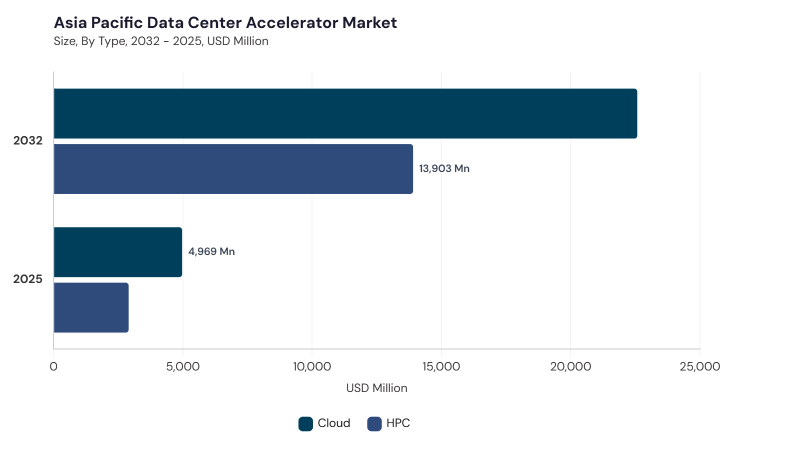
Based on Type, the market is segmented into Cloud and HPC. The Cloud market dominated the Asia Pacific Data Center Accelerator Market by Type in 2025, and would continue to be a dominant market till 2033; thereby, achieving a market value of USD 14.0 billion by 2030, growing at a CAGR of 25.2 % during the forecast period. The HPC market is expected to witness a CAGR of 26.2% during (2026 - 2033).
Cloud enables enterprises, startups, researchers, developers, and public organizations to access GPUs and specialized processors without building costly private infrastructure. It is especially important in emerging markets where direct ownership of accelerators, cooling, networking, and data center capacity can be difficult. HPC retained a promising presence due to demand from scientific research, weather forecasting, semiconductor design, engineering simulations, manufacturing, pharmaceuticals, energy, and government laboratories. As AI and HPC converge, both segments increasingly depend on GPU-rich systems, HBM, high-speed networking, liquid cooling, and sophisticated software environments.
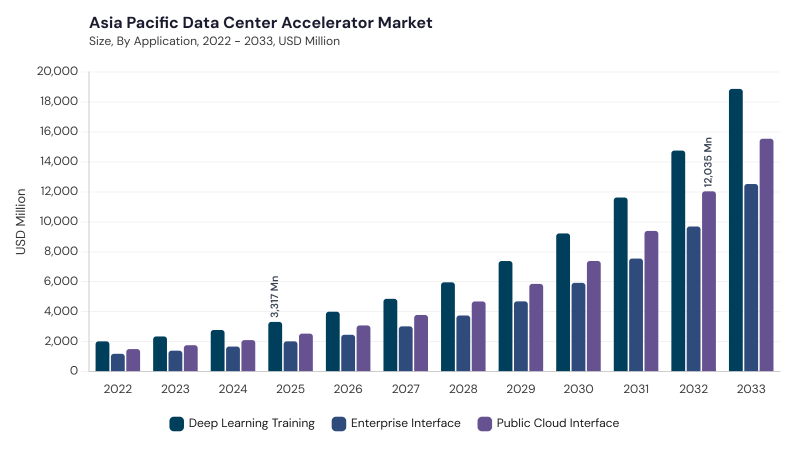
Based on Application, the market is segmented into Deep Learning Training, Public Cloud Interface, and Enterprise Interface. Deep Learning Training requires large-scale parallel compute, HBM, high memory bandwidth, fast interconnects, cluster scalability, and distributed training software. China represents a major training market due to its large internet and AI ecosystem, while Japan, South Korea, India, and other markets are strengthening AI model development.
Public Cloud Interface attained a substantial share as cloud platforms and shared compute resources make accelerators accessible through flexible service models. Enterprise Interface demonstrated a promising presence as manufacturing, financial services, telecom, e-commerce, healthcare, and technology organizations deploy AI infrastructure for analytics, automation, robotics, and generative AI.
Based on Processor, the market is segmented into GPU, FPGA, CPU, and ASIC. GPUs remain central because they provide high computational throughput, HBM support, fast interconnects, and strong software ecosystems for AI training, inference, and HPC. FPGA registered a significant share due to adaptability in telecommunications, edge-to-cloud processing, inference, networking, and latency-sensitive workloads.
CPU preserved a considerable presence as the orchestration and general-compute layer for operating systems, databases, preprocessing, storage, and workload scheduling. ASIC formed a promising segment as domestic semiconductor capabilities, specialized inference needs, and demand for application-specific computing encourage greater interest in custom accelerator designs.
Free Valuable Insights: Data Center Accelerator Market is Predicted to reach USD 137.0 Billion billion by 2033, at a CAGR of 24.8%
Based on Country, the market is segmented into China, Japan, India, South Korea, Singapore, Malaysia, and Rest of Asia Pacific. The China market dominated the Asia Pacific Data Center Accelerator Market by Country in 2025, and would continue to be a dominant market till 2033; thereby, achieving a market value of USD 7.5 billion by 2030, growing at a CAGR of 23.7 % during the forecast period. The Japan market is expected to witness a CAGR of 24.5% during (2026 - 2033). Additionally, The India market is expected to witness a CAGR of 26.6% during (2026 - 2033).
Across Asia Pacific, data center accelerator adoption varies with AI infrastructure scale, semiconductor capability, cloud maturity, energy availability, and national technology policies. China emphasizes intelligent computing capacity, domestic AI processors, AI data centers, power planning, and localized semiconductor ecosystems, while Japan focuses on HPC, industrial AI, robotics, manufacturing, energy-efficient data centers, and scientific computing. India is advancing through IndiaAI Compute, shared accelerator access, cloud growth, software development, startups, and enterprise generative AI. South Korea prioritizes advanced GPU procurement, domestic NPUs, HBM, AI networking, and semiconductor-linked infrastructure, whereas Singapore remains a regional cloud and accelerator hub shaped by connectivity, finance, and power constraints. Malaysia is emerging through hyperscale investment, GPU-as-a-Service, AI factories, cloud platforms, and Singapore-linked data center expansion. Rest of Asia Pacific combines Australia, New Zealand, Taiwan, Indonesia, Thailand, Vietnam, the Philippines, and other markets where cloud-based inference, scientific computing, enterprise AI, semiconductor supply chains, and regional data center growth support long-term demand.

By Type
By Application
By Processor
By Country
Set to reach $22.5 Billion by 2030, growing at 25.6% CAGR during 2026-2033.
China leads with a market value of $7.5 billion by 2030, growing at 23.7% CAGR during 2026-2033.
Rising enterprise cloud adoption and AI-driven workloads are the main catalysts.
Cloud segment hits $14.0 billion by 2030, growing at 25.2% CAGR during 2026-2033.
The India market is expected to witness a CAGR of 26.6% during 2026-2033.
The HPC market is expected to witness a CAGR of 26.2% during 2026-2033.
Our team of dedicated experts can provide you with attractive expansion opportunities for your business.




 Unique Offerings
