The sample copy of this report is available for access.
The LAMEA Control Tower Market is expected to reach USD 2.1 billion by 2029, growing at a CAGR of 26% during (2026 – 2033).
The LAMEA Control Tower Market emerged as organizations across Latin America, the Middle East, and Africa began seeking stronger visibility over fragmented logistics and supply chain operations. Early control tower deployments were largely manual or semi-automated, using basic IT systems to collect shipment, inventory, and operational data. With the arrival of cloud computing, data analytics, IoT, artificial intelligence, and machine learning, control towers gradually shifted from simple visibility platforms into predictive command centers. This evolution became important as regional businesses faced infrastructure gaps, regulatory diversity, cross-border trade complexity, and volatile logistics conditions.
The LAMEA Control Tower Market is being shaped by digital logistics modernization, growing trade activity, regional infrastructure investment, sustainability priorities, and the need for resilient supply chain management. Organizations are using control towers to improve inventory control, supplier coordination, shipment tracking, fleet visibility, demand planning, and regulatory compliance. Demand is supported by smart ports, warehouse automation, public-private infrastructure initiatives, cloud platforms, AI-driven analytics, IoT sensors, and expanding multimodal logistics networks. Vendors are focusing on localized compliance modules, multilingual support, scalable deployment, secure data exchange, edge computing, predictive insights, and cost-efficient service models.
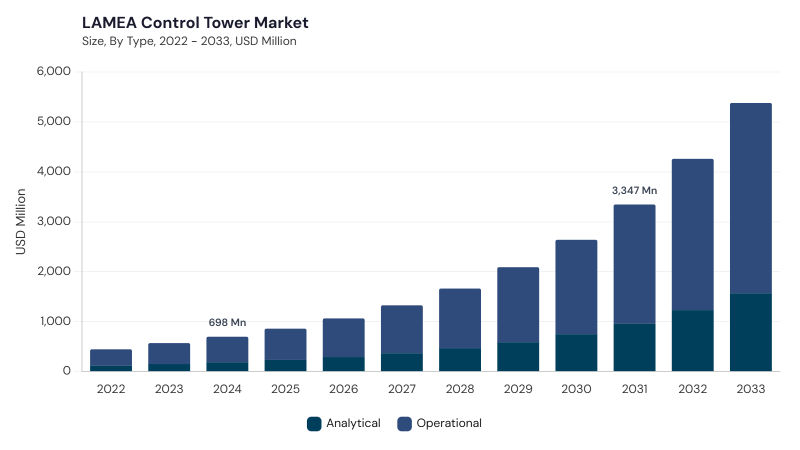
Based on Type, the market is segmented into Operational and Analytical. The Operational market dominated the LAMEA Control Tower Market by Type in 2025, and would continue to be a dominant market till 2033; thereby, achieving a market value of USD 1.5 billion by 2029, growing at a CAGR of 25.6 % during the forecast period. Additionally, The Analytical market is expected to witness highest CAGR of 27.2% during (2026 - 2033).
Operational control towers lead due to rising demand for real-time shipment visibility, inventory tracking, order monitoring, logistics coordination, and exception management across diverse regional supply chains. These platforms help enterprises manage daily execution across ports, warehouses, transportation networks, suppliers, and distribution centers. Analytical control towers remain important as companies seek predictive risk assessment, scenario planning, demand forecasting, and performance analytics. This segment benefits from AI, machine learning, cloud analytics, IoT data streams, and simulation tools that help organizations improve resilience, reduce disruptions, and strengthen decision-making.
Based on Application, the market is segmented into Supply Chain and Transportation. The Supply Chain market dominated the LAMEA Control Tower Market by Application in 2025, and would continue to be a dominant market till 2033; thereby, achieving a market value of USD 1.2 billion by 2029, growing at a CAGR of 25.5 % during the forecast period. Additionally, The Transportation market is expected to witness highest CAGR of 26.8% during (2026 - 2033).
Supply Chain leads due to increasing focus on end-to-end visibility, supplier collaboration, inventory optimization, procurement coordination, and disruption management across expanding manufacturing and distribution networks. Enterprises use supply chain control towers to connect data from suppliers, warehouses, manufacturers, retailers, and logistics partners for faster operational decisions. Transportation remains significant as companies invest in freight management, fleet tracking, multimodal shipment visibility, route optimization, and delivery performance monitoring. This segment is supported by GPS tracking, telematics, IoT sensors, predictive maintenance, compliance tools, and sustainable routing solutions designed to improve transport transparency and efficiency.
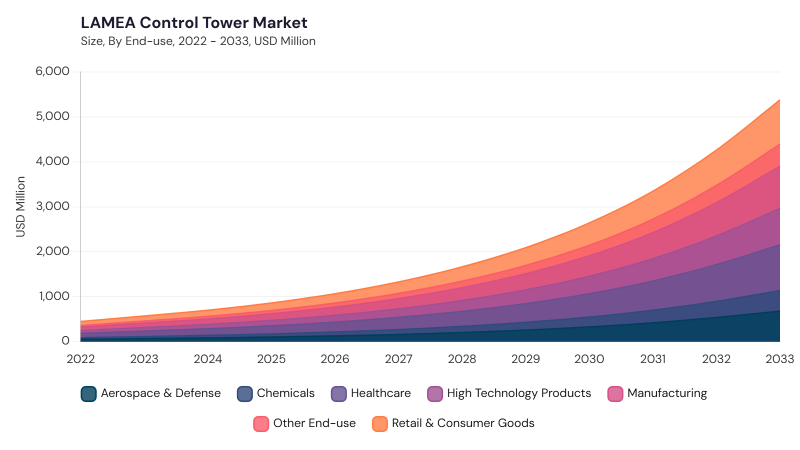
Based on End-use, the market is segmented into Healthcare, Retail & Consumer Goods, Manufacturing, High Technology Products, Aerospace & Defense, Chemicals, and Other End-use. Healthcare leads due to increasing need for pharmaceutical distribution visibility, medical inventory control, vaccine logistics, cold chain monitoring, and reliable delivery of critical healthcare products. Retail & Consumer Goods uses control towers for inventory visibility, omnichannel fulfillment, demand forecasting, warehouse coordination, and modern retail distribution.
Manufacturing applies these platforms for supplier coordination, production planning, industrial digitization, and operational continuity. High Technology Products, Aerospace & Defense, Chemicals, and Other End-use areas add demand through component tracking, defense logistics, hazardous material monitoring, cybersecurity, ESG reporting, energy asset coordination, agriculture logistics, and specialized supply chain visibility.
Free Valuable Insights: Control Tower Market Size Worth USD 60.4 Billion billion by 2033
Based on Country, the market is segmented into Brazil, Argentina, UAE, Saudi Arabia, South Africa, Nigeria, and Rest of LAMEA. The Brazil market dominated the LAMEA Control Tower Market by Country in 2025, and would continue to be a dominant market till 2033; thereby, achieving a market value of USD 472.7 million by 2029, growing at a CAGR of 24.3 % during the forecast period. The Argentina market is expected to witness a CAGR of 26.7% during (2026 - 2033). Additionally, The UAE market is expected to witness a CAGR of 25% during (2026 - 2033).
Brazil leads due to expanding industrial activity, e-commerce growth, agriculture supply chains, logistics modernization, AI-powered analytics, and increasing demand for localized control tower deployments. Argentina supports market growth through digital transformation, IoT adoption, regulatory digitization, cross-border collaboration, and predictive supply chain visibility. The UAE contributes through advanced ports, aviation logistics, AI-enabled platforms, data governance, and its role as a regional trade hub. Saudi Arabia, South Africa, and Nigeria add momentum through Vision-driven digitalization, cloud-based logistics control, mining and retail supply chains, ICT development, and localized software adoption, while Rest of LAMEA benefits from infrastructure upgrades, sustainability tracking, and scalable control tower platforms.

By Type
By Application
By End-use
By Country
Set to reach $2.1 Billion by 2029, growing at 26% CAGR during 2026-2033.
Brazil leads with a market value of USD 472.7 million by 2029, growing at 24.3% CAGR during the forecast period.
Rising demand in the Supply Chain segment, reaching USD 1.2 billion by 2029, at 25.5% CAGR during the forecast period.
The Operational segment will achieve USD 1.5 billion by 2029, growing at 25.6% CAGR during the forecast period.
The UAE market is expected to witness a CAGR of 25% during 2026-2033.
The Analytical segment is expected to witness the highest CAGR of 27.2% during 2026-2033.
Our team of dedicated experts can provide you with attractive expansion opportunities for your business.




 Unique Offerings