The sample copy of this report is available for access.
The Europe Control Tower Market is expected to reach USD 10.2 billion by 2031, growing at a CAGR of 23.4% during (2026 – 2033).
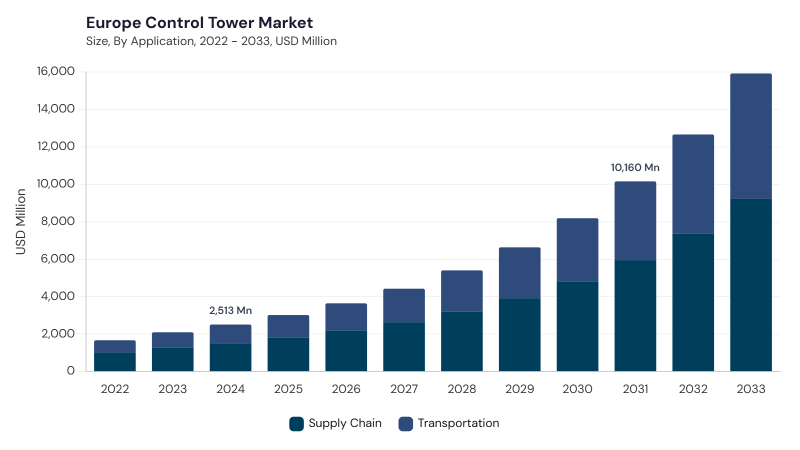
The Europe Control Tower Market developed from centralized logistics and supply chain command centers created to improve visibility across distributed procurement, transportation, and inventory operations. Early solutions mainly supported tracking, reporting, and event monitoring for manufacturers, retailers, and logistics providers. Over time, cloud computing, IoT sensors, automation, artificial intelligence, and advanced analytics expanded control towers into predictive and collaborative orchestration platforms. The rise of cross-border supply chains, regulatory reporting, geopolitical disruptions, and sustainability mandates further increased their strategic importance.
The Europe Control Tower Market is being shaped by digital transformation, supply chain volatility, sustainability requirements, regulatory scrutiny, and rising demand for real-time decision support. Organizations are using control towers to improve supplier coordination, inventory optimization, demand forecasting, shipment visibility, multimodal logistics monitoring, and disruption response. Demand is supported by AI-powered analytics, cloud-native platforms, IoT-based tracking, digital twins, ESG reporting tools, and multi-enterprise data-sharing models. Vendors are focusing on interoperable platforms, compliance automation, cybersecurity, predictive insights, sustainability dashboards, and integration with ERP, WMS, and TMS systems.
Based on Type, the market is segmented into Operational and Analytical. The Operational market dominated the Europe Control Tower Market by Type in 2025, and would continue to be a dominant market till 2033; thereby, achieving a market value of USD 7.2 billion by 2031, growing at a CAGR of 23 % during the forecast period. Additionally, The Analytical market is expected to witness highest CAGR of 24.5% during (2026 - 2033).
Operational control towers lead due to their strong role in real-time logistics execution, shipment monitoring, workflow coordination, inventory visibility, and exception management across European supply networks. They help enterprises manage cross-border movement, warehouse activity, supplier events, and transport disruptions through centralized dashboards. Analytical control towers remain important as companies require forecasting, scenario modeling, supplier risk assessment, and sustainability performance analysis. This segment benefits from AI, machine learning, cloud analytics, digital twins, and data visualization tools that support predictive and prescriptive supply chain decisions.
Based on Application, the market is segmented into Supply Chain and Transportation. The Supply Chain market dominated the Europe Control Tower Market by Application in 2025, and would continue to be a dominant market till 2033; thereby, achieving a market value of USD 5.9 billion by 2031, growing at a CAGR of 22.9 % during the forecast period. Additionally, The Transportation market is expected to witness highest CAGR of 24.2% during (2026 - 2033).
Supply Chain leads due to rising need for end-to-end visibility, supplier collaboration, inventory planning, demand sensing, procurement coordination, and sustainable sourcing transparency. European companies use supply chain control towers to connect data from suppliers, factories, warehouses, retailers, and logistics partners for faster decision-making. Transportation remains significant as businesses invest in freight visibility, carrier coordination, route optimization, fleet monitoring, and multimodal movement management. This segment is supported by GPS tracking, telematics, IoT sensors, AI-based routing, emissions monitoring, and digital freight platforms designed to improve delivery performance and reduce operational inefficiencies.
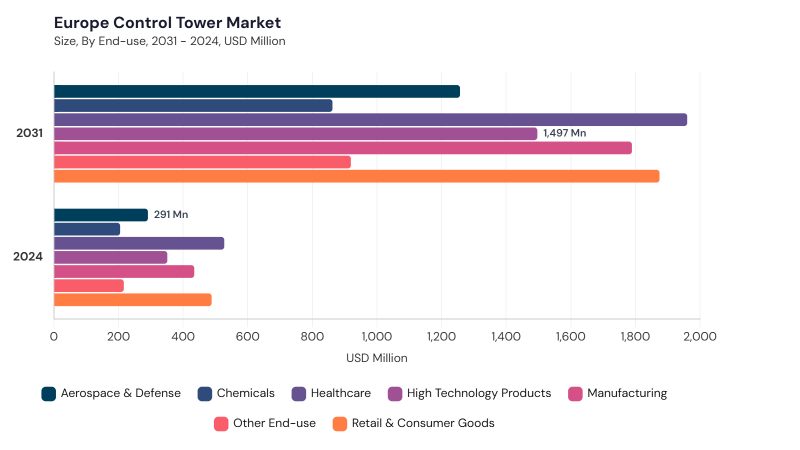
Based on End-use, the market is segmented into Healthcare, Retail & Consumer Goods, Manufacturing, High Technology Products, Aerospace & Defense, Chemicals, and Other End-use. Healthcare leads due to the need for pharmaceutical logistics visibility, medical inventory control, cold chain monitoring, regulatory compliance, and timely supply of critical healthcare products. Retail & Consumer Goods uses control towers for omnichannel fulfillment, demand forecasting, stock visibility, supplier coordination, and last-mile performance management.
Manufacturing applies these platforms for production scheduling, supplier risk monitoring, quality visibility, and Industry 4.0-enabled operations. High Technology Products, Aerospace & Defense, Chemicals, and Other End-use areas add demand through component tracking, export compliance, hazardous material monitoring, mission-critical logistics, ESG reporting, and specialized supply chain control.
Free Valuable Insights: The Worldwide Control Tower Market is projected to reach USD 60.4 Billion billion by 2033, at a CAGR of 23.9%
Based on Country, the market is segmented into Germany, UK, France, Russia, Spain, Italy, and Rest of Europe. The Germany market dominated the Europe Control Tower Market by Country in 2025, and would continue to be a dominant market till 2033; thereby, achieving a market value of USD 2.1 billion by 2031, growing at a CAGR of 21.8 % during the forecast period. The UK market is expected to witness a CAGR of 22.4% during (2026 - 2033). Additionally, The France market is expected to witness a CAGR of 24.3% during (2026 - 2033).
Germany leads due to its strong industrial base, advanced manufacturing networks, AI-enabled supply chain systems, cybersecurity focus, and growing use of control towers for automotive, logistics, and manufacturing operations. The UK supports market growth through digital supply chain modernization, cloud adoption, predictive analytics, cybersecurity investments, and demand for resilient logistics operations. France contributes through digital sovereignty priorities, AI-augmented control towers, sustainability tracking, and compliance-focused supply chain platforms. Russia, Spain, and Italy add demand through localized control tower deployments, IoT adoption, green logistics, cloud infrastructure, and manufacturing digitization, while Rest of Europe benefits from AI-enabled risk management, digital invoicing, cross-border visibility, and collaborative logistics ecosystems.

By Type
By Application
By End-use
By Country
Set to reach $10.2 Billion by 2031, growing at 23.4% CAGR during 2026-2033.
Germany leads with $2.1 billion by 2031, growing at a CAGR of 21.8% during the forecast period.
Rising enterprise cloud adoption and AI-driven workloads are the main catalysts.
Operational segment reaches $7.2 billion by 2031, growing at a CAGR of 23% during the forecast period.
The UK market is expected to witness a CAGR of 22.4% during 2026-2033.
The Analytical segment is expected to witness the highest CAGR of 24.5% during 2026-2033.
Our team of dedicated experts can provide you with attractive expansion opportunities for your business.



 Unique Offerings