The sample copy of this report is available for access.
The LAMEA Chipless RFID Market is expected to reach USD 286.4 million by 2029, growing at a CAGR of 26.4% during (2026 – 2033).
Chipless RFID development across LAMEA emerged from the need for affordable, scalable, and environmentally responsible identification technologies that reduce dependence on traditional barcodes and semiconductor-based RFID tags. Early development focused on passive resonator structures and material-based electromagnetic signatures capable of storing identifiable information without silicon chips. Advances in printable electronics, metamaterials, conductive inks, and reader technologies gradually strengthened tag reliability, detection accuracy, and production scalability. The integration of sensing capabilities further expanded chipless RFID from basic identification toward environmental monitoring, asset tracking, authentication, and connected industrial applications across Latin America, the Middle East, and Africa.
Sustainability, IoT integration, supply-chain digitalization, and localized technology development are increasingly shaping the regional landscape. Companies are exploring recyclable, flexible, and low-material tag designs while connecting chipless RFID systems with digital platforms for real-time tracking, predictive maintenance, and operational visibility. Growing demand for anti-counterfeiting, product authentication, and smart infrastructure is also broadening adoption across pharmaceuticals, retail, logistics, healthcare, and public-sector applications. At the same time, vendors are adapting tag architectures, reader algorithms, and materials to accommodate the region’s diverse climatic, infrastructural, regulatory, and economic conditions.
Based on Product, the market is segmented into Tag, Reader, and Middleware. The Tag market dominated the LAMEA Chipless RFID Market by Product in 2025, and would continue to be a dominant market till 2033; thereby, achieving a market value of USD 165.4 million by 2029, growing at a CAGR of 25.9 % during the forecast period. The Reader market is expected to witness a CAGR of 26.9% during (2026 - 2033). The Middleware market is expected to witness a CAGR of 27.8% during (2026 - 2033).
Tags remain the core identification element of chipless RFID systems and benefit from advances in printable inks, flexible substrates, resonator structures, and environmentally conscious materials. Their chip-free architecture supports large-volume deployment where conventional RFID may be cost-prohibitive, including inventory management, anti-counterfeiting, smart labeling, and supply-chain applications. Reader followed as businesses invested in specialized detection systems capable of improving tag recognition, asset visibility, and operational efficiency across challenging environments. Middleware supports data filtering, normalization, reporting, and integration with ERP, warehouse management, cloud, and analytics platforms, enabling chipless RFID information to be incorporated into broader enterprise workflows.
Based on Operating Frequency, the market is segmented into HF, UHF, and LF. The HF market dominated the LAMEA Chipless RFID Market by Operating Frequency in 2025, and would continue to be a dominant market till 2033; thereby, achieving a market value of USD 125.8 million by 2029, growing at a CAGR of 25.7 % during the forecast period. The UHF market is expected to witness a CAGR of 26.8% during (2026 - 2033). Additionally, The LF market is expected to witness highest CAGR of 27.4% during (2026 - 2033).
HF supports reliable close-range identification suited to authentication, smart cards, healthcare, retail, and controlled-access applications where environmental stability and cost efficiency are important. UHF is increasingly used across logistics, warehouse management, asset tracking, ports, and supply-chain operations where longer read ranges and faster tag detection improve throughput. Integration with IoT platforms is further increasing the relevance of UHF systems for large-scale monitoring. LF remains important for livestock identification, industrial equipment tracking, construction environments, and secure access applications that require dependable short-range performance under challenging physical conditions.
Based on Material, the market is segmented into Silver-nano Ink, Copper-based Ink, and Graphene/Carbon Ink. The Silver-nano Ink market dominated the LAMEA Chipless RFID Market by Material in 2025, and would continue to be a dominant market till 2033; thereby, achieving a market value of USD 160.0 million by 2029, growing at a CAGR of 26 % during the forecast period. The Copper-based Ink market is expected to witness a CAGR of 26.6% during (2026 - 2033). The Graphene/Carbon Ink market is expected to witness a CAGR of 27.8% during (2026 - 2033).
Silver-nano ink provides strong electrical performance and precise conductive patterns for applications requiring dependable identification, including pharmaceutical traceability, industrial logistics, premium retail, healthcare, and high-value asset monitoring. Copper-based ink offers a more economical conductive alternative for high-volume applications such as consumer packaging, warehouse labels, transportation documents, agricultural containers, and retail inventory systems, although oxidation management remains important for long-term reliability. Graphene/Carbon Ink is emerging for flexible, lightweight, and potentially sustainable applications such as wearable devices, smart packaging, agricultural sensing, and environmental monitoring. Continued research into hybrid formulations and scalable printing techniques is improving the commercial potential of these next-generation materials.
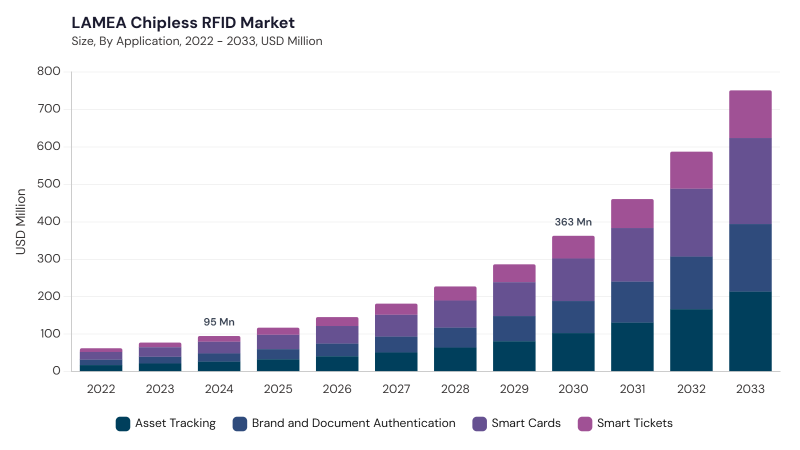
Based on Application, the market is segmented into Smart Cards, Asset Tracking, Brand and Document Authentication, and Smart Tickets. Smart Cards use chipless RFID for low-cost identification and authentication across payment, identity, and access applications where large-scale issuance is required. Asset Tracking followed as manufacturing, logistics, agriculture, and industrial users adopted cost-efficient tagging for goods, equipment, livestock, vehicles, and transport units.
Brand and Document Authentication is gaining momentum as pharmaceuticals, luxury goods, consumer products, and public organizations strengthen anti-counterfeiting and verification systems. Smart Tickets are gradually expanding across public transportation, entertainment, and sporting environments where contactless access, fast processing, and scalable low-cost issuance remain important.
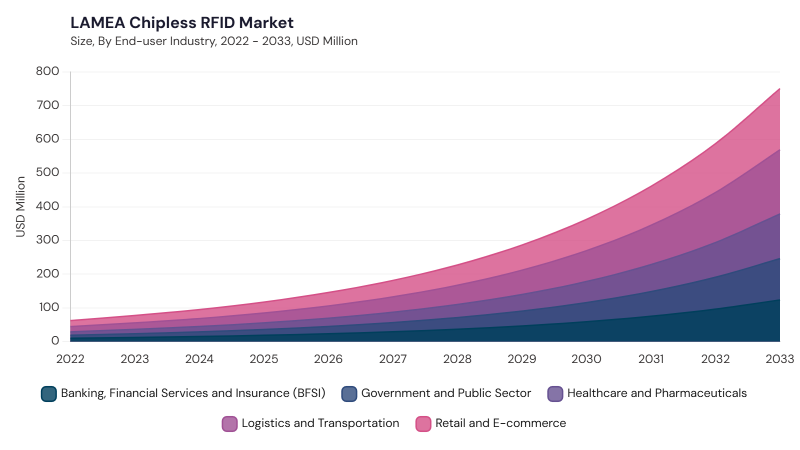
Based on End-user Industry, the market is segmented into Retail and E-commerce, Logistics and Transportation, Healthcare and Pharmaceuticals, Banking, Financial Services and Insurance (BFSI), and Government and Public Sector. Retail and e-commerce applications focus on stock visibility, product authentication, anti-theft systems, and large-volume tagging where cost efficiency is essential. Logistics and Transportation use chipless RFID for shipment tracking, container identification, fleet monitoring, warehouse operations, and supply-chain visibility across complex trade corridors.
Healthcare and Pharmaceuticals increasingly adopt the technology for drug authentication, hospital asset management, patient identification, and traceability. BFSI applications center on document security, asset protection, authentication, and fraud prevention, while Government and Public Sector uses include citizen identification, infrastructure monitoring, document authentication, public transportation, access control, and digital governance initiatives.
Free Valuable Insights: Chipless RFID Market Size Worth USD 9818.4 Million billion by 2033
Based on Country, the market is segmented into Brazil, Argentina, UAE, Saudi Arabia, South Africa, Nigeria, and Rest of LAMEA. The Brazil market dominated the LAMEA Chipless RFID Market by Country in 2025, and would continue to be a dominant market till 2033; thereby, achieving a market value of USD 74.3 million by 2029, growing at a CAGR of 24.9 % during the forecast period. The Argentina market is expected to witness a CAGR of 27.8% during (2026 - 2033). Additionally, The UAE market is expected to witness a CAGR of 25.3% during (2026 - 2033).
Across LAMEA, chipless RFID adoption is increasingly shaped by cost-efficient tracking, sustainability, digitalization, anti-counterfeiting, and the need for technologies suited to diverse operating conditions. Brazil is advancing agribusiness traceability, textile-integrated tags, recyclable solutions, and connected asset-monitoring applications, while Argentina is emphasizing sustainable materials, sensor integration, and printable tags for large-volume deployment. The UAE is strengthening smart-city, agritech, IoT, and environmentally focused applications, whereas Saudi Arabia is integrating chipless RFID with logistics modernization, smart packaging, sensing, and digital transformation initiatives. South Africa is progressing through IoT-enabled sensing, advanced antenna designs, and sustainable identification systems, while Nigeria is focusing on affordable tracking, anti-counterfeit applications, localized production, and supply-chain monitoring. Rest of LAMEA is also expanding eco-friendly materials, IoT-connected tracking, advanced signal processing, and application-specific deployments.

By Product
By Operating Frequency
By Material
By Application
By End-user Industry
By Country
Set to reach $286.4 Million by 2029, growing at a CAGR of 26.4% during (2026 – 2033).
Brazil leads with $74.3 million by 2029, growing at a CAGR of 24.9% during the forecast period.
The Tag segment will achieve $165.4 million by 2029, growing at a CAGR of 25.9% during the forecast period.
HF segment reaches $125.8 million by 2029 at a CAGR of 25.7% during the forecast period.
The UAE market is expected to witness a CAGR of 25.3% during (2026 - 2033).
Graphene/Carbon Ink market is expected to witness a CAGR of 27.8% during (2026 - 2033).
Our team of dedicated experts can provide you with attractive expansion opportunities for your business.




 Unique Offerings