The sample copy of this report is available for access.
The Europe Chipless RFID Market is expected to reach USD 1627.4 million by 2031, growing at a CAGR of 23.5% during (2026 – 2033).
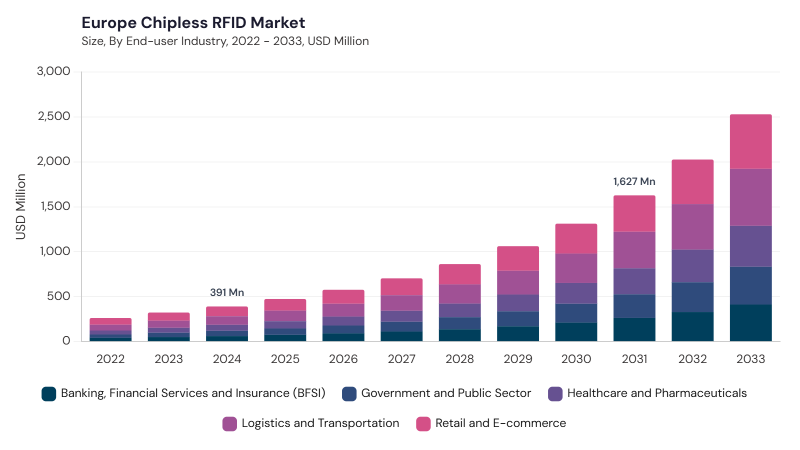
Chipless RFID development across Europe emerged from efforts to reduce the cost, complexity, and environmental burden associated with silicon-based RFID technologies. Early research focused on electromagnetic signatures, passive resonators, and printable structures capable of identifying objects without integrated circuits. Advances in materials science, flexible substrates, antenna design, ultra-wideband principles, and signal-processing methods gradually improved tag reliability and application flexibility. The integration of textile-based, wearable, and sensor-enabled chipless RFID further expanded the technology from conventional tracking into healthcare, smart packaging, industrial monitoring, authentication, and connected supply-chain applications.
Sustainability, digital transformation, IoT integration, and intelligent signal processing are increasingly shaping market development. European organizations are exploring recyclable, biodegradable, flexible, and low-material tag architectures to align identification systems with environmental objectives. Wearable and textile-integrated tags are broadening healthcare and consumer applications, while AI-supported decoding is improving electromagnetic signature recognition in complex environments. Integration with IoT platforms, wireless networks, additive manufacturing, and sensor technologies is also enabling chipless RFID to support real-time monitoring, asset visibility, supply-chain transparency, and increasingly data-rich industrial applications.
Based on Product, the market is segmented into Tag, Reader, and Middleware. The Tag market dominated the Europe Chipless RFID Market by Product in 2025, and would continue to be a dominant market till 2033; thereby, achieving a market value of USD 923.3 million by 2031, growing at a CAGR of 23 % during the forecast period. The Reader market is expected to witness a CAGR of 24% during (2026 - 2033). The Middleware market is expected to witness a CAGR of 24.6% during (2026 - 2033).
Tags remain the central identification component of chipless RFID systems and benefit from advances in printable electronics, textile substrates, flexible materials, electromagnetic encoding, and sustainable manufacturing methods. Their low-cost and chip-free architecture supports large-scale deployment in smart packaging, inventory management, authentication, industrial monitoring, and wearable applications. Readers followed as organizations invested in specialized systems capable of detecting and interpreting complex electromagnetic signatures with improved accuracy and range. Middleware connects reader data with ERP, warehouse management, manufacturing, logistics, compliance, and analytics platforms, supporting event filtering, data validation, device management, and integration across mixed identification environments.
Based on Operating Frequency, the market is segmented into HF, UHF, and LF. The HF market dominated the Europe Chipless RFID Market by Operating Frequency in 2025, and would continue to be a dominant market till 2033; thereby, achieving a market value of USD 700.2 million by 2031, growing at a CAGR of 22.8 % during the forecast period. The UHF market is expected to witness a CAGR of 24% during (2026 - 2033). Additionally, The LF market is expected to witness highest CAGR of 24.2% during (2026 - 2033).
HF provides balanced short-range performance suited to smart cards, ticketing, authentication, and consumer-facing applications where compatibility with existing contactless infrastructure is important. UHF supports longer read distances and faster scanning, making it increasingly relevant across warehouse automation, logistics, industrial asset monitoring, inventory management, and transportation applications. Improvements in antenna designs and reader sensitivity continue to strengthen UHF deployment in demanding environments. LF serves specialized industrial, healthcare, and access-control applications requiring stable performance around challenging materials, although shorter read distances and lower data throughput restrict broader adoption.
Based on Material, the market is segmented into Silver-nano Ink, Copper-based Ink, and Graphene/Carbon Ink. The Silver-nano Ink market dominated the Europe Chipless RFID Market by Material in 2025, and would continue to be a dominant market till 2033; thereby, achieving a market value of USD 894.2 million by 2031, growing at a CAGR of 23.1 % during the forecast period. The Copper-based Ink market is expected to witness a CAGR of 23.8% during (2026 - 2033). The Graphene/Carbon Ink market is expected to witness a CAGR of 24.6% during (2026 - 2033).
Silver-nano ink enables high-quality conductive patterns across paper, plastic, textile, and other flexible substrates, supporting smart packaging, retail tagging, inventory management, and anti-counterfeiting applications. Copper-based ink is gaining adoption as a lower-cost conductive alternative for industrial and logistics applications where manufacturers seek scalable production without significantly compromising conductivity. Improvements in oxidation-resistant formulations continue to strengthen its practicality. Graphene/Carbon Ink represents a developing segment focused on ultra-thin, flexible, mechanically resilient, and potentially sustainable chipless RFID structures suited to wearable technology, sensor-enabled tags, smart packaging, and environmental monitoring.
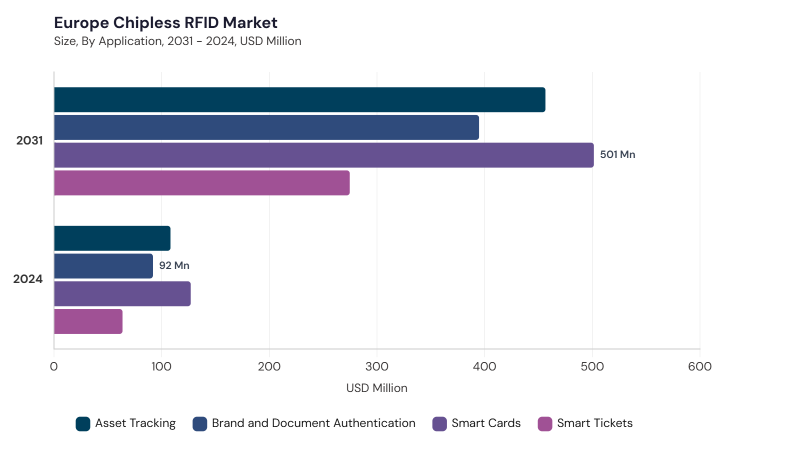
Based on Application, the market is segmented into Smart Cards, Asset Tracking, Brand and Document Authentication, and Smart Tickets. Smart Cards use chipless electromagnetic signatures to support contactless identification and authentication while reducing dependence on conventional semiconductor components. Asset Tracking followed as logistics, manufacturing, healthcare, and retail organizations increased focus on inventory visibility, equipment monitoring, container tracking, and supply-chain transparency.
Brand and Document Authentication is gaining importance as companies and public organizations strengthen anti-counterfeiting, product integrity, and secure-document verification through difficult-to-replicate electromagnetic patterns. Smart Tickets support high-volume contactless validation across public transit, sports, cultural venues, and event environments where scalability, low material use, and rapid verification are important.
Based on End-user Industry, the market is segmented into Retail and E-commerce, Logistics and Transportation, Healthcare and Pharmaceuticals, Banking, Financial Services and Insurance (BFSI), and Government and Public Sector. Retail and e-commerce applications focus on inventory accuracy, product authentication, automated processes, packaging-level identification, and supply-chain visibility. Logistics and Transportation use chipless RFID for container identification, shipment verification, asset monitoring, warehouse automation, and cross-border traceability.
Healthcare and Pharmaceuticals increasingly apply the technology to medical asset tracking, pharmaceutical authentication, cold-chain monitoring, and patient safety-related applications. BFSI utilizes chipless RFID primarily for secure documents, identity verification, fraud prevention, and sensitive asset protection, while Government and Public Sector applications include citizen identification, document authentication, public transportation, infrastructure monitoring, and smart city-related systems.
Free Valuable Insights: The Worldwide Chipless RFID Market is projected to reach USD 9818.4 Million billion by 2033, at a CAGR of 24.0%
Based on Country, the market is segmented into Germany, UK, France, Russia, Spain, Italy, and Rest of Europe. The Germany market dominated the Europe Chipless RFID Market by Country in 2025, and would continue to be a dominant market till 2033; thereby, achieving a market value of USD 367.9 million by 2031, growing at a CAGR of 22 % during the forecast period. The UK market is expected to witness a CAGR of 22.3% during (2026 - 2033). Additionally, The France market is expected to witness a CAGR of 24.5% during (2026 - 2033).
Across Europe, chipless RFID adoption is increasingly influenced by sustainability requirements, industrial digitalization, smart supply chains, and the need for scalable low-cost identification. Germany is emphasizing recyclable tags, sensor integration, circular-economy applications, and industrial IoT connectivity, while the UK is advancing flexible printed tags, multi-parameter sensing, and cold-chain monitoring solutions. France is strengthening smart materials, UWB-based designs, digital product applications, and IoT-enabled traceability, whereas Russia continues to focus on cost-efficient identification, environmental sensing, and localized industrial deployments. Spain is progressing through printable electronics, sensor networks, and application-specific IoT integration, while Italy is developing flexible tags, agricultural monitoring, collaborative platforms, and sustainable identification solutions. Rest of Europe is also expanding sustainable tags, advanced signal processing, multifunctional sensing, and digital supply-chain applications.

By Product
By Operating Frequency
By Material
By Application
By End-user Industry
By Country
Set to reach $1627.4 Million by 2031, growing at 23.5% CAGR during 2026-2033.
Germany leads with $367.9 million by 2031, growing at a 22% CAGR during the forecast period.
The Tag segment will reach $923.3 million by 2031, growing at a 23% CAGR during the forecast period.
The HF segment will reach $700.2 million by 2031, growing at a 22.8% CAGR during the forecast period.
The UK market is expected to witness a 22.3% CAGR during 2026-2033.
Graphene/Carbon Ink is expected to grow at a 24.6% CAGR during 2026-2033.
Our team of dedicated experts can provide you with attractive expansion opportunities for your business.




 Unique Offerings