The sample copy of this report is available for access.
“Global Chipless RFID Market to reach a market value of USD 9,818.48 Million by 2033 growing at a CAGR of 24%”
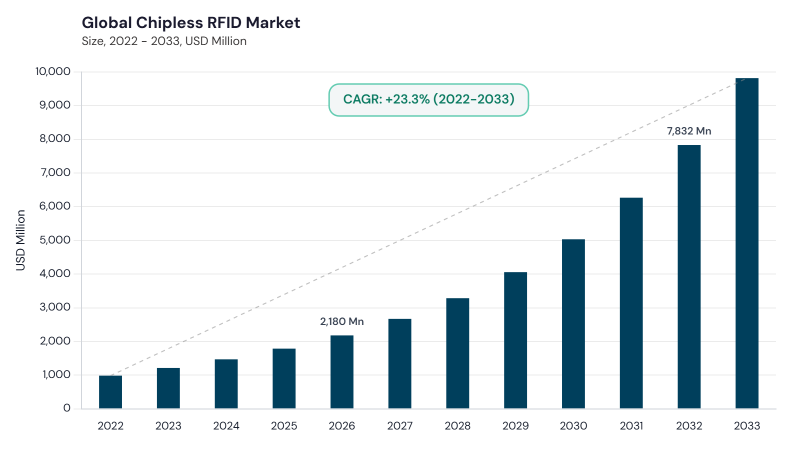
The Global Chipless RFID Market is expected to reach USD 9818.5 million by 2033, growing at a CAGR of 24% during (2026 – 2033).
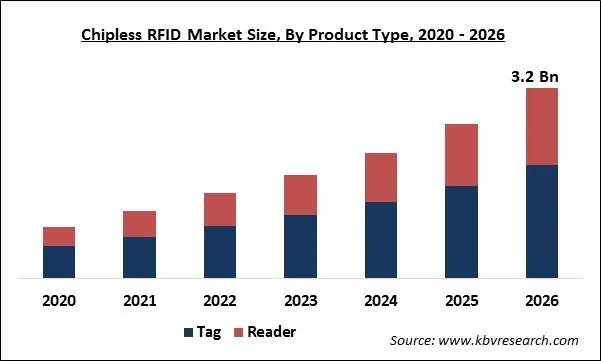
Demand is supported by the need for cost-effective, printable, and scalable identification and tracking solutions across retail, logistics, healthcare, manufacturing, packaging, and supply chains. Advances in conductive inks, flexible substrates, printable electronics, sensor-enabled tags, and smart packaging are strengthening technology development. Market participants are focusing on improved reading range, data capacity, sustainable materials, reliable signal detection, and integration with IoT-enabled tracking systems.
The chipless RFID industry has evolved from early silicon-based RFID concepts toward fully passive identification systems that encode information through electromagnetic signatures, resonant structures, and material properties. Development has increasingly focused on printable tags, orientation-independent structures, multifunctional sensing, and IoT integration. These advances are extending chipless RFID beyond identification toward environmental monitoring, authentication, smart packaging, inventory management, and intelligent asset tracking.
The competitive environment is primarily shaped by technology innovation, material science, signal processing, sensor integration, pricing, and interoperability. Market participants are investing in advanced encoding technologies, sustainable materials, improved reader systems, and partnerships with IoT platforms, system integrators, research institutions, and end-user industries. Competitive differentiation increasingly depends on balancing low tagging costs with reliable detection, scalability, environmental resilience, and application-specific functionality.
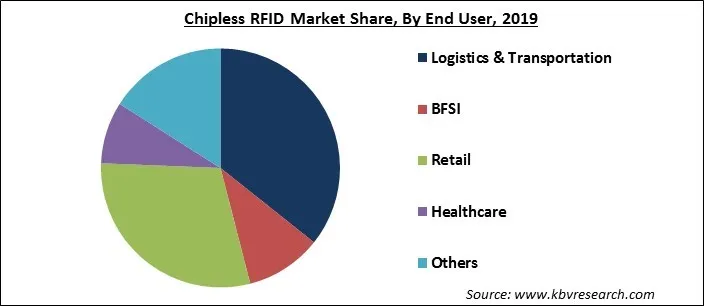


The Chipless RFID Market presents an innovation-driven competitive landscape characterized by specialized chipless RFID developers alongside broader RFID, authentication, smart packaging, and identification technology providers. TagSense maintains a direct specialization in chipless RFID readers, resonant tags, sensing labels, and licensed technologies, while PulpaTronics focuses on metal-free and silicon-free sustainable chipless RFID tags. Spectra Systems participates through chipless RFID-based authentication and anti-counterfeiting applications.
On the basis of Product, the Chipless RFID Market is classified into Tag, Reader, and Middleware. The Tag market dominated the Global Chipless RFID Market by Product in 2025, and would continue to be a dominant market till 2033; thereby, achieving a market value of USD 5515.5 million by 2033, growing at a CAGR of 23.5 % during the forecast period. The Reader market is expected to witness a CAGR of 24.5% during (2026 - 2033). The Middleware market is expected to witness a CAGR of 25% during (2026 - 2033).
Tags form the core identification layer and use printed inks, nanostructures, or resonant antenna patterns instead of integrated circuits, supporting scalable and low-cost deployments. Readers detect and decode the electromagnetic responses generated by chipless tags through specialized sensing and signal-processing technologies. Middleware connects tag and reader information with ERP, SCM, asset tracking, cloud, and analytics platforms, enabling real-time visibility and enterprise integration.
On the basis of Operating Frequency, the Chipless RFID Market is classified into HF, UHF, and LF. The HF market dominated the Global Chipless RFID Market by Operating Frequency in 2025, and would continue to be a dominant market till 2033; thereby, achieving a market value of USD 4171.3 million by 2033, growing at a CAGR of 23.3 % during the forecast period. The UHF market is expected to witness a CAGR of 24.4% during (2026 - 2033). Additionally, The LF market is expected to witness highest CAGR of 24.7% during (2026 - 2033).
HF supports moderate-range applications such as smart packaging, authentication, smart cards, and inventory management. UHF provides extended read ranges and faster identification for logistics, warehouse automation, supply chain management, and asset tracking. LF offers stable near-field performance in challenging environments involving metals and liquids, making it relevant for specialized access control and industrial identification applications.
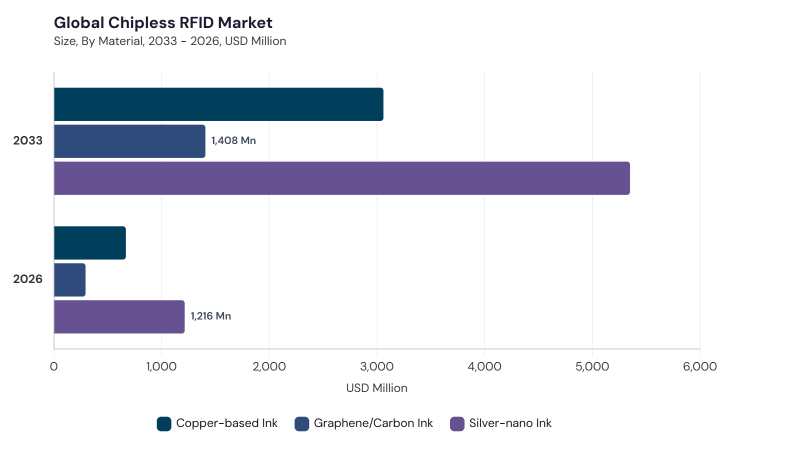
On the basis of Material, the Chipless RFID Market is classified into Silver-nano Ink, Copper-based Ink, and Graphene/Carbon Ink. The Silver-nano Ink market dominated the Global Chipless RFID Market by Material in 2025, and would continue to be a dominant market till 2033; thereby, achieving a market value of USD 5350.1 million by 2033, growing at a CAGR of 23.6 % during the forecast period. The Copper-based Ink market is expected to witness a CAGR of 24.3% during (2026 - 2033). The Graphene/Carbon Ink market is expected to witness a CAGR of 25% during (2026 - 2033).
Silver-nano Ink provides high electrical conductivity and printing accuracy for reliable resonator and antenna fabrication. Copper-based Ink offers a lower-cost conductive alternative suitable for large-volume applications, although oxidation resistance remains important. Graphene/Carbon Ink supports flexible, sustainable, and sensor-enabled chipless RFID designs, aligning with emerging requirements for environmentally responsible and multifunctional identification solutions.
On the basis of Application, the Chipless RFID Market is classified into Smart Cards, Asset Tracking, Brand and Document Authentication, and Smart Tickets. The Smart Cards market dominated the Global Chipless RFID Market by Application in 2025, and would continue to be a dominant market till 2033; thereby, achieving a market value of USD 2973.5 million by 2033, growing at a CAGR of 23 % during the forecast period. The Asset Tracking market is expected to witness a CAGR of 24.2% during (2026 - 2033). Additionally, The Brand and Document Authentication market is expected to witness highest CAGR of 24.6% during (2026 - 2033).
Smart Cards support secure identification, access control, and contactless applications, while Asset Tracking improves inventory visibility and supply chain monitoring. Brand and Document Authentication uses unique chipless signatures to strengthen anti-counterfeiting and product provenance, whereas Smart Tickets provide scalable and contactless identification across transportation, entertainment, and event-management applications.
On the basis of End-user Industry, the Chipless RFID Market is classified into Retail and E-commerce, Logistics and Transportation, Healthcare and Pharmaceuticals, Banking, Financial Services and Insurance (BFSI), and Government and Public Sector. The Retail and E-commerce market dominated the Global Chipless RFID Market by End-user Industry in 2025, and would continue to be a dominant market till 2033; thereby, achieving a market value of USD 2353.8 million by 2033, growing at a CAGR of 21.9 % during the forecast period. The Logistics and Transportation market is expected to witness a CAGR of 24.3% during (2026 - 2033). Additionally, The Healthcare and Pharmaceuticals market is expected to witness highest CAGR of 24.8% during (2026 - 2033).
Retail and E-commerce use chipless RFID for inventory visibility, loss prevention, fulfillment, and product traceability. Logistics applications emphasize shipment and asset tracking, while healthcare uses authentication and medical asset management. BFSI adoption centers on secure identification and document authentication, whereas government applications include identity management, public-sector asset tracking, secure documents, and smart infrastructure.
Free Valuable Insights: Chipless RFID Market Size to reach $9818.4 Million by 2033
Region-wise, the Chipless RFID Market is analyzed across North America, Europe, Asia Pacific, and LAMEA. The Asia Pacific market dominated the Global Chipless RFID Market by Region in 2025, and would continue to be a dominant market till 2033; thereby, achieving a market value of USD 3547.4 million by 2033, growing at a CAGR of 24.5 % during the forecast period. The North America market is expected to witness a CAGR of 23.3% during (2026 - 2033). Additionally, The Europe market is expected to witness a CAGR of 23.5% during (2026 - 2033).
Asia Pacific maintains the leading position, supported by expanding electronics manufacturing, industrialization, retail automation, logistics modernization, and smart-identification adoption. North America benefits from technology development and digital supply chain investment, while Europe is influenced by Industry 4.0, traceability requirements, and contactless identification. LAMEA continues developing through logistics modernization, retail digitalization, and expanding use of tracking and authentication technologies.
| Report Attribute | Details |
|---|---|
| Market size value in 2026 | USD 2179.5 million |
| Market size forecast in 2033 | USD 9818.4 million |
| Base Year | 2025 |
| Historical Period | 2022 to 2024 |
| Forecast Period | 2026 to 2033 |
| Revenue Growth Rate | CAGR of 24.0% from 2026 to 2033 |
| Number of Pages | 750 |
| Tables | 930 |
| Report Coverage | Market Trends, Revenue Estimation and Forecast, Segmentation Analysis, Regional and Country Breakdown, Competitive Landscape, Market Share Analysis, Company Profiling, Companies Strategic Developments, SWOT Analysis, Product Life Cycle Analysis, Value Chain Analysis, Market Consolidation Analysis, Key Customer Criteria, Pandemic Impact Analysis, and Winning Imperatives |
| Segments Covered | Product, Operating Frequency, Material, Application, End-user Industry, and Geography |
| Country Scope |
|
| Companies Included | TagSense, Inc.; Spectra Systems Corporation; TOPPAN Holdings Inc.; Stora Enso Oyj; Linxens; Tageos; IDTRONIC GmbH; Variuscard GmbH; PulpaTronics Ltd.; SML Group |
By Product
By Operating Frequency
By Material
By Application
By End-user Industry
By Geography
The market is expected to reach USD 9818.5 million by 2033, growing at 24.0% CAGR during 2026-2033.
The market is projected to grow at 24.0% CAGR during the forecast period (2026-2033).
TagSense, Inc., Spectra Systems Corporation, TOPPAN Holdings Inc., and Stora Enso Oyj are key players.
Cost-effective manufacturing techniques and enhanced supply chain transparency are key growth drivers.
The market is experiencing growth due to sustainability and environmental compliance demands.
The Global Chipless RFID Market size is expected to reach USD 9818.5 million by 2033.
Our team of dedicated experts can provide you with attractive expansion opportunities for your business.








 Unique Offerings