The sample copy of this report is available for access.
The LAMEA Automatic Fire Ball Extinguisher Market is expected to reach USD 87.6 million by 2029, growing at a CAGR of 7.8% during (2026 – 2033).
The LAMEA Automatic Fire Ball Extinguisher Market developed from the need for rapid, autonomous fire suppression across residential, commercial, and industrial environments. Early fire safety solutions in the region relied mostly on manual extinguishers and basic detection devices, which offered limited response when human intervention was delayed. Automatic fire ball extinguishers introduced a compact, self-activating format capable of dispersing suppressant agents when exposed to flame or high heat. Over time, heat-sensitive materials, improved packaging, durable casings, and eco-friendly agents strengthened product reliability.
The LAMEA Automatic Fire Ball Extinguisher Market is being shaped by stricter safety practices, urban construction, industrial expansion, fire-related risk awareness, and demand for automated protection in high-risk spaces. Commercial facilities, homes, warehouses, hotels, healthcare centers, oil and gas sites, power facilities, telecom spaces, and transportation assets are increasingly adopting compact fire suppression devices. Demand is supported by quick activation, simple deployment, reduced dependence on trained operators, and suitability for areas where conventional systems may be difficult to install. Vendors are focusing on sensor integration, non-toxic agents, humidity-resistant designs, localized support, and cost-efficient manufacturing.
Based on Application, the market is segmented into Commercial and Residential. The Commercial market dominated the LAMEA Automatic Fire Ball Extinguisher Market by Application in 2025, and would continue to be a dominant market till 2033; thereby, achieving a market value of USD 63.0 million by 2029, growing at a CAGR of 7.4 % during the forecast period. The Residential market is expected to witness a CAGR of 8.8% during (2026 - 2033).
Commercial applications lead due to the expansion of retail centers, office complexes, airports, hotels, hospitals, warehouses, industrial establishments, and public infrastructure across Latin America, the Middle East, and Africa. These spaces require fast and localized fire response to protect people, equipment, inventories, and business continuity. Residential adoption remains important as apartments, villas, gated communities, kitchens, garages, and multi-family housing projects increasingly include preventive fire safety products. This segment is supported by rising household safety awareness, urban housing growth, affordable product availability, and government initiatives promoting safer residential environments.
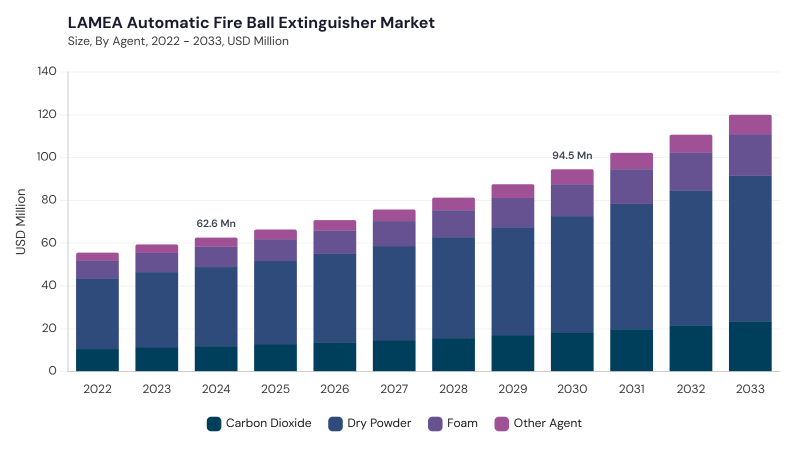
Based on Agent, the market is segmented into Dry Powder, Carbon Dioxide, Foam, and Other Agent. The Dry Powder market dominated the LAMEA Automatic Fire Ball Extinguisher Market by Agent in 2025, and would continue to be a dominant market till 2033; thereby, achieving a market value of USD 50.6 million by 2029, growing at a CAGR of 7.4 % during the forecast period. The Carbon Dioxide market is expected to witness a CAGR of 8.1% during (2026 - 2033). Additionally, The Foam market is expected to witness highest CAGR of 8.7% during (2026 - 2033).
Dry Powder leads due to its effectiveness across diverse fire scenarios and suitability for commercial buildings, industrial facilities, warehouses, construction sites, transportation infrastructure, and mixed-risk environments. Its durability under varied climatic conditions and ease of deployment make it well suited to LAMEA’s broad operating landscape. Carbon Dioxide remains significant in banks, telecom facilities, data rooms, healthcare centers, and electronic equipment areas where residue-free suppression is required. Foam supports oil and gas, petrochemical, mining, port, marine, and fuel storage applications, while Other Agent includes clean gases, wet chemicals, and eco-friendly materials for specialized fire protection needs.
Based on Fire Type, the market is segmented into Class C, Class A, Class B, Class K, and Class D. Class C leads due to the expansion of power generation, electrical distribution, telecommunications infrastructure, commercial buildings, and industrial modernization across the region. Growing electrification increases the need for automatic suppression devices that can protect energized electrical equipment.
Class A remains significant across schools, homes, offices, public buildings, and commercial premises where wood, paper, textiles, plastics, and other ordinary combustibles are common. Class B supports oil and gas, petrochemical, fuel storage, transportation, and marine applications, while Class K serves restaurants, hotels, and institutional kitchens. Class D addresses specialized risks in mining, metal processing, energy, and heavy engineering sectors.
Free Valuable Insights: Automatic Fire Ball Extinguisher Market Size Worth USD 1.5 Billion billion by 2033
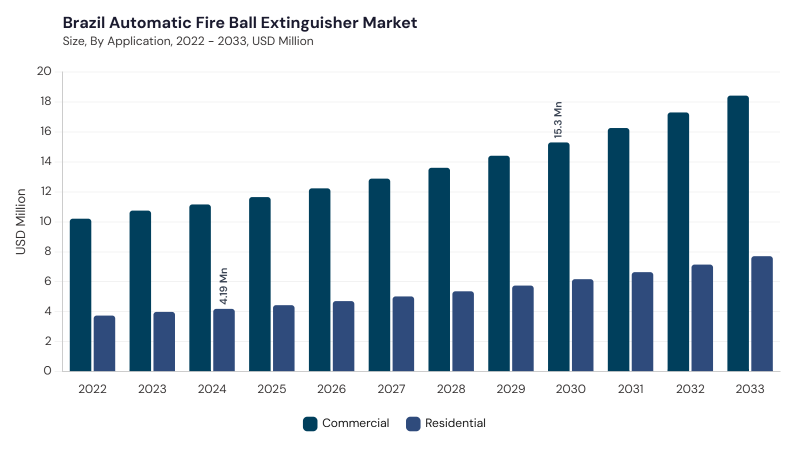
Based on Country, the market is segmented into Brazil, Argentina, UAE, Saudi Arabia, South Africa, Nigeria, and Rest of LAMEA. The Brazil market dominated the LAMEA Automatic Fire Ball Extinguisher Market by Country in 2025, and would continue to be a dominant market till 2033; thereby, achieving a market value of USD 20.2 million by 2029, growing at a CAGR of 6.4 % during the forecast period. The Argentina market is expected to witness a CAGR of 8.5% during (2026 - 2033). Additionally, The UAE market is expected to witness a CAGR of 6.7% during (2026 - 2033).
Brazil leads due to stronger fire safety mandates, industrial activity, transportation needs, residential adoption, and growing use of automated suppression products across commercial and public spaces. Argentina supports market growth through stricter urban safety enforcement, demand for certified automatic systems, eco-friendly agents, and smart fire safety integration. The UAE contributes through smart building projects, high-rise infrastructure, and drone-assisted deployment concepts, and advanced fire safety compliance. Saudi Arabia, South Africa, and Nigeria add momentum through industrial safety upgrades, oil and gas applications, vehicle safety awareness, urban development, and localized distribution networks, while Rest of LAMEA benefits from compact product designs, eco-conscious agents, and broader automated fire protection adoption.

By Application
By Agent
By Fire Type
By Country
Set to reach $87.6 Million by 2029, growing at 7.8% CAGR during (2026–2033).
Brazil leads with $20.2 million by 2029, maintaining dominance with a 6.4% CAGR during the forecast period.
The Residential segment is expected to grow at an 8.8% CAGR during (2026–2033).
The Commercial segment will reach $63.0 million by 2029, growing at a 7.4% CAGR during the forecast period.
The UAE market is expected to witness a CAGR of 6.7% during (2026–2033).
The Dry Powder segment will achieve $50.6 million by 2029, growing at a 7.4% CAGR during the forecast period.
Our team of dedicated experts can provide you with attractive expansion opportunities for your business.




 Unique Offerings