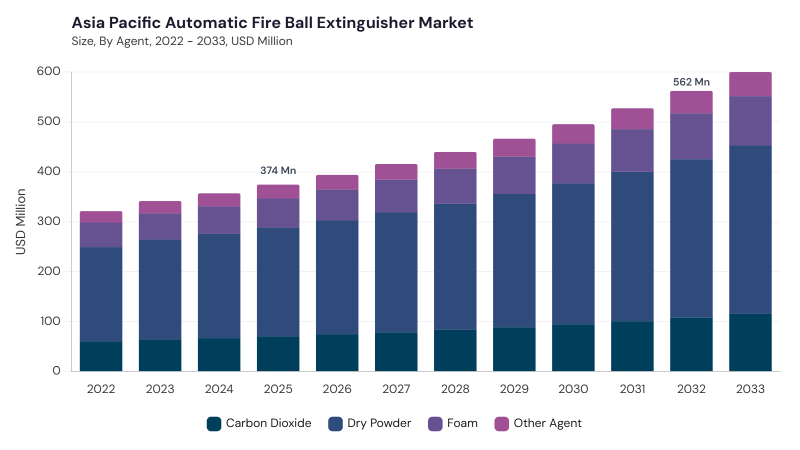
The Asia Pacific Automatic Fire Ball Extinguisher Market is expected to reach USD 495.6 million by 2030, growing at a CAGR of 6.2% during (2026 – 2033).
The Asia Pacific Automatic Fire Ball Extinguisher Market evolved from early efforts to create compact, self-activating fire suppression devices for high-risk spaces. Initial products relied on chemical agents enclosed in durable spherical casings that could activate when exposed to flame or high heat. Adoption was first concentrated in industrial and commercial locations where rapid response and easy placement were important. Over time, improvements in sensor precision, wireless connectivity, fire-retardant materials, and eco-friendly agents enhanced product reliability and widened market use.
The Asia Pacific Automatic Fire Ball Extinguisher Market is being shaped by infrastructure expansion, industrial growth, stricter fire safety compliance, smart city development, and rising awareness among SMEs and households. Commercial facilities, public infrastructure, residential towers, manufacturing units, warehouses, data centers, hotels, and educational campuses are increasingly adopting compact automatic suppression products. Demand is supported by quick activation, easy installation, minimal manual intervention, lower maintenance needs, and suitability for confined or hard-to-access areas. Vendors are focusing on smart sensors, AI-enabled risk alerts, non-toxic agents, modular designs, localized production, and compatibility with safety management systems.
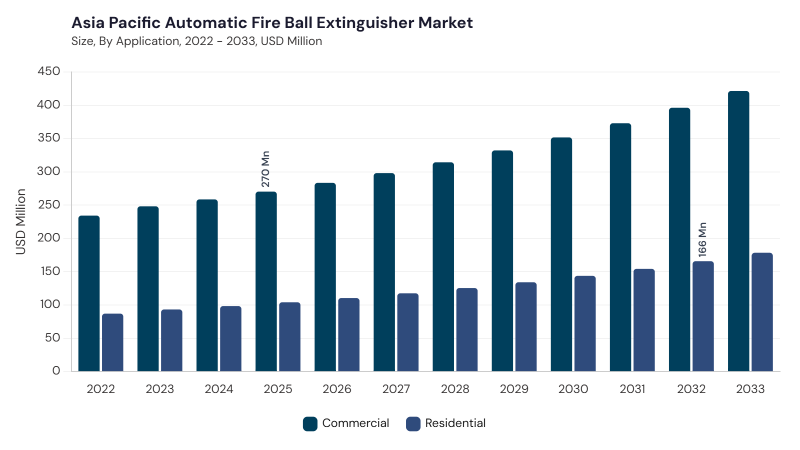
Based on Application, the market is segmented into Commercial and Residential. The Commercial market dominated the Asia Pacific Automatic Fire Ball Extinguisher Market by Application in 2025, and would continue to be a dominant market till 2033; thereby, achieving a market value of USD 351.7 million by 2030, growing at a CAGR of 5.8 % during the forecast period. The Residential market is expected to witness a CAGR of 7.1% during (2026 - 2033).
Commercial applications lead due to rapid urbanization, expanding business districts, industrial parks, shopping complexes, hospitals, schools, logistics hubs, and smart commercial buildings. These facilities require automated and localized fire suppression solutions that can contain early fire incidents without depending on human response. Residential adoption remains important as high-rise apartments, gated communities, kitchens, garages, and living spaces increasingly incorporate preventive safety devices. This segment is supported by rising safety awareness, improved affordability, urban housing growth, smart home integration, and demand for compact fire protection products.
Based on Agent, the market is segmented into Dry Powder, Carbon Dioxide, Foam, and Other Agent. The Dry Powder market dominated the Asia Pacific Automatic Fire Ball Extinguisher Market by Agent in 2025, and would continue to be a dominant market till 2033; thereby, achieving a market value of USD 282.3 million by 2030, growing at a CAGR of 5.7 % during the forecast period. The Carbon Dioxide market is expected to witness a CAGR of 6.5% during (2026 - 2033). Additionally, The Foam market is expected to witness highest CAGR of 6.9% during (2026 - 2033).
Dry Powder leads due to its adaptability across residential, commercial, industrial, transportation, and electrical risk environments. Its multi-fire-class suitability, economical installation, and relatively simple maintenance support broad deployment across both developed and emerging economies. Carbon Dioxide remains significant in offices, data centers, laboratories, telecom facilities, electronics manufacturing plants, and electrical rooms where residue-free suppression is required. Foam supports petrochemical sites, ports, airports, warehouses, manufacturing units, and facilities handling combustible liquids, while Other Agent includes clean agents, aerosols, and hybrid compounds used in sensitive or specialized fire protection environments.
Based on Fire Type, the market is segmented into Class C, Class A, Class B, Class K, and Class D. Class C leads due to the rapid expansion of electrical infrastructure, electronics manufacturing, power distribution networks, renewable energy projects, telecom systems, and digital connectivity across the region. Rising dependence on energized equipment increases demand for automatic suppression solutions designed for electrical fire risks.
Class A remains significant across homes, schools, offices, public buildings, and commercial spaces where ordinary combustibles are widely present. Class B supports chemical, automotive, oil and gas, aviation, and manufacturing fire protection, while Class K serves kitchens and foodservice facilities. Class D addresses specialized fire risks in metal processing, mining, aerospace, and advanced manufacturing operations.
Free Valuable Insights: Automatic Fire Ball Extinguisher Market is Predicted to reach USD 1.5 Billion billion by 2033, at a CAGR of 5.8%
Based on Country, the market is segmented into China, Japan, India, South Korea, Australia, Malaysia, and Rest of Asia Pacific. The China market dominated the Asia Pacific Automatic Fire Ball Extinguisher Market by Country in 2025, and would continue to be a dominant market till 2033; thereby, achieving a market value of USD 143.4 million by 2030, growing at a CAGR of 4.4 % during the forecast period. The Japan market is expected to witness a CAGR of 5.2% during (2026 - 2033). Additionally, The India market is expected to witness a CAGR of 6.8% during (2026 - 2033).
China leads due to large-scale urban construction, industrial expansion, domestic manufacturing strength, smart fire detection adoption, and rising use of automatic suppression devices in commercial, residential, and public infrastructure. Japan supports growth through stringent safety standards, smart fire safety integration, eco-friendly agents, drone-assisted suppression concepts, and demand from dense urban facilities. India is advancing through fire safety compliance, local manufacturing, public infrastructure growth, and wider adoption across commercial and residential buildings. South Korea, Australia, and Malaysia add momentum through smart sensor use, regulatory upgrades, sustainability-focused agents, hospitality and industrial safety demand, and localized product design, while Rest of Asia Pacific benefits from infrastructure modernization and broader automated fire safety adoption.

By Application
By Agent
By Fire Type
By Country
Set to reach $495.6 Million by 2030, growing at 6.2% CAGR during 2026-2033.
China leads with $143.4 million by 2030, growing at a 4.4% CAGR during the forecast period.
Rising adoption in residential applications, expected to grow at a 7.1% CAGR during 2026-2033.
Commercial segment to reach $351.7 million by 2030, growing at a 5.8% CAGR during the forecast period.
India market is expected to witness a CAGR of 6.8% during 2026-2033.
Foam segment expected to witness the highest CAGR of 6.9% during 2026-2033.
Our team of dedicated experts can provide you with attractive expansion opportunities for your business.




 Unique Offerings