The sample copy of this report is available for access.
The Europe Automatic Fire Ball Extinguisher Market is expected to reach USD 348.1 million by 2031, growing at a CAGR of 5.4% during (2026 – 2033).
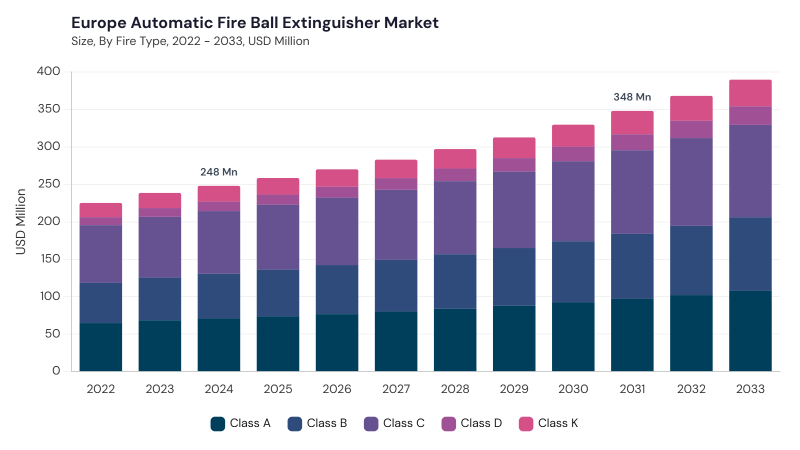
The Europe Automatic Fire Ball Extinguisher Market emerged from the region’s broader shift toward passive and automated fire suppression technologies. Earlier fire safety practices depended mainly on manual extinguishers, fire blankets, and conventional suppression systems that required timely human response. Automatic fire ball extinguishers introduced a self-activating format that could respond quickly when exposed to flame or high heat. Over time, improvements in heat-sensitive activation, chemical suppression agents, compact product design, and safety certification strengthened product acceptance.
The Europe Automatic Fire Ball Extinguisher Market is being shaped by stricter fire safety codes, sustainability rules, smart building adoption, public safety investment, and demand for low-maintenance automated protection. Commercial buildings, residential properties, hospitals, transportation facilities, industrial sites, data centers, and public infrastructure are increasingly adopting localized fire suppression solutions. Demand is supported by rapid activation, compact installation, reduced dependence on manual operation, and compatibility with different fire risk environments. Vendors are focusing on advanced sensors, IoT-enabled monitoring, biodegradable suppressants, nanotechnology-based agents, and improved dispersion performance.
Based on Application, the market is segmented into Commercial and Residential. The Commercial market dominated the Europe Automatic Fire Ball Extinguisher Market by Application in 2025, and would continue to be a dominant market till 2033; thereby, achieving a market value of USD 246.3 million by 2031, growing at a CAGR of 5 % during the forecast period. The Residential market is expected to witness a CAGR of 6.3% during (2026 - 2033).
Commercial applications lead due to rigorous fire protection requirements across offices, manufacturing facilities, hotels, public buildings, healthcare sites, educational institutions, warehouses, and transportation hubs. These locations need automated suppression devices that can limit fire spread before manual response begins. Residential adoption remains important as households seek easy-to-install fire protection for kitchens, garages, utility rooms, apartments, and multi-family dwellings. This segment is supported by renovation activity, rising household safety awareness, compact product availability, and increasing acceptance of self-activating safety devices.
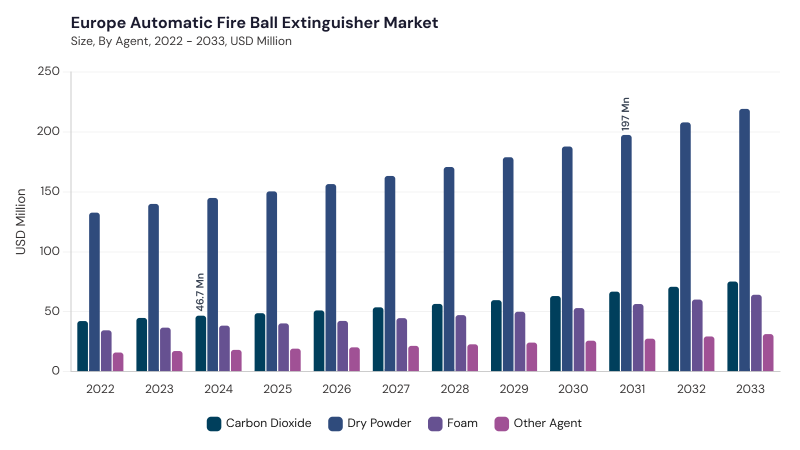
Based on Agent, the market is segmented into Dry Powder, Carbon Dioxide, Foam, and Other Agent. The Dry Powder market dominated the Europe Automatic Fire Ball Extinguisher Market by Agent in 2025, and would continue to be a dominant market till 2033; thereby, achieving a market value of USD 197.5 million by 2031, growing at a CAGR of 4.9 % during the forecast period. The Carbon Dioxide market is expected to witness a CAGR of 5.7% during (2026 - 2033). Additionally, The Foam market is expected to witness highest CAGR of 6.1% during (2026 - 2033).
Dry Powder leads due to its broad use across industrial plants, commercial complexes, warehouses, transportation facilities, and utility infrastructure where multiple fire hazards may be present. Its versatility, rapid suppression capability, and alignment with European safety requirements support sustained deployment. Carbon Dioxide remains significant in server rooms, research labs, healthcare facilities, IT centers, and electrical spaces where residue-free suppression is preferred. Foam supports flammable liquid protection in chemical, aviation, marine, logistics, and energy facilities, while Other Agent includes clean agents, aerosols, and specialized eco-friendly compounds for sensitive and high-value environments.
Based on Fire Type, the market is segmented into Class C, Class A, Class B, Class K, and Class D. Class C leads due to Europe’s advanced electrical infrastructure, data centers, renewable energy systems, automated factories, telecom networks, and digital communication assets requiring dependable protection against electrical fire incidents. Class A remains significant across residential areas, schools, public institutions, heritage properties, offices, and retail spaces where ordinary combustibles are widely present.
Class B supports fire safety in automotive, chemical, aviation, petroleum, and logistics environments involving flammable liquids. Class K serves hotels, restaurants, catering facilities, and institutional kitchens, while Class D addresses specialized metal fire risks in aerospace, defense, engineering, and metal processing operations.
Free Valuable Insights: The Worldwide Automatic Fire Ball Extinguisher Market is projected to reach USD 1.5 Billion billion by 2033, at a CAGR of 5.8%
Based on Country, the market is segmented into Germany, UK, France, Russia, Spain, Italy, and Rest of Europe. The Germany market dominated the Europe Automatic Fire Ball Extinguisher Market by Country in 2025, and would continue to be a dominant market till 2033; thereby, achieving a market value of USD 61.2 million by 2031, growing at a CAGR of 3.8 % during the forecast period. The UK market is expected to witness a CAGR of 4.4% during (2026 - 2033). Additionally, The France market is expected to witness a CAGR of 6.1% during (2026 - 2033).
Germany leads due to strong fire safety regulation, industrial automation, smart sensor adoption, eco-friendly suppressant demand, and wider use of automated fire protection in commercial, industrial, residential, and automotive settings. The UK supports market growth through strict building safety requirements, smart fire suppression adoption, environmental agent reformulation, and demand across industrial, commercial, and residential facilities. France contributes through IoT-enabled fire detection, regulatory compliance, public building safety upgrades, and sustainability-focused product development. Russia, Spain, and Italy add demand through localized certification, smart building integration, commercial infrastructure modernization, and eco-friendly agent adoption, while Rest of Europe benefits from micro fire suppression systems, connected safety platforms, and growing demand for compact automated protection.

By Application
By Agent
By Fire Type
By Country
Set to reach $348.1 Million by 2031, growing at 5.4% CAGR during 2026-2033.
Germany leads with $61.2 million by 2031, growing at a CAGR of 3.8% during the forecast period.
Rising adoption in commercial applications, projected to reach $246.3 million by 2031 at 5% CAGR.
Dry Powder segment to reach $197.5 million by 2031, growing at a CAGR of 4.9% during the forecast period.
The UK market is expected to witness a CAGR of 4.4% during 2026-2033.
The Residential segment is expected to witness a CAGR of 6.3% during 2026-2033.
Our team of dedicated experts can provide you with attractive expansion opportunities for your business.




 Unique Offerings