The sample copy of this report is available for access.
The LAMEA Automated Optical Inspection Systems Market is expected to reach USD 102.3 million by 2029, growing at a CAGR of 10.6% during (2026 – 2033).
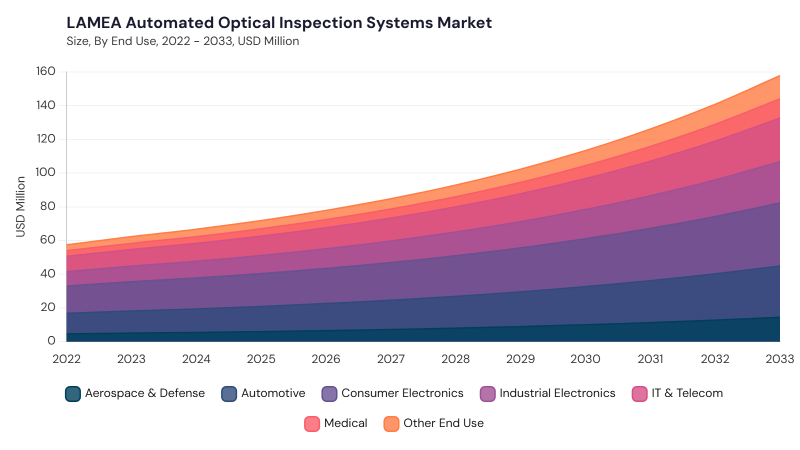
The LAMEA Automated Optical Inspection Systems Market developed as manufacturers across Latin America, the Middle East, and Africa began replacing manual visual checks with automated quality inspection tools. Early inspection activity relied on basic optical devices and human assessment, which limited throughput and created variation in defect identification. As imaging sensors, computational processing, high-resolution cameras, and image analysis software improved, AOI systems became more practical for PCB inspection and electronic component quality control. The market gradually shifted from standalone inspection equipment toward connected platforms that support real-time data sharing with manufacturing systems.
The LAMEA Automated Optical Inspection Systems Market is being shaped by AI-based defect detection, compact system designs, smart factory adoption, flexible AOI configurations, and rising demand for cost-efficient production automation. Manufacturers are adopting AOI systems to improve inspection speed, reduce false positives, lower rework, and support quality consistency across electronics, automotive, telecom, industrial, and healthcare applications. Demand is supported by expanding electronics assembly, automotive electronics, connected devices, data infrastructure, defense modernization, and healthcare equipment production. Vendors are focusing on machine vision, deep learning, modular architectures, real-time analytics, regional customization, and stronger after-sales support.
Based on Type, the market is segmented into 2D AOI and 3D AOI. The 2D AOI market dominated the LAMEA Automated Optical Inspection Systems Market by Type in 2025, and would continue to be a dominant market till 2033; thereby, achieving a market value of USD 55.9 million by 2029, growing at a CAGR of 10.1 % during the forecast period. The 3D AOI market is expected to witness a CAGR of 11.2% during (2026 - 2033).
2D AOI leads due to affordability, easier deployment, faster inspection speed, and broad use in PCB inspection across developing electronics manufacturing facilities. These systems are widely adopted to identify visible defects, solder issues, missing components, surface anomalies, and component misalignment in standard assembly environments. 3D AOI is gaining traction as manufacturers invest in higher-precision inspection for complex assemblies, high-value industrial electronics, automotive modules, aerospace systems, and medical devices. Its ability to assess height, coplanarity, solder volume, and surface topology makes it valuable where reliability, certification, and dimensional accuracy are essential.
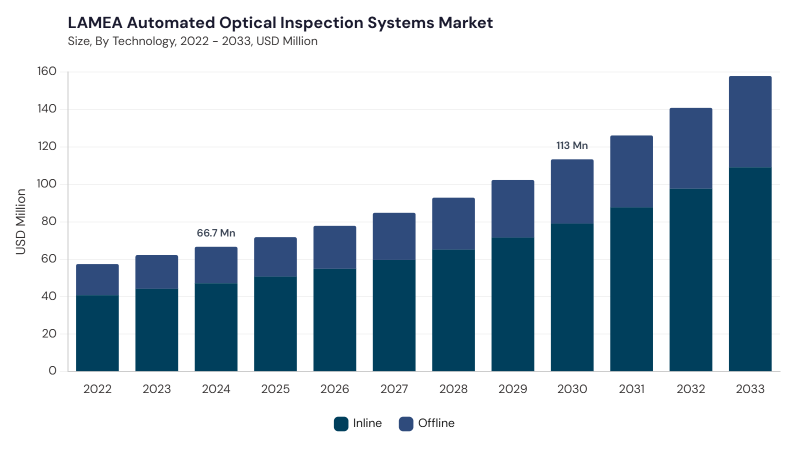
Based on Technology, the market is segmented into Inline and Offline. The Inline market dominated the LAMEA Automated Optical Inspection Systems Market by Technology in 2025, and would continue to be a dominant market till 2033; thereby, achieving a market value of USD 71.6 million by 2029, growing at a CAGR of 10.3 % during the forecast period. The Offline market is expected to witness a CAGR of 11.3% during (2026 - 2033).
Inline AOI leads due to rising automation, real-time quality assurance, smart production adoption, and the need to reduce defects during active manufacturing. These systems support immediate inspection feedback, lower scrap, better throughput, and stronger synchronization with production workflows. Inline inspection is increasingly relevant for PCB assembly, automotive electronics, telecom equipment, industrial electronics, and consumer device manufacturing. Offline AOI remains important for prototype testing, low-volume production, maintenance inspection, laboratory quality checks, and detailed defect analysis where flexible deployment and lower integration complexity are preferred.
Based on End Use, the market is segmented into Consumer Electronics, Automotive, IT & Telecom, Industrial Electronics, Aerospace & Defense, Medical, and Other End Use. Consumer Electronics leads due to growing demand for smartphones, home appliances, wearables, connected devices, and regional electronics assembly activities requiring dependable inspection. Automotive follows as vehicle production, electronic control systems, EV components, lighting assemblies, sensors, and safety-related modules increase quality assurance needs.
IT & Telecom benefits from digital transformation, expanding communication infrastructure, network equipment, data connectivity, and telecom electronics production. Industrial Electronics, Aerospace & Defense, Medical, and Other End Use areas add demand through automation equipment, energy systems, defense electronics, avionics, diagnostic devices, medical electronics, transportation, mining, research, and specialized industrial inspection requirements.
Free Valuable Insights: Automated Optical Inspection Systems Market Size Worth USD 1.8 Billion billion by 2033
Based on Country, the market is segmented into Brazil, Argentina, UAE, Saudi Arabia, South Africa, Nigeria, and Rest of LAMEA. The Brazil market dominated the LAMEA Automated Optical Inspection Systems Market by Country in 2025, and would continue to be a dominant market till 2033; thereby, achieving a market value of USD 22.5 million by 2029, growing at a CAGR of 9 % during the forecast period. The Argentina market is expected to witness a CAGR of 12.1% during (2026 - 2033). Additionally, The UAE market is expected to witness a CAGR of 9.7% during (2026 - 2033).
Brazil leads due to growing electronics, automotive, industrial, and smart factory activity, along with rising adoption of AI-driven inspection and real-time quality monitoring. Argentina supports market growth through PCB inspection modernization, inline inspection adoption, international quality compliance, and demand from electronics and automotive manufacturing. The UAE contributes through Industry 4.0 programs, advanced manufacturing, AI-powered AOI, aerospace activity, and demand for robust inspection systems suited to Gulf operating conditions. Saudi Arabia, South Africa, and Nigeria add momentum through industrial diversification, automation programs, localized manufacturing, smart factory adoption, and quality improvement initiatives, while Rest of LAMEA benefits from broader industrial digitization and electronics assembly growth.

By Type
By Technology
By End Use
By Country
Set to reach $102.3 Million by 2029, growing at 10.6% CAGR during 2026–2033.
Brazil leads with $22.5 million by 2029, growing at 9% CAGR during the forecast period.
The 2D AOI segment will reach $55.9 million by 2029, growing at 10.1% CAGR during the forecast period.
Inline technology will reach $71.6 million by 2029, growing at 10.3% CAGR during the forecast period.
The UAE market is expected to witness a CAGR of 9.7% during 2026-2033.
The 3D AOI segment is expected to witness a CAGR of 11.2% during 2026-2033.
Our team of dedicated experts can provide you with attractive expansion opportunities for your business.




 Unique Offerings