The sample copy of this report is available for access.
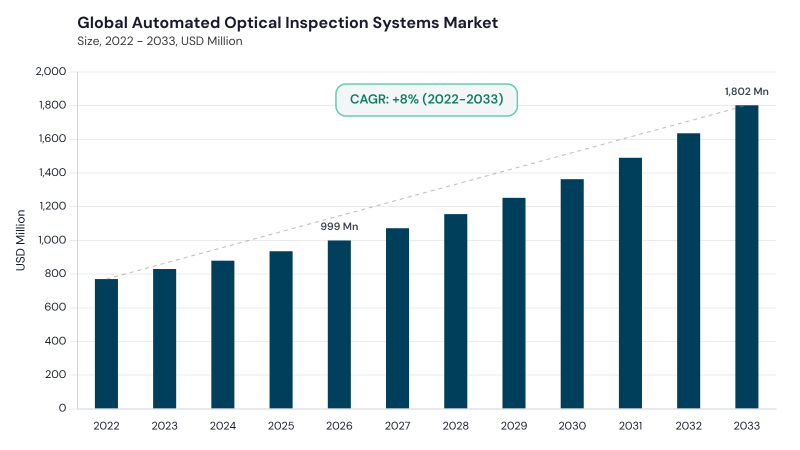
“Global Automated Optical Inspection Systems Market to reach a market value of USD 1,802.34 Million by 2033 growing at a CAGR of 8.8%”
The Global Automated Optical Inspection Systems Market is expected to reach USD 1.8 billion by 2033, growing at a CAGR of 8.8% during (2026 - 2033).
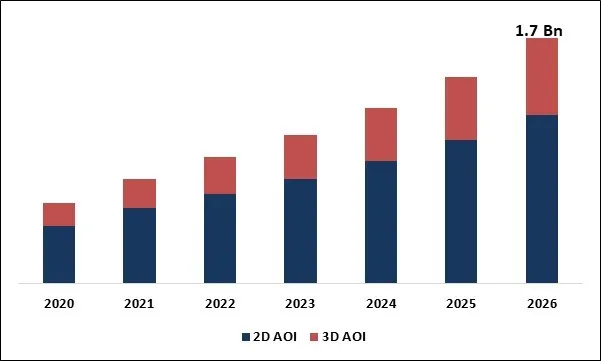
Automated optical inspection systems market is shaped by rising demand for accurate, reliable and fast defect detection across automotive, semiconductor, industrial manufacturing, electronics, and medical device applications. Demand is also growing as manufacturers focus on reduced production errors, product quality, lower inspection costs, and higher production efficiency. The market evolved as industries shifted from manual visual inspection toward automated quality control. With time, multi-angle inspection, higher-resolution cameras, product-line integration, and faster image processing integration enhanced inspection reliability.
Automated optical inspection system market is expanding as manufacturers largely adopt automated inspection to reduce false calls, enhance yield, minimize manual inspection dependency, and support traceability. Machine learning and AI are transforming AOI systems by miniaturized electronics, semiconductor packaging, complex PCB assemblies, electric vehicles, and stricter quality expectations across regulated industries.
Market’s competitive landscape is technology-intensive, driven by industrial automation companies, specialized AOI manufacturers, semiconductor inspection solution suppliers, and machine vision providers. Market players compete through inspection accuracy, 3D imaging, AI-based defect classification, integration with MES platforms, faster throughput, and lifecycle support. Market competition is further supported by rising demand for connected quality assurance systems, and smart factory adoption.
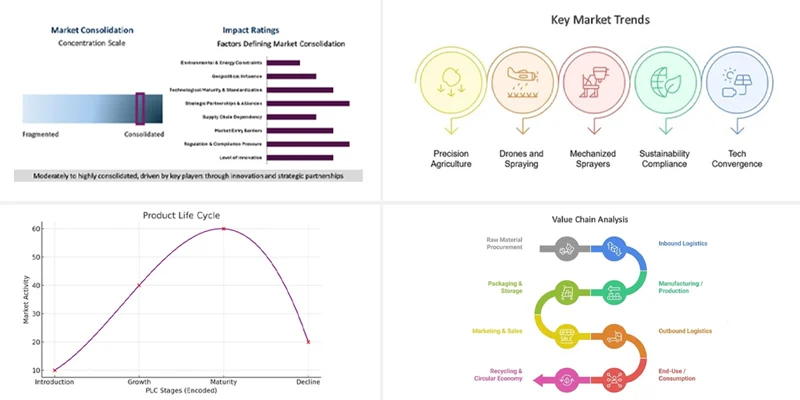

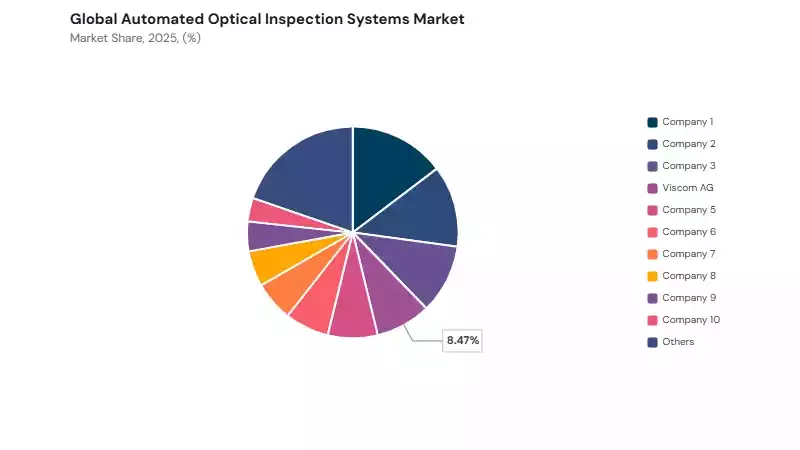
Automated optical inspection systems market represents a moderately consolidated market supported by industrial automation companies, and machine vision solution providers. Omron Corporation and Koh Young Technology maintain strong leadership through machine vision expertise, manufacturing automation integration, and advanced AOI platforms. Viscom, Test Research, Nordson Corporation, Saki, Camtek, and GOPEL electronic further support competition through SPI, 3D AOI, AXI, semiconductor inspection, high-precision metrology capabilities, and smart factory integration.
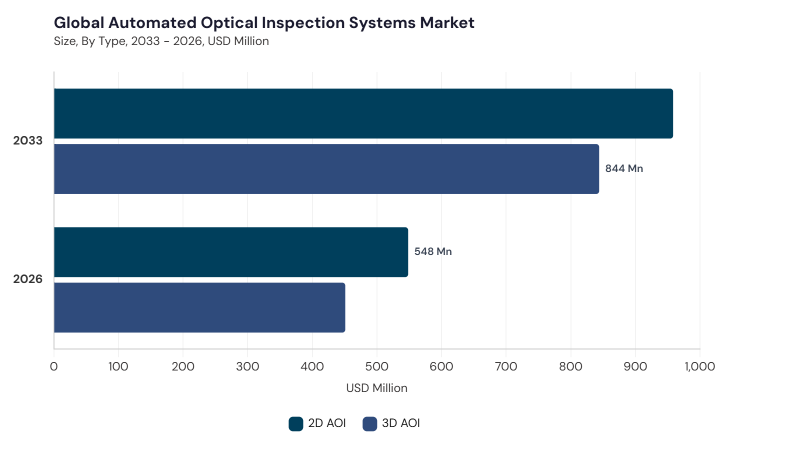
Based on Type, the market is segmented into 2D AOI and 3D AOI. The 2D AOI market dominated the Global Automated Optical Inspection Systems Market by Type in 2025, and would continue to be a dominant market till 2033; thereby, achieving a market value of USD 958.4 million by 2033, growing at a CAGR of 8.3 % during the forecast period. The 3D AOI market is expected to witness a CAGR of 9.4% during (2026 - 2033).
3D AOI is gaining strong traction as electronic assemblies become more compact, complex, and densely packed. These systems provide depth measurement, volumetric analysis, component height inspection, coplanarity verification, and improved solder joint evaluation. Demand for 3D AOI is rising across automotive electronics, semiconductor packaging, aerospace electronics, and advanced consumer electronics where inspection accuracy and process control are critical.
Based on Technology, the market is segmented into Inline and Offline. The Inline market dominated the Global Automated Optical Inspection Systems Market by Technology in 2025, and would continue to be a dominant market till 2033; thereby, achieving a market value of USD 1.2 billion by 2033, growing at a CAGR of 8.5 % during the forecast period. The Offline market is expected to witness a CAGR of 9.4% during (2026 - 2033).
Offline AOI remains important for prototype inspection, first article inspection, product validation, failure analysis, and low-volume or high-mix production environments. These systems provide flexibility where manufacturers require detailed operator-controlled inspection outside the main production line. Offline AOI also supports R&D, customized electronics manufacturing, process development, and specialized inspection requirements.
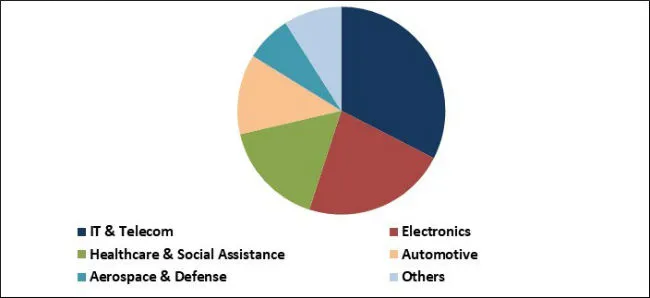
Based on End Use, the market is segmented into Consumer Electronics, Automotive, IT & Telecom, Industrial Electronics, Aerospace & Defense, Medical, and Other End Use. The Consumer Electronics market dominated the Global Automated Optical Inspection Systems Market by End Use in 2025, and would continue to be a dominant market till 2033; thereby, achieving a market value of USD 423.1 million by 2033, growing at a CAGR of 6.9 % during the forecast period. The Automotive market is expected to witness a CAGR of 7.8% during (2026 - 2033). Additionally, The IT & Telecom market is expected to witness highest CAGR of 9.1% during (2026 - 2033).
Automotive demand is supported by increasing use of electronic control units, sensors, ADAS modules, infotainment systems, battery management systems, and electric vehicle components. IT & Telecom benefits from demand for reliable networking hardware, servers, 5G equipment, and communication devices. Industrial Electronics, Aerospace & Defense, Medical, and Other End Use continue adopting AOI systems to support reliability, compliance, safety, and precision manufacturing.
Free Valuable Insights: Automated Optical Inspection Systems Market Size to reach $1.8 Billion by 2033
Region-wise, the Automated Optical Inspection Systems Market is analyzed across North America, Europe, Asia Pacific, and LAMEA. APAC region dominated the automated optical inspection systems market and is estimated to continue the same till 2033, by achieving a market value of USD 834.3 million with a CAGR of 9.1% in the projection period. The North America market is predicted to expand at a CAGR of 8% during 2026-2033. Moreover, the Europe market is estimated to grow at a CAGR of 8.3% during the forecast period.
Europe is driven by industrial automation, automotive electronics, medical technology, strict quality standards, and aerospace manufacturing. Asia Pacific remains a key manufacturing hub because of semiconductor activity, large-scale electronics production, expanding industrial automation investments, and consumer electronics assembly. Moreover, LAMEA is developing through industrial modernization, electronics manufacturing expansion, increasing demand for automated quality control, and infrastructure investment.
| Report Attribute | Details |
|---|---|
| Market size value in 2026 | USD 999.4 million |
| Market size forecast in 2033 | USD 1.8 billion |
| Base Year | 2025 |
| Historical Period | 2022 to 2024 |
| Forecast Period | 2026 to 2033 |
| Revenue Growth Rate | CAGR of 8.8% from 2026 to 2033 |
| Number of Pages | 563 |
| Tables | 660 |
| Report Coverage | Market Trends, Revenue Estimation and Forecast, Segmentation Analysis, Regional and Country Breakdown, Competitive Landscape, Market Share Analysis, Company Profiling, Companies Strategic Developments, SWOT Analysis, Product Life Cycle Analysis, Value Chain Analysis, Market Consolidation Analysis, Key Customer Criteria, Pandemic Impact Analysis, and Winning Imperatives |
| Segments Covered | Type, Technology, End Use, and Geography |
| Country Scope |
|
| Companies Included | Koh Young Technology Inc.; Omron Corporation; Nordson Corporation (CyberOptics); Viscom AG; Saki Corporation; MIRTEC Co., Ltd.; Test Research, Inc. (TRI); ViTrox Corporation Berhad; Camtek Ltd.; GÖPEL electronic GmbH |
By Type
By Technology
By End Use
By Geography
The market is expected to reach USD 1.8 billion by 2033, growing at 8.8% CAGR during 2026-2033.
Inline AOI systems lead, projected to achieve USD 1.2 billion by 2033.
Koh Young Technology, Omron, Nordson, Viscom, Saki, MIRTEC, TRI, ViTrox, Camtek, GÖPEL electronic.
Enhanced manufacturing efficiency and quality control, and AI integration drive market growth.
The market grows at 8.8% CAGR during the forecast period (2026-2033).
They enable real-time inspection, improve throughput, reduce errors, and support automated quality assurance.
Our team of dedicated experts can provide you with attractive expansion opportunities for your business.








 Unique Offerings