The sample copy of this report is available for access.
The LAMEA Anti Stretch Mark Products Market is expected to reach USD 160.4 Million by 2029, growing at a CAGR of 6% during 2026 - 2033.
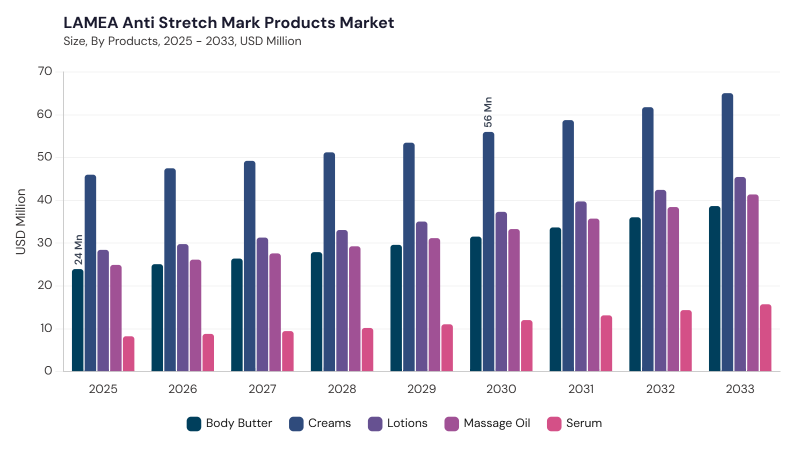
The LAMEA Anti Stretch Mark Products Market is witnessing steady growth, supported by rising maternity care awareness, growing beauty and wellness spending, increasing urban retail access, post-pregnancy skincare needs, body moisturization habits, premium personal care adoption, and stronger consumer focus on skin comfort, nourishment, and appearance management.
The current market is shaped by multifunctional products, digital marketing channels, direct-to-consumer engagement, natural ingredients, bioactive formulations, controlled-release delivery systems, and stronger demand for transparent, safe, and effective skincare solutions. Consumers across LAMEA are increasingly seeking products that combine prevention, hydration, nourishment, stretch mark reduction, and skin comfort in formats suitable for daily use. Brands are responding through dermatologist partnerships, localized marketing, regional ingredient sourcing, premium and mass-market product ranges, e-commerce expansion, sustainability initiatives, and formulations adapted to tropical climates, diverse skin phototypes, and culturally familiar skincare routines.
Based on products, the market is segmented into Creams, Lotions, Massage Oil, Body Butter, and Serum. The Creams market dominated the LAMEA Anti Stretch Mark Products Market by Products in 2025, and would continue to be a dominant market till 2033; thereby, achieving a market value of $ 53.5 million by 2029, growing at a CAGR of 4.6 % during the forecast period. The Lotions market is expected to witness a CAGR of 6.2% during (2026 - 2033). Additionally, The Massage Oil market is expected to witness highest CAGR of 6.8% during (2026 - 2033).
Creams represent the foremost product category, supported by rich hydration, targeted use, consumer familiarity, and suitability for pregnancy, postpartum care, weight-related skin changes, and everyday body-care routines. Lotions form a significant category, driven by smooth application, lighter feel, quick absorption, and convenience for regular use across larger skin areas. Massage Oil serves a distinct role, supported by skin softness, relaxation-led application, maternity massage practices, and preference for oil-based nourishment in several local markets. Body Butter maintains consistent demand, favored for intensive moisture, dense texture, and appeal among consumers with dry skin or those seeking longer-lasting comfort. Serum serves a selective premium category, supported by concentrated ingredients, refined texture, advanced skincare positioning, and demand from consumers looking for focused stretch mark care.
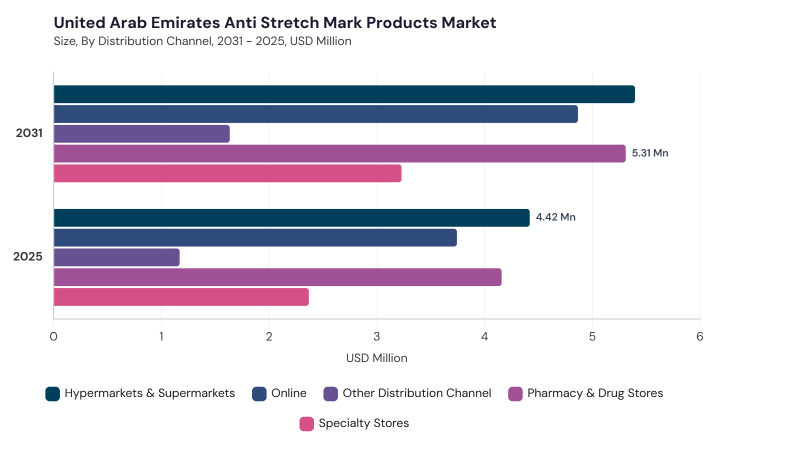
Based on distribution channel, the market is segmented into Hypermarkets & Supermarkets, Pharmacy & Drug Stores, Online, Specialty Stores, and Other Distribution Channel. The Hypermarkets & Supermarkets market dominated the LAMEA Anti Stretch Mark Products Market by Distribution Channel in 2025, and would continue to be a dominant market till 2033; thereby, achieving a market value of $ 42.9 million by 2029, growing at a CAGR of 5 % during the forecast period. The Pharmacy & Drug Stores market is expected to witness a CAGR of 5.7% during (2026 - 2033). Additionally, The Online market is expected to witness highest CAGR of 6.2% during (2026 - 2033).
Hypermarkets & Supermarkets represent the major channel, supported by convenient shopping, broad product access, competitive pricing, and placement across beauty, personal care, maternity, and wellness aisles. Pharmacy & Drug Stores form a trusted channel, driven by pregnancy-related product confidence, sensitive-skin needs, pharmacist guidance, and availability of dermatology-oriented formulations. Online channels continue to gain momentum through mobile shopping, social media influence, product reviews, ingredient comparisons, discreet purchasing, and access to international or niche brands. Specialty Stores support focused purchases through beauty retailers, maternity shops, skincare outlets, and wellness stores offering curated ranges and product guidance. Other Distribution Channel includes department stores, clinics, spas, independent retailers, and local outlets that address selective and community-based consumer requirements.
Free Valuable Insights: Anti Stretch Mark Products Market Size Worth USD 2,211.9 Million billion by 2033
Based on country, the market is segmented into Brazil, Argentina, UAE, Saudi Arabia, South Africa, Nigeria, and Rest of LAMEA. Brazil is a major market for anti stretch mark products in LAMEA, supported by body aesthetics awareness, natural and eco-conscious formulations, digital engagement, postpartum skincare demand, bioactive ingredients, and product customization for diverse skin types. Argentina is witnessing growth through plant-based formulations, Centella Asiatica use, preventive skincare adoption, e-commerce access, Mercosur-aligned cosmetic safety practices, and multifunctional product development. The UAE is advancing through clean formulations, ingredient transparency, premium skincare demand, e-commerce expansion, cosmetic technology adoption, and products tailored to Middle Eastern climates and skin concerns. Saudi Arabia is expanding through rising beauty awareness, natural and organic product preference, digital platforms, dermatology-backed products, multifunctional formulations, and localized skincare solutions. South Africa is supported by natural ingredients such as shea butter, skin barrier-focused formulations, local ingredient use, dermatology partnerships, and products suited to diverse consumer needs. Nigeria is emerging through cocoa butter and shea butter-based products, e-commerce influence, urban skincare awareness, male grooming expansion, affordable formulations, and stronger demand for culturally familiar natural skincare solutions.

By Products
By Distribution Channel
By Country
Set to reach $160.4 Million by 2029, growing at 6% CAGR during 2026-2033.
Creams dominate, achieving $53.5 million by 2029, growing at 4.6% CAGR during 2026-2033.
Lotions market to witness a CAGR of 6.2% during 2026-2033.
Hypermarkets & Supermarkets lead, reaching $42.9 million by 2029, with a 5% CAGR during 2026-2033.
Massage Oil market to witness the highest CAGR of 6.8% during 2026-2033.
Online market to witness a CAGR of 6.2% during 2026-2033.
Our team of dedicated experts can provide you with attractive expansion opportunities for your business.




 Unique Offerings