The sample copy of this report is available for access.
The Asia Pacific Anti Stretch Mark Products Market is expected to reach USD 664.4 Million by 2030, growing at a CAGR of 5.3% during 2026 - 2033.
The Asia Pacific Anti Stretch Mark Products Market is witnessing strong growth, supported by expanding maternity care awareness, rising beauty and personal care spending, growing urban lifestyles, postnatal skincare needs, body-care premiumization, social media-led product discovery, and increasing consumer interest in skin elasticity, hydration, and preventive care routines.
The current market is shaped by natural and clean beauty demand, bioactive ingredient innovation, nano-encapsulation, microsphere technologies, e-commerce expansion, influencer-led product discovery, and growing interest in personalized skincare. Consumers across Asia Pacific are increasingly seeking products that combine safety, visible efficacy, affordability, ingredient transparency, and compatibility with humid climates, sensitive skin, pregnancy care, and traditional wellness practices. Brands are responding through localized formulations, digital marketing, dermatologist partnerships, botanical ingredients, advanced delivery systems, and product ranges suited to pregnant women, new mothers, younger consumers, fitness-focused users, and beauty-conscious adults.
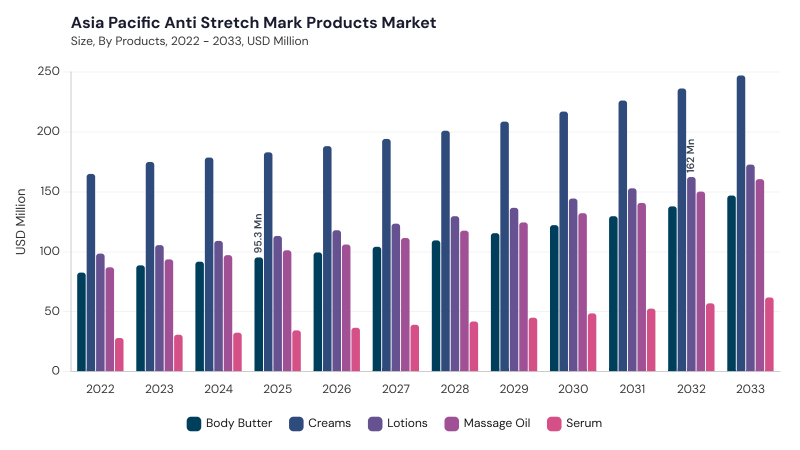
Based on products, the market is segmented into Creams, Lotions, Massage Oil, Body Butter, and Serum. The Creams market dominated the Asia Pacific Anti Stretch Mark Products Market by Products in 2025, and would continue to be a dominant market till 2033; thereby, achieving a market value of $ 217.0 million by 2030, growing at a CAGR of 4 % during the forecast period. The Lotions market is expected to witness a CAGR of 5.6% during (2026 - 2033). Additionally, The Massage Oil market is expected to witness highest CAGR of 6.1% during (2026 - 2033).
Creams represent the leading product category, supported by intensive moisturization, targeted application, broad consumer familiarity, and strong use among pregnant women, new mothers, and users addressing skin changes linked to weight variation. Lotions form an important category, driven by lighter texture, easy daily use, quick spreading, and suitability for humid climates and larger body areas. Massage Oil holds a meaningful role, supported by traditional body-care practices, nourishment benefits, maternity massage routines, and preference for oil-based formulations in several regional markets. Body Butter maintains stable demand, favored for deep hydration, thicker consistency, and appeal among consumers seeking long-lasting skin comfort. Serum serves a developing premium category, supported by concentrated ingredients, lightweight absorption, advanced skincare positioning, and demand from consumers looking for specialized body-treatment solutions.
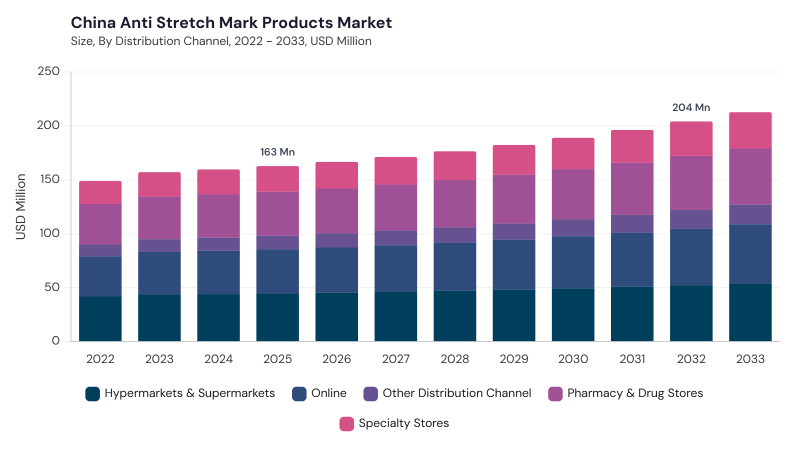
Based on distribution channel, the market is segmented into Hypermarkets & Supermarkets, Pharmacy & Drug Stores, Online, Specialty Stores, and Other Distribution Channel. The Hypermarkets & Supermarkets market dominated the Asia Pacific Anti Stretch Mark Products Market by Distribution Channel in 2025, and would continue to be a dominant market till 2033; thereby, achieving a market value of $ 174.8 million by 2030, growing at a CAGR of 4.4 % during the forecast period. The Pharmacy & Drug Stores market is expected to witness a CAGR of 5.1% during (2026 - 2033). Additionally, The Online market is expected to witness highest CAGR of 5.6% during (2026 - 2033).
Hypermarkets & Supermarkets represent the key channel, supported by convenient access, wide brand availability, family shopping behavior, and product placement across beauty, personal care, maternity, and wellness sections. Pharmacy & Drug Stores form a reliable channel, driven by trust in pregnancy-related products, sensitive-skin positioning, pharmacist support, and availability of dermatology-oriented brands. Online channels are gaining strong traction through mobile commerce, influencer recommendations, product ratings, ingredient comparisons, discreet purchasing, and access to international, premium, and niche labels. Specialty Stores support focused demand through beauty retailers, maternity outlets, wellness shops, and skincare boutiques offering curated selections and product assistance. Other Distribution Channel includes department stores, clinics, spas, independent shops, and local retail formats that serve selective and community-based purchasing needs.
Free Valuable Insights: Anti Stretch Mark Products Market is Predicted to reach USD 2,211.9 Million billion by 2033, at a CAGR of 4.9%
Based on country, the market is segmented into China, Japan, India, South Korea, Singapore, Malaysia, and Rest of Asia Pacific. China is a major market for anti stretch mark products in Asia Pacific, supported by rising postpartum body-care awareness, natural and organic product demand, digital commerce, domestic skincare innovation, scientific ingredient adoption, and localized formulations tailored to Chinese skin types and preferences. Japan is witnessing growing adoption through clean-label skincare, hypoallergenic products, advanced delivery mechanisms, male grooming awareness, botanical ingredients, and personalized skincare consultations. India is expanding through traditional herbal skincare practices, natural oils, clinically tested creams, e-commerce adoption, urban grooming trends, and affordable products combining botanicals with modern bioactive ingredients. South Korea is supported by K-beauty innovation, advanced bioactive ingredients, clean-label formulations, microencapsulation, digital social commerce, and premium skincare positioning. Singapore is advancing through maternity-safe products, dermatologist-tested formulations, premium pharmacy channels, social media-led discovery, and demand for lightweight textures suited to humid climates. Malaysia is growing through clean and toxin-free products, Centella Asiatica-based formulations, pregnancy-safe certifications, dermatology partnerships, digital awareness campaigns, and localized skincare solutions.

By Products
By Distribution Channel
By Country
Set to reach $664.4 Million by 2030, growing at a CAGR of 5.3% during 2026 - 2033.
Creams will dominate with a market value of $217.0 million by 2030, growing at a CAGR of 4% during the forecast period.
The Online market is expected to witness the highest CAGR of 5.6% during 2026 - 2033.
The Lotions segment is expected to grow at a CAGR of 5.6% during 2026 - 2033.
Hypermarkets & Supermarkets will achieve a market value of $174.8 million by 2030, growing at a CAGR of 4.4% during the forecast period.
Our team of dedicated experts can provide you with attractive expansion opportunities for your business.




 Unique Offerings