The sample copy of this report is available for access.
The LAMEA Aeroponics Market is expected to reach USD 657.4 million by 2029, growing at a CAGR of 10.8% during (2026 - 2033).
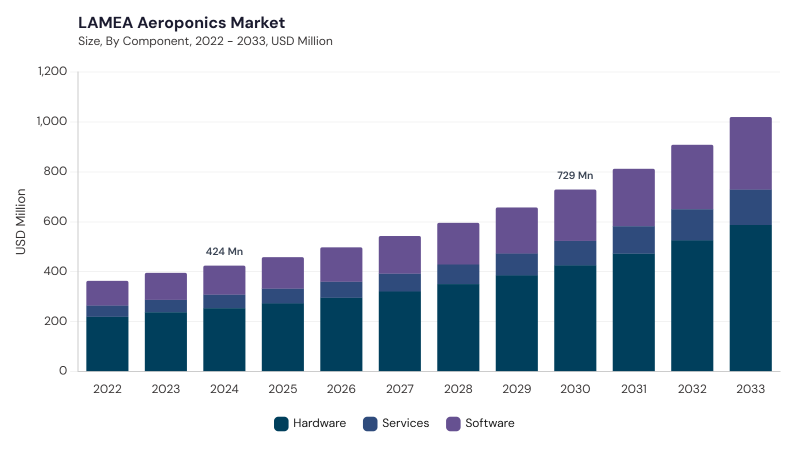
The LAMEA Aeroponics Market evolved from the growing need for sustainable and efficient agriculture across Latin America, the Middle East, and Africa. Early adoption began as a niche controlled-environment agriculture concept, mainly focused on urban and research applications where existing hydroponic methods were adapted for mist-based nutrient delivery. Over time, improved misting mechanisms, aeration techniques, automation, sensor-driven control systems, and pilot projects by governments and private players shifted aeroponics from fragmented experimentation toward scalable commercial use across urban farming, commercial horticulture, and high-value crop production.
Current market growth is shaped by water conservation, digital agriculture, IoT-enabled sensors, AI-based analytics, local food security, and demand for pesticide-free produce. Growers are increasingly adopting systems that support real-time monitoring, adaptive control, minimal water use, improved crop yield, and reduced operational costs across arid, urban, and infrastructure-constrained locations. Demand is also rising for modular, energy-efficient, and regionally adapted aeroponic solutions that reduce dependence on compromised soils, support import substitution, and improve fresh produce availability near major consumption centers.
Based on Component, the market is segmented into Hardware, Software, and Services. The Hardware market dominated the LAMEA Aeroponics Market by Component in 2025, and would continue to be a dominant market till 2033; thereby, achieving a market value of USD 385.1 million by 2029, growing at a CAGR of 10.3 % during the forecast period. The Software market is expected to witness a CAGR of 11.2% during (2026 - 2033). The Services market is expected to witness a CAGR of 12% during (2026 - 2033).
Hardware remains central as aeroponic systems depend on structural frameworks, misting systems, nutrient delivery modules, environmental controls, reservoirs, pumps, lighting, and durable infrastructure suited to water-scarce and climate-variable conditions. Software holds a significant share through environmental monitoring platforms, nutrient dosing controls, digital dashboards, IoT sensor data, AI-driven analytics, remote management, predictive maintenance, and growth forecasting. Services maintain the smallest but promising presence through feasibility assessment, installation, consulting, training, system customization, technical support, equipment servicing, troubleshooting, and capacity building across emerging regional markets.
Based on End-use, the market is segmented into Commercial Growers, Research Institutions, and Government Organizations. The Commercial Growers market dominated the LAMEA Aeroponics Market by End-use in 2025, and would continue to be a dominant market till 2033; thereby, achieving a market value of USD 466.7 million by 2029, growing at a CAGR of 10.4 % during the forecast period. The Research Institutions market is expected to witness a CAGR of 11.6% during (2026 - 2033). Additionally, The Government Organizations market is expected to witness highest CAGR of 12.1% during (2026 - 2033).
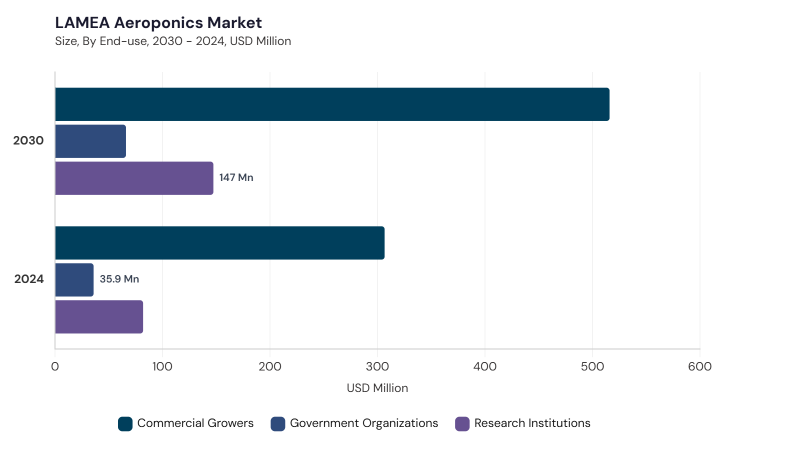
Commercial Growers remain the core end-use segment as farms and agribusinesses use aeroponics for leafy greens, herbs, specialty vegetables, year-round production, water efficiency, faster crop turnover, and locally supplied fresh produce. Research Institutions hold a substantial share through studies on water productivity, crop resilience, nutrient efficiency, propagation methods, vertical farming, automation, data analytics, and cultivation under arid or challenging conditions. Government Organizations represent the smallest but emerging segment through food-security programs, agricultural diversification strategies, demonstration farms, public research initiatives, subsidies, grants, and capacity-building programs supporting resource-efficient agriculture.
Based on Farm Type, the market is segmented into Indoor, Greenhouses, Vertical, and Container. Indoor aeroponics remains important as controlled facilities regulate temperature, humidity, lighting, airflow, and nutrient delivery to support dependable production near expanding metropolitan areas. Greenhouses hold a significant share by combining aeroponic cultivation with protected structures, natural sunlight, smart cooling, automated misting, climate sensors, shading systems, and nutrient-management platforms.
Vertical farming records a considerable presence through stacked cultivation, urban food production, smart-city agriculture, LED efficiency, automation, renewable energy, and water recycling. Container farming maintains the smallest but promising foothold through modular deployment, standardized configurations, transportability, digital monitoring, water recycling, solar integration, and suitability for remote, arid, isolated, institutional, and infrastructure-constrained locations.
Based on Crop Type, the market is segmented into Leafy Greens, Fruits & Vegetables, Flowers & Ornamentals, Medicinal & Aromatic Plants, and Other Crop Type. Leafy Greens remain the leading crop type as lettuce, spinach, kale, arugula, herbs, and similar crops benefit from short growth cycles, high-density planting, vertical farming compatibility, pesticide-free positioning, and strong demand from retail and hospitality channels. Fruits & Vegetables hold a substantial share through tomatoes, cucumbers, peppers, strawberries, premium urban demand, extended harvest periods, and precision nutrient management.
Flowers & Ornamentals maintain a considerable presence through indoor flowers, orchids, ornamental foliage, controlled propagation, bloom synchronization, and water-efficient year-round production. Medicinal & Aromatic Plants hold a noteworthy standing through mint, basil, lemongrass, traditional medicinal species, contaminant-free cultivation, phytochemical consistency, and pharmaceutical or nutraceutical relevance. Other Crop Type includes specialty vegetables, microgreens, sprouts, seedlings, propagation materials, experimental crops, and locally relevant varieties supported by pilot programs and ongoing technology transfer.
Free Valuable Insights: Aeroponics Market Size Worth USD 9575.8 Million billion by 2033
Based on Country, the market is segmented into Brazil, Argentina, UAE, Saudi Arabia, South Africa, Nigeria, and Rest of LAMEA. The Brazil market dominated the LAMEA Aeroponics Market by Country in 2025, and would continue to be a dominant market till 2033; thereby, achieving a market value of USD 210.0 million by 2029, growing at a CAGR of 9.7 % during the forecast period. The Argentina market is expected to witness a CAGR of 12.4% during (2026 - 2033). Additionally, The UAE market is expected to witness a CAGR of 9.9% during (2026 - 2033).
Brazil is shaped by vertical aeroponics, water conservation, IoT-enabled control systems, sensor integration, and urban high-density production, while Argentina reflects drought-driven water efficiency, smart nutrient management, IoT-based environmental controls, and pesticide-free local produce demand. The UAE is supported by water-saving closed-loop systems, food security priorities, IoT sensors, AI analytics, renewable energy integration, and crop diversification, whereas Saudi Arabia is driven by desert-climate constraints, import reduction, government-backed food-tech initiatives, AI-driven nutrient management, and urban commercial farms. South Africa is advancing through renewable energy-powered systems, AI-based nutrient delivery, urban vertical farms, and water-efficient food production; Nigeria is influenced by renewable energy integration, urban agriculture, modular systems, IoT monitoring, and local crop adaptation; and Rest of LAMEA is shaped by water and nutrient efficiency, IoT and AI convergence, government food-security initiatives, modular units, solar-powered systems, and localized training support.

By Component
By End-use
By Farm Type
By Crop Type
By Country
Set to reach $657.4 Million by 2029, growing at 10.8% CAGR during 2026-2033.
Brazil leads with $210.0 million by 2029, growing at 9.7% CAGR during 2026-2033.
Hardware segment will reach $385.1 million by 2029, growing at 10.3% CAGR during 2026-2033.
The UAE market is expected to witness a CAGR of 9.9% during 2026-2033.
Government Organizations segment is expected to witness the highest CAGR of 12.1% during 2026-2033.
Our team of dedicated experts can provide you with attractive expansion opportunities for your business.




 Unique Offerings
