The sample copy of this report is available for access.
The Asia Pacific Aeroponics Market is expected to reach USD 1978.7 million by 2030, growing at a CAGR of 9.9% during (2026 - 2033).
The Asia Pacific Aeroponics Market originated as a niche segment within controlled-environment agriculture, emerging in response to limited arable land, water scarcity, and the need for sustainable food production. Early adoption began in advanced economies such as Japan and South Korea, where research focused on mist-based nutrient delivery and optimized plant growth. Over time, improvements in nutrient delivery, environmental controls, automation, IoT monitoring, and data analytics shifted the market from experimental farms and pilot projects toward scalable urban and peri-urban farming operations.
Current market growth is shaped by sustainable agriculture demand, pesticide-free produce preference, digital agriculture, AI, machine learning, smart city initiatives, and urban food security needs. Growers are increasingly adopting closed-loop systems, sensors, automated nutrient delivery, climate control, modular units, and vertical farming integration to improve crop quality while reducing water use, waste, and land dependency. Demand is also rising for cost-efficient, scalable, and localized aeroponic systems suited to dense urban environments, diverse climates, and emerging high-value crop applications.
Based on Component, the market is segmented into Hardware, Software, and Services. The Hardware market dominated the Asia Pacific Aeroponics Market by Component in 2025, and would continue to be a dominant market till 2033; thereby, achieving a market value of USD 1147.4 million by 2030, growing at a CAGR of 9.4 % during the forecast period. The Software market is expected to witness a CAGR of 10.3% during (2026 - 2033). The Services market is expected to witness a CAGR of 10.9% during (2026 - 2033).
Hardware remains central as aeroponic systems depend on root chambers, misting systems, nutrient reservoirs, lighting, environmental control units, sensors, and modular physical infrastructure for controlled cultivation. Software holds a significant share through control platforms, data analytics tools, automation software, IoT-enabled monitoring, AI-based crop optimization, yield forecasting, and remote system management. Services represent the smallest but promising segment through installation, system design consulting, maintenance, operator training, technical support, troubleshooting, performance-based agreements, and post-installation assistance for new controlled-environment agriculture entrants.
Based on End-use, the market is segmented into Commercial Growers, Research Institutions, and Government Organizations. The Commercial Growers market dominated the Asia Pacific Aeroponics Market by End-use in 2025, and would continue to be a dominant market till 2033; thereby, achieving a market value of USD 1391.3 million by 2030, growing at a CAGR of 9.5 % during the forecast period. The Research Institutions market is expected to witness a CAGR of 10.7% during (2026 - 2033). Additionally, The Government Organizations market is expected to witness highest CAGR of 11% during (2026 - 2033).
Commercial Growers remain the core end-use segment as large-scale growers, vertical farms, greenhouse operators, and urban agriculture businesses use aeroponics for premium crops, year-round cultivation, pesticide-free produce, resource efficiency, and local food supply. Research Institutions hold a substantial share through work on plant propagation, nutrient-use efficiency, crop adaptation, root development, system design, disease-resistant varieties, and next-generation controlled cultivation systems. Government Organizations maintain the smallest but emerging presence through urban agriculture programs, food security initiatives, agricultural modernization, resource conservation, pilot projects, technology transfer, and support for sustainable farming models.
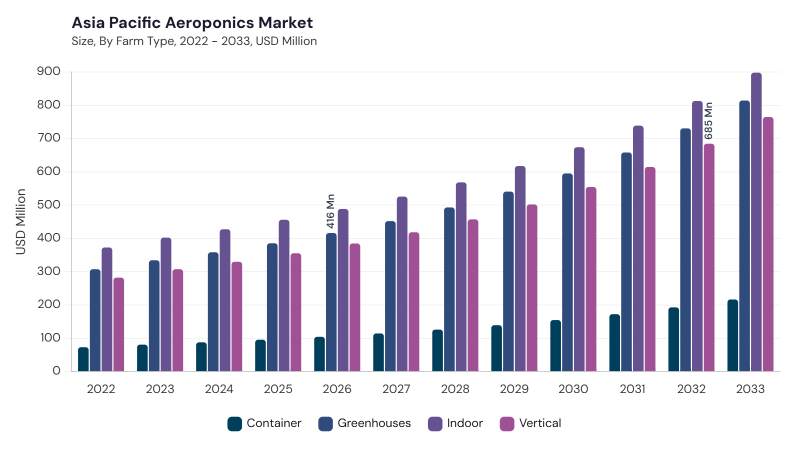
Based on Farm Type, the market is segmented into Indoor, Greenhouses, Vertical, and Container. Indoor aeroponics remains important as enclosed farms use controlled lighting, humidity, temperature, nutrient delivery, and vertical stacking to produce leafy greens, herbs, and specialty crops near urban consumers. Greenhouses hold a significant share by combining natural sunlight with aeroponic misting, climate control, pest protection, and protected cultivation for fruits, vegetables, and medicinal plants.
Vertical farming records a considerable presence through multi-layer production, modular designs, robotics, real-time monitoring, and high-density output in land-constrained cities. Container farming represents the smallest but promising segment through portable, modular, and rapidly deployable systems suited to urban outskirts, islands, remote areas, disaster-prone zones, and off-grid production using solar power and water recycling.
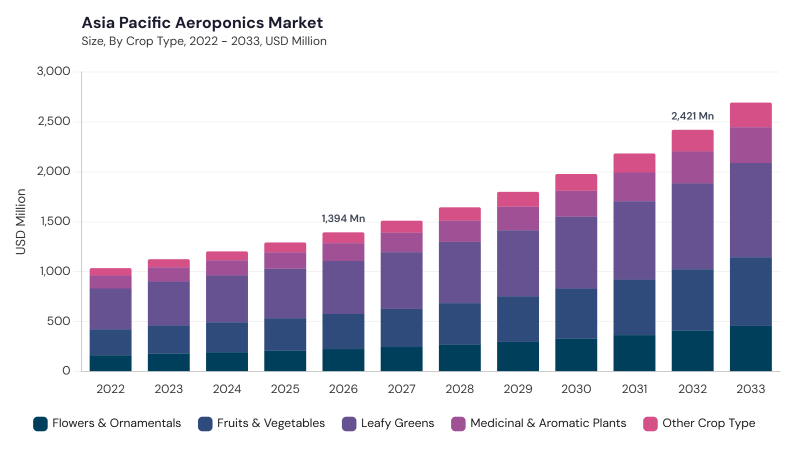
Based on Crop Type, the market is segmented into Leafy Greens, Fruits & Vegetables, Flowers & Ornamentals, Medicinal & Aromatic Plants, and Other Crop Type. Leafy Greens remain the leading crop type as lettuce, spinach, kale, arugula, herbs, and similar crops benefit from rapid growth, strong urban demand, year-round supply, pesticide-free positioning, and efficient controlled-environment production. Fruits & Vegetables hold a substantial share through tomatoes, peppers, strawberries, cucumbers, local produce demand, extended shelf life, and precision nutrient control for higher-value crops.
Flowers & Ornamentals maintain a considerable presence through orchids, chrysanthemums, bonsai species, bloom-quality control, pathogen reduction, export standards, and premium horticultural demand. Medicinal & Aromatic Plants hold a noteworthy position through basil, mint, lavender, herbs, pharmaceutical applications, essential oils, natural health products, and standardized contaminant-free biomass. Other Crop Type includes microgreens, bamboo shoots, specialty mushrooms, exotic herbs, seedlings, planting materials, reforestation crops, and locally important varieties supported by experimental and niche aeroponic applications.
Free Valuable Insights: Aeroponics Market is Predicted to reach USD 9575.8 Million billion by 2033, at a CAGR of 9.3%
Based on Country, the market is segmented into China, Japan, India, South Korea, Singapore, Malaysia, and Rest of Asia Pacific. The China market dominated the Asia Pacific Aeroponics Market by Country in 2025, and would continue to be a dominant market till 2033; thereby, achieving a market value of USD 454.0 million by 2030, growing at a CAGR of 7.5 % during the forecast period. The Japan market is expected to witness a CAGR of 9.1% during (2026 - 2033). Additionally, The India market is expected to witness a CAGR of 10.6% during (2026 - 2033).
China is shaped by automation, precision agriculture, climate-resilient farming, vertical farming integration, IoT monitoring, and AI-driven environmental controls, while Japan reflects limited arable land, urban food security, pesticide-free produce demand, digital crop management, automation, and smart city agriculture. India is supported by shrinking arable land, water scarcity, IoT-enabled monitoring, organic and pesticide-free vegetables, public-private collaboration, and modular aeroponic systems. South Korea is advancing through smart farming policies, vertical aeroponics, AI-based crop monitoring, renewable energy, closed-loop water recycling, and compact urban production, whereas Singapore is influenced by food security priorities, digital agriculture, water efficiency, modular urban farming, IoT sensors, and automation. Malaysia is progressing through sustainable farming, IoT and AI monitoring, urban agriculture, localized food systems, high-tech startups, and tropical-climate system adaptation, while Rest of Asia Pacific is shaped by smart sensors, automated nutrient delivery, crop diversification, vertical farm partnerships, renewable energy integration, and localized technical support.

By Component
By End-use
By Farm Type
By Crop Type
By Country
Set to reach $1978.7 Million by 2030, growing at 9.9% CAGR during 2026-2033.
China leads with $454.0 million by 2030, growing at a 7.5% CAGR during 2026-2033.
Rising demand from commercial growers, reaching $1391.3 million by 2030 at a 9.5% CAGR during 2026-2033.
Hardware segment to achieve $1147.4 million by 2030, growing at a 9.4% CAGR during 2026-2033.
India market to witness a 10.6% CAGR during 2026-2033.
Services segment to witness a 10.9% CAGR during 2026-2033.
Our team of dedicated experts can provide you with attractive expansion opportunities for your business.




 Unique Offerings
