The sample copy of this report is available for access.
“Global Aeroponics Market to reach a market value of USD 9575.82 Million by 2033 growing at a CAGR of %”
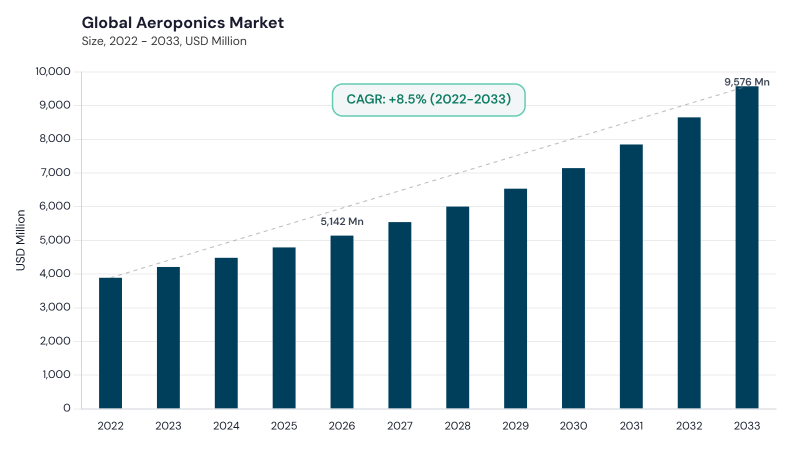
The Global Aeroponics Market is expected to reach USD 9575.8 million by 2033, growing at a CAGR of 9.3% during (2026 - 2033).
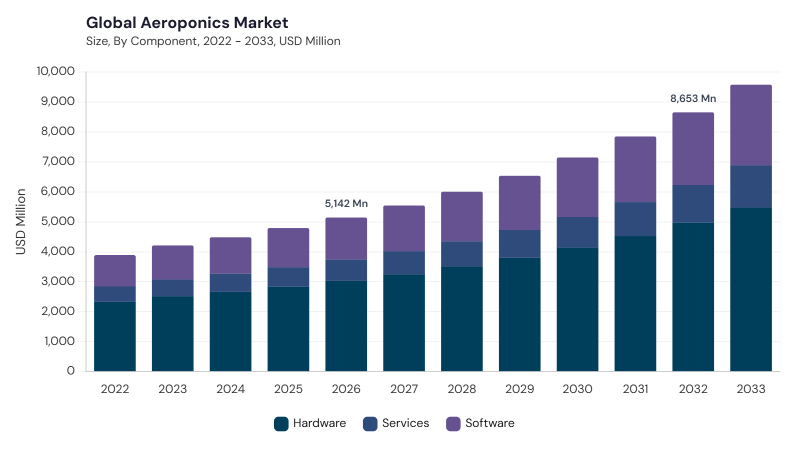
Aeroponics adoption is gaining pace as growers look for farming methods that use less water, reduce land dependence, and support year-round crop production with higher yield consistency. The system allows plants to receive nutrient-rich mist in controlled environments, helping improve water conservation, nutrient delivery, crop quality, and reduced reliance on soil. Market demand is also supported by vertical farming, urban agriculture, pesticide-reduced food preferences, controlled-environment agriculture, and rising investment in indoor farming infrastructure.
Rising demand for precision agriculture and resource-efficient cultivation is strengthening aeroponics adoption across commercial farms, urban farming projects, research facilities, and government-backed food security programs. The technology enables precise control over nutrient delivery, moisture, root oxygenation, and environmental conditions, helping growers reduce water use and improve crop consistency. Urban agriculture and vertical farming are expanding the addressable market by supporting high-density production near consumption centers. Demand for safe, fresh, traceable, and pesticide-reduced produce is also encouraging controlled-environment farming investments. At the same time, sensor-based monitoring, automation, AI analytics, modular system design, and customized nutrient solutions are improving scalability and making aeroponics more commercially relevant.
The competitive environment is shaped by innovation-driven differentiation, cost management, and regional customization. Companies compete through proprietary misting systems, automation precision, smart farm management integration, modular platforms, crop-specific configurations, and service support. High setup costs make affordability and scalable deployment important, especially for smaller growers and urban farming operators. Partnerships with horticultural engineering firms, research institutions, technology providers, and regional distributors are helping companies expand adoption and reduce implementation complexity. Global firms benefit from R&D resources and broader supply networks, while regional players compete through local market knowledge, climate-specific adaptation, and customer support.
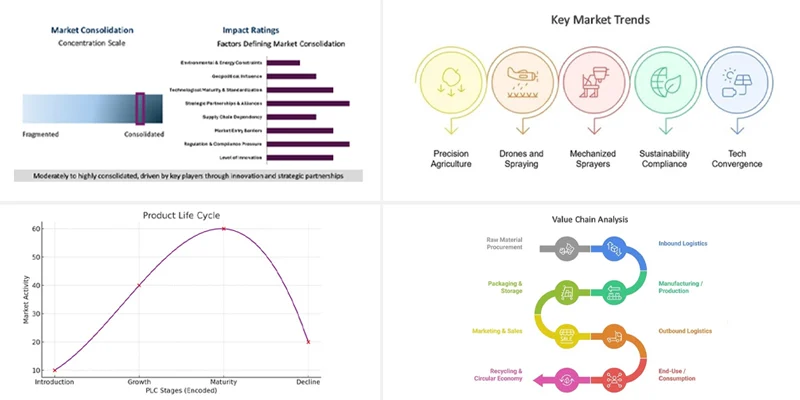


The Aeroponics Market is moderately consolidated, with specialized technology providers, controlled-environment agriculture companies, indoor farming operators, and system integrators competing across hardware, software, services, and commercial cultivation models. AeroFarms, AEssense Corporation, CleanGreens Solutions SA, LettUs Grow, Bifarm Tech, Living Greens Farm, Altius Farms, Eden Grow Systems, Barton Breeze, and Neofarms GmbH represent diverse positions across commercial production, aeroponic equipment, modular grow systems, greenhouse integration, and consumer-oriented indoor farming. Market share is influenced by system reliability, automation depth, water-use efficiency, crop performance, scalability, installation support, and ability to serve commercial growers as well as urban and research applications.
Based on component, the market is segmented into Hardware, Software, and Services. The Hardware market dominated the Global Aeroponics Market by Component in 2025, and would continue to be a dominant market till 2033; thereby, achieving a market value of USD 5474.9 million by 2033, growing at a CAGR of 8.8 % during the forecast period. The Software market is expected to witness a CAGR of 9.7% during (2026 - 2033). The Services market is expected to witness a CAGR of 10.3% during (2026 - 2033).
Hardware remains central to aeroponic adoption because growers require misting systems, pumps, reservoirs, sensors, lighting, climate-control equipment, growing structures, and nutrient delivery infrastructure. Software supports digital farm management by enabling environmental monitoring, nutrient scheduling, analytics, remote controls, and automation across controlled cultivation sites. Services play an important role in installation, calibration, maintenance, agronomic support, technical consulting, and system integration. As aeroponic farms become more complex, buyers increasingly seek bundled solutions that combine physical equipment, intelligent controls, and ongoing operational support. Together, these components create the foundation for scalable, reliable, and commercially viable aeroponic cultivation.
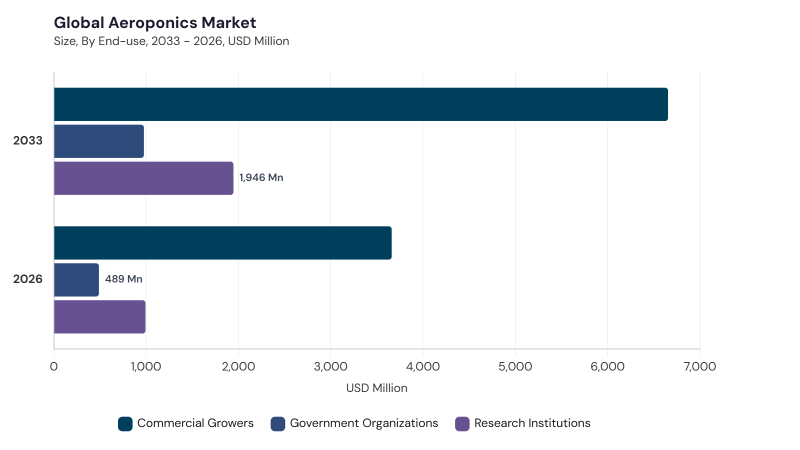
Based on end-use, the market is segmented into Commercial Growers, Research Institutions, and Government Organizations. The Commercial Growers market dominated the Global Aeroponics Market by End-use in 2025, and would continue to be a dominant market till 2033; thereby, achieving a market value of USD 6653.7 million by 2033, growing at a CAGR of 8.9 % during the forecast period. The Research Institutions market is expected to witness a CAGR of 10.1% during (2026 - 2033). Additionally, The Government Organizations market is expected to witness highest CAGR of 10.4% during (2026 - 2033).
Commercial Growers use aeroponics to improve crop density, resource utilization, production consistency, and year-round supply in controlled environments. Research Institutions rely on aeroponic systems for studies related to plant nutrition, root development, genetics, disease management, propagation, and cultivation techniques. Government Organizations support adoption through agricultural research programs, demonstration projects, food-security initiatives, and resource-efficient farming investments. Each end-use group has different priorities, with commercial operators emphasizing productivity and reliability, researchers focusing on controlled experimentation, and public agencies evaluating sustainability and resilience. This mix supports broader market development across production, scientific, and policy-led applications.
Based on farm type, the market is segmented into Indoor, Greenhouses, Vertical, and Container. The Indoor market dominated the Global Aeroponics Market by Farm Type in 2025, and would continue to be a dominant market till 2033; thereby, achieving a market value of USD 3187.3 million by 2033, growing at a CAGR of 8.5 % during the forecast period. The Greenhouses market is expected to witness a CAGR of 9.5% during (2026 - 2033). Additionally, The Vertical market is expected to witness highest CAGR of 9.7% during (2026 - 2033).
Indoor aeroponics supports precise control over temperature, humidity, lighting, nutrients, and production cycles, making it suitable for consistent cultivation independent of external weather conditions. Greenhouses combine protected cultivation with aeroponic root systems, allowing growers to use natural light while improving water and nutrient management. Vertical systems maximize production in limited spaces through stacked configurations, automation, LED lighting, and sensor-based monitoring. Container farms provide modular, portable, and compact deployment models for urban sites, remote areas, pilot projects, and decentralized food production. These farm types reflect the market’s movement toward flexible cultivation formats that can serve commercial, urban, and infrastructure-constrained environments.
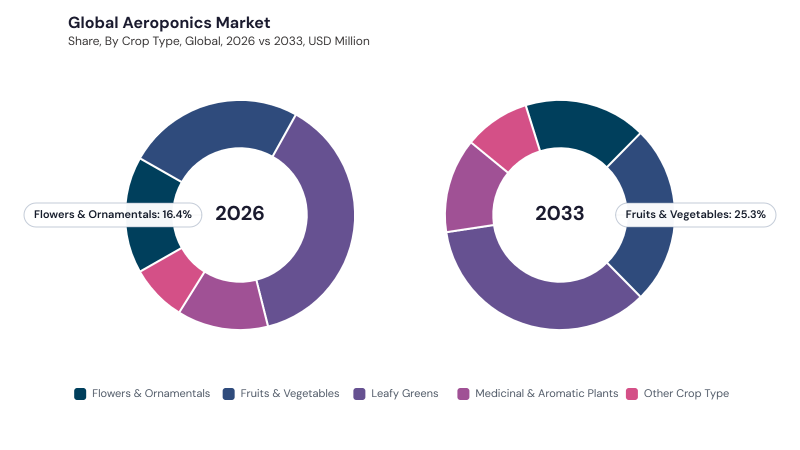
Based on crop type, the market is segmented into Leafy Greens, Fruits & Vegetables, Flowers & Ornamentals, Medicinal & Aromatic Plants, and Other Crop Type. The Leafy Greens market dominated the Global Aeroponics Market by Crop Type in 2025, and would continue to be a dominant market till 2033; thereby, achieving a market value of USD 3348.9 million by 2033, growing at a CAGR of 8 % during the forecast period. The Fruits & Vegetables market is expected to witness a CAGR of 9.5% during (2026 - 2033). Additionally, The Flowers & Ornamentals market is expected to witness highest CAGR of 10% during (2026 - 2033).
Leafy Greens are highly compatible with aeroponics because of their short growth cycles, compact structure, frequent harvesting potential, and predictable nutrient needs. Fruits & Vegetables are gaining attention as improvements in crop-support systems, precision nutrition, and environmental control enable growers to expand beyond traditional greens. Flowers & Ornamentals benefit from controlled propagation, uniform plant quality, and carefully managed growing conditions. Medicinal & Aromatic Plants require consistent nutrient and environmental management to support standardized crop characteristics. Other Crop Type includes specialty crops, seedlings, propagation materials, and experimental varieties where controlled root-zone management and water efficiency offer operational advantages.
Free Valuable Insights: Aeroponics Market Size to reach $9575.8 Million by 2033
Region-wise, the Aeroponics Market is analyzed across North America, Europe, Asia Pacific, and LAMEA. The North America market dominated the Global Aeroponics Market by Region in 2025, and would continue to be a dominant market till 2033; thereby, achieving a market value of USD 3204.1 million by 2033, growing at a CAGR of 8.7 % during the forecast period. The Asia Pacific market is expected to witness a CAGR of 9.9% during (2026 - 2033). Additionally, The Europe market is expected to witness a CAGR of 8.9% during (2026 - 2033).
North America is supported by mature controlled-environment agriculture platforms, urban farming adoption, demand for locally sourced produce, and integration of IoT, AI, LED lighting, and automated nutrient management. Europe benefits from sustainability mandates, urban and peri-urban agriculture, pesticide-reduced produce demand, and alignment with resource-efficient farming objectives. Asia Pacific is driven by limited arable land, rapid urbanization, food-security concerns, smart city initiatives, and government-backed interest in scalable soilless farming. LAMEA is shaped by water scarcity, challenging climatic conditions, urban food demand, and the need for controlled cultivation models that reduce dependence on conventional soil-based agriculture.
| Report Attribute | Details |
|---|---|
| Market size value in 2026 | USD 5142.2 million |
| Market size forecast in 2033 | USD 9575.8 million |
| Base Year | 2025 |
| Historical Period | 2022 to 2024 |
| Forecast Period | 2026 to 2033 |
| Revenue Growth Rate | CAGR of 9.3% from 2026 to 2033 |
| Number of Pages | 660 |
| Tables | 600 |
| Report Coverage | Market Trends, Revenue Estimation and Forecast, Segmentation Analysis, Regional and Country Breakdown, Competitive Landscape, Market Share Analysis, Company Profiling, Companies Strategic Developments, SWOT Analysis, Product Life Cycle Analysis, Value Chain Analysis, Market Consolidation Analysis, Key Customer Criteria, Pandemic Impact Analysis, and Winning Imperatives |
| Segments Covered | Component, End-use, Farm Type, Crop Type, and Geography |
| Country Scope |
|
| Companies Included | AeroFarms; AEssense Corporation; CleanGreens Solutions SA; LettUs Grow; Bifarm Tech; Living Greens Farm; Altius Farms; Eden Grow Systems; Barton Breeze; Neofarms GmbH |
By Component
By End-use
By Farm Type
By Crop Type
By Geography
Expected to reach USD 9575.8 million by 2033, growing at 9.3% CAGR during the forecast period (2026-2033).
The aeroponics market segment is projected to reach USD 9575.8 million by 2033.
AeroFarms, AEssense Corporation, CleanGreens Solutions SA, LettUs Grow, and Bifarm Tech lead the market.
Precision agriculture and resource efficiency enhancements are boosting aeroponics adoption.
Regional dominance data is not specified in the provided information.
The market is expected to grow at 9.3% CAGR during the forecast period (2026-2033).
Our team of dedicated experts can provide you with attractive expansion opportunities for your business.






 Unique Offerings
