“Global Human Resource Technology Market to reach a market value of USD 78041.71 Million by 2033 growing at a CAGR of %”
The Global Human Resource (HR) Technology Market is expected to reach USD 78.0 billion by 2033, growing at a CAGR of 7.9% during (2026 - 2033).
Increasing workforce digitalization, automated HR processes, cloud-based workforce management, employee experience platforms, payroll efficiency, workforce analytics, and integrated human capital management systems are driving the Human Resource (HR) Technology Market across enterprises of all sizes. Growth is further strengthened by hybrid work models, AI-enabled recruitment, predictive workforce planning, self-service HR portals, automated payroll, personalized learning, talent intelligence, and scalable cloud-native HR systems.
Growth in the Human Resource (HR) Technology Market is driven by organizations shifting HR from transactional administration toward strategic, data-driven workforce management. Enterprises increasingly require systems that combine recruitment, onboarding, payroll, performance management, learning, workforce planning, employee engagement, and compliance into connected digital ecosystems. AI and analytics are becoming central to candidate matching, skills intelligence, employee retention, workforce forecasting, payroll anomaly detection, and employee self-service. As hybrid and distributed workforces become more common, demand is expanding for cloud HR platforms that support remote onboarding, digital performance management, workforce communication, global payroll, contractor management, and flexible scheduling.
The competitive environment is moderately fragmented and innovation-driven, with enterprise HCM providers, payroll specialists, workforce-management platforms, talent-management vendors, and integrated software companies competing across the market. Workday, UKG, SAP SuccessFactors, ADP, and Oracle hold strong positions through integrated cloud HCM, payroll, workforce management, analytics, employee experience, and enterprise software ecosystems. Paycom, Dayforce, Paylocity, Paychex, and Cornerstone OnDemand strengthen the market through payroll automation, single-data architectures, workforce intelligence, mid-market HR platforms, learning, skills management, and employee development solutions.
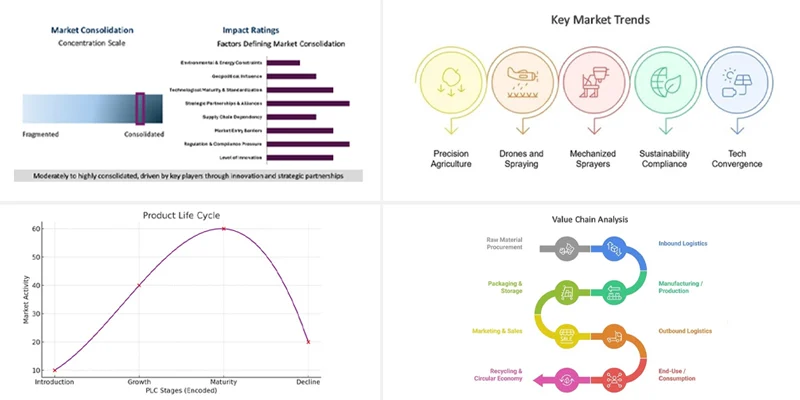


The global Human Resource (HR) Technology Market reflects a moderately fragmented, cloud-software-driven, and increasingly AI-enabled competitive landscape. Workday leads through cloud-based HCM, workforce planning, payroll, recruiting, talent management, skills intelligence, analytics, and employee-experience functionality. UKG maintains a strong position through payroll, workforce management, time and attendance, scheduling, and employee experience, particularly across frontline and distributed workforces. SAP SuccessFactors and Oracle strengthen the enterprise tier through integration with broader enterprise application environments, while ADP remains highly relevant through payroll scale, compliance expertise, HRIS, HCM, and workforce services. Paycom, Dayforce, Paylocity, Paychex, and Cornerstone OnDemand add depth through automation, AI assistants, single-data-model platforms, mid-market payroll and HR solutions, learning, skills intelligence, and workforce agility.
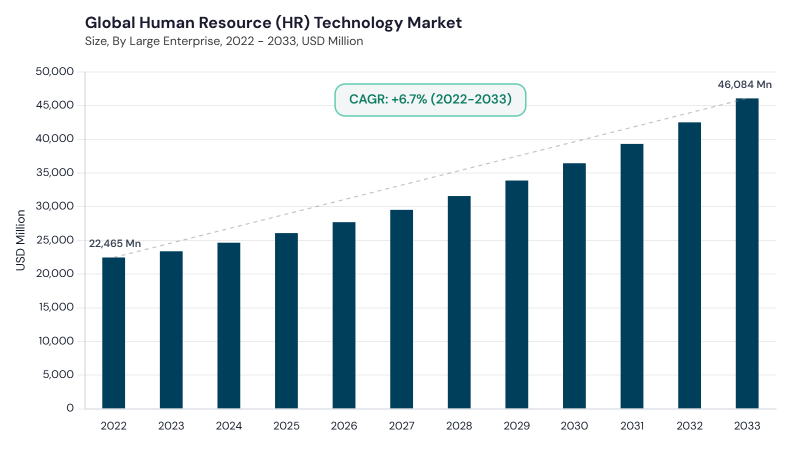
Based on Enterprise Size, the market is segmented into Large Enterprise and Small and Medium Enterprises (SMEs). The Large Enterprise market dominated the Global Human Resource (HR) Technology Market by Enterprise Size in 2025, and would continue to be a dominant market till 2033; thereby, achieving a market value of USD 46.0 billion by 2033, growing at a CAGR of 7.5 % during the forecast period. The Small and Medium Enterprises (SMEs) market is expected to witness a CAGR of 8.5% during (2026 - 2033).
Large Enterprise remains the leading segment as major organizations manage extensive workforces across multiple locations, jurisdictions, departments, and business units. These organizations require integrated HR technology platforms that support recruitment, payroll, employee records, performance management, learning, compensation, succession planning, compliance, workforce planning, and analytics. Adoption is supported by strong HR technology budgets, complex administrative requirements, and the need for unified human capital management systems. Small and Medium Enterprises (SMEs) are gaining traction as subscription-based HR platforms, modular applications, employee self-service tools, and simplified cloud deployment reduce the cost and complexity of digitizing HR operations. SMEs increasingly use HR technology to automate payroll, attendance, employee records, recruitment, and administrative workflows without heavy infrastructure investment.
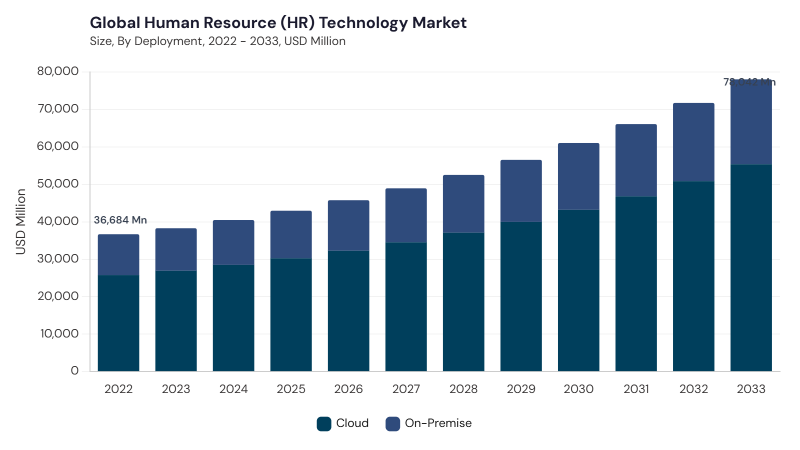
Based on Deployment, the market is segmented into Cloud and On-Premise. The Cloud market dominated the Global Human Resource (HR) Technology Market by Deployment in 2025, and would continue to be a dominant market till 2033; thereby, achieving a market value of USD 55.3 billion by 2033, growing at a CAGR of 8 % during the forecast period. Additionally, The On-Premise market is expected to witness highest CAGR of 7.7% during (2026 - 2033).
Cloud remains the dominant deployment model due to scalability, remote accessibility, faster implementation, continuous updates, reduced infrastructure dependency, and easier integration with enterprise applications. Cloud HR platforms support hybrid workforces, employee self-service, AI-assisted recruitment, workforce analytics, payroll automation, and employee engagement across distributed organizations. SaaS models also enable companies to adopt advanced HR capabilities through subscription-based pricing and modular expansion. On-Premise deployment remains relevant for organizations requiring direct control over employee data, customized system configurations, security policies, legacy infrastructure integration, and internal governance. Highly regulated sectors and organizations with complex internal IT environments continue to use on-premise systems where data sovereignty, control, and customization remain priorities.
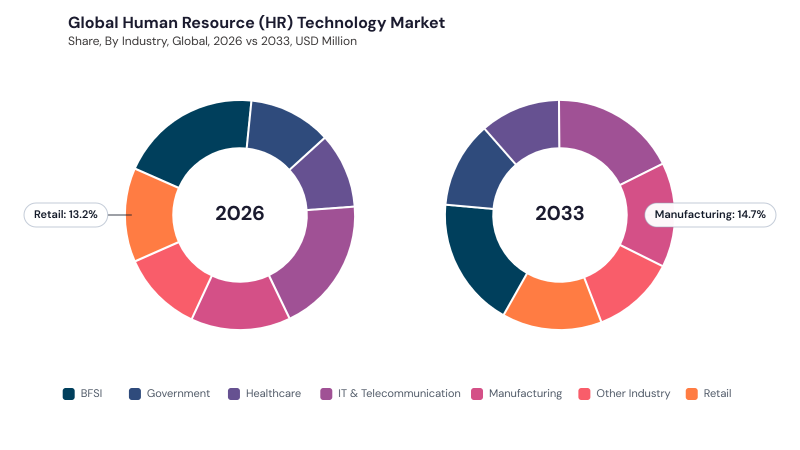
Based on Industry, the market is segmented into BFSI, IT & Telecommunication, Manufacturing, Retail, Government, Healthcare, and Other Industry. The BFSI market dominated the Global Human Resource (HR) Technology Market by Industry in 2025, and would continue to be a dominant market till 2033; thereby, achieving a market value of USD 14.2 billion by 2033, growing at a CAGR of 6.6 % during the forecast period. The IT & Telecommunication market is expected to witness a CAGR of 6.9% during (2026 - 2033). Additionally, The Manufacturing market is expected to witness highest CAGR of 8.7% during (2026 - 2033).
BFSI remains the leading industry due to large workforces, compliance-intensive operations, specialized talent requirements, regulatory reporting, payroll complexity, and strong demand for workforce analytics. IT & Telecommunication adoption is supported by rapid workforce expansion, skills management, hybrid work, intense competition for technical talent, and advanced digital HR practices. Manufacturing uses HR technology for shift scheduling, attendance tracking, payroll automation, workforce planning, training, and labor optimization. Retail benefits from high employee volumes, seasonal staffing, distributed workforce administration, and scheduling complexity. Government adoption is driven by modernization of administrative processes and employee management systems, while Healthcare uses HR technology for complex scheduling, credential management, workforce shortages, regulatory needs, and staff retention. Other Industry includes professional services, education, hospitality, transportation, and additional sectors accelerating HR process digitization.
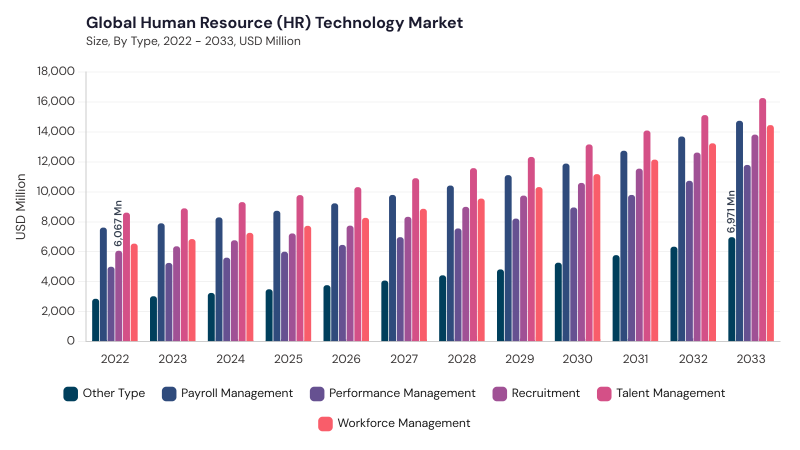
Based on Type, the market is segmented into Talent Management, Payroll Management, Workforce Management, Recruitment, Performance Management, and Other Type. The Talent Management market dominated the Global Human Resource (HR) Technology Market by Type in 2025, and would continue to be a dominant market till 2033; thereby, achieving a market value of USD 16.2 billion by 2033, growing at a CAGR of 6.7 % during the forecast period. The Payroll Management market is expected to witness a CAGR of 6.9% during (2026 - 2033). Additionally, The Workforce Management market is expected to witness highest CAGR of 8.3% during (2026 - 2033).
Talent Management remains the leading type segment as organizations prioritize employee development, succession planning, skills assessment, learning, retention, internal mobility, and leadership pipeline development. Payroll Management holds a strong position because compensation processing, tax administration, compliance, benefits integration, and payroll accuracy remain core HR requirements. Workforce Management is expanding through scheduling, time tracking, attendance, labor forecasting, absence management, and workforce analytics. Recruitment is supported by AI-assisted candidate sourcing, applicant tracking, resume screening, interview scheduling, digital onboarding, and candidate experience improvement. Performance Management is gaining relevance through continuous feedback, goal tracking, employee analytics, and data-driven appraisal systems. Other Type includes employee experience tools, benefits administration, HR analytics, compliance platforms, wellness solutions, and other specialized HR applications increasingly integrated into unified digital ecosystems.
Free Valuable Insights: Human Resource Technology Market Size to reach $78.0 Billion by 2033
Region-wise, the Human Resource (HR) Technology Market is analyzed across North America, Europe, Asia Pacific, and LAMEA. The North America market dominated the Global Human Resource (HR) Technology Market by Region in 2025, and would continue to be a dominant market till 2033; thereby, achieving a market value of USD 29.4 billion by 2033, growing at a CAGR of 7.4 % during the forecast period. The Asia Pacific market is expected to witness a CAGR of 8.5% during (2026 - 2033). Additionally, The Europe market is expected to witness a CAGR of 7.5% during (2026 - 2033).
North America leads the global market due to mature enterprise software adoption, strong investment in workforce digitalization, widespread cloud deployment, advanced payroll infrastructure, and rapid integration of AI and analytics across HR processes. Europe is shaped by workforce modernization, stringent employee data requirements, GDPR-driven compliance priorities, cloud-based HCM adoption, and multi-country HR administration needs. Asia Pacific is expanding through large workforces, enterprise digital transformation, growth in technology-sector employment, startup ecosystems, mobile-first HR applications, and increasing adoption of automated HR platforms among large enterprises and SMEs. LAMEA is developing through cloud adoption, business digitalization, modernization of workforce processes, subscription-based HR solutions, formalization of employment practices, and demand for localized HR platforms across diverse regulatory environments.
| Report Attribute | Details |
|---|---|
| Market size value in 2026 | USD 45.7 billion |
| Market size forecast in 2033 | USD 78.0 billion |
| Base Year | 2025 |
| Historical Period | 2022 to 2024 |
| Forecast Period | 2026 to 2033 |
| Revenue Growth Rate | CAGR of 7.9% from 2026 to 2033 |
| Number of Pages | XX |
| Tables | XX |
| Report Coverage | Market Trends, Revenue Estimation and Forecast, Segmentation Analysis, Regional and Country Breakdown, Competitive Landscape, Market Share Analysis, Company Profiling, Companies Strategic Developments, SWOT Analysis, Product Life Cycle Analysis, Value Chain Analysis, Market Consolidation Analysis, Key Customer Criteria, Pandemic Impact Analysis, and Winning Imperatives |
| Segments Covered | Enterprise Size, Deployment, Industry, Type, and Geography |
| Country Scope |
|
| Companies Included | Workday, Inc.; UKG Inc.; SAP SE; Automatic Data Processing, Inc.; Oracle Corporation; Paycom Software, Inc.; Dayforce, Inc.; Paylocity Holding Corporation; Paychex, Inc.; Cornerstone OnDemand, Inc. |
By Enterprise Size
By Deployment
By Industry
By Type
By Geography
Expected to reach USD 78.0 billion by 2033, growing at 7.9% CAGR during 2026-2033.
Large Enterprise segment leads with a market value of USD 46.0 billion by 2033.
Key players include Workday, UKG, SAP, ADP, Oracle, Paycom, Dayforce, Paylocity, Paychex.
Cloud segment dominates with a market value of USD 55.3 billion by 2033.
North America leads with a market value of USD 29.4 billion by 2033.
BFSI segment leads with a market value of USD 14.2 billion by 2033.
Our team of dedicated experts can provide you with attractive expansion opportunities for your business.






 Unique Offerings
