The Europe Human Resource (HR) Technology Market is expected to reach USD 17.2 billion by 2031, growing at a CAGR of 7.5% during (2026 - 2033).
The Europe Human Resource Technology Market evolved from basic payroll and employee record-keeping applications toward integrated platforms supporting recruitment, performance management, workforce planning, employee engagement, and regulatory compliance. Early digitalization was centered on administrative automation, while enterprise resource planning systems broadened HR functionality across large organizations. Cloud computing later enabled scalable, real-time access and expanded adoption among smaller businesses, followed by growing use of mobile applications, advanced analytics, artificial intelligence, and machine learning. The market now combines cloud infrastructure, automated workflows, predictive workforce insights, employee-centric design, and compliance-oriented functionality suited to Europe’s diverse labor markets and regulatory environment.
Artificial intelligence, cloud-based platforms, employee experience, hybrid working, compliance automation, and workforce analytics are shaping current market development. Organizations increasingly deploy AI for candidate screening, workforce planning, skills assessment, sentiment analysis, and personalized development, while cloud and SaaS models improve accessibility, scalability, and system integration. Regulatory requirements surrounding data protection, employee rights, algorithmic transparency, and labor compliance are encouraging vendors to strengthen governance, auditability, security, and localized functionality. Employee-centric platforms incorporating self-service, continuous feedback, wellness, and digital learning are also gaining importance. However, implementation costs, legacy-system integration, data privacy requirements, talent shortages, interoperability issues, and complex multi-country compliance continue to influence adoption.
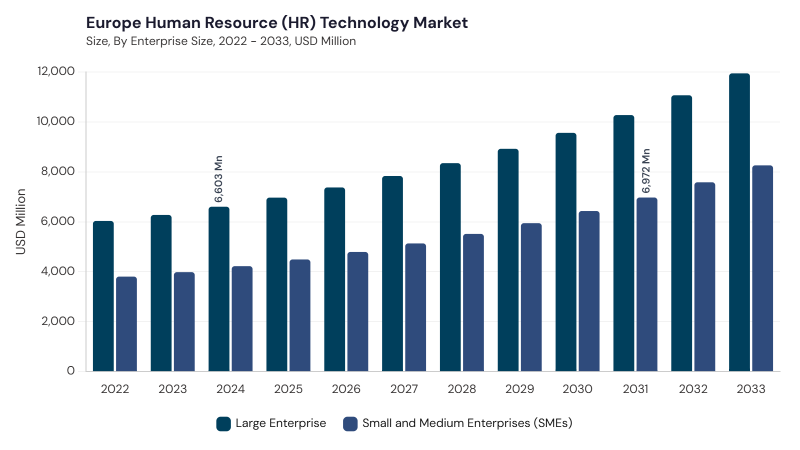
Based on Enterprise Size, the market is segmented into Large Enterprise and Small and Medium Enterprises (SMEs). The Large Enterprise market dominated the Europe Human Resource (HR) Technology Market by Enterprise Size in 2025, and would continue to be a dominant market till 2033; thereby, achieving a market value of USD 10.2 billion by 2031, growing at a CAGR of 7.1 % during the forecast period. The Small and Medium Enterprises (SMEs) market is expected to witness a CAGR of 8.1% during (2026 - 2033).
Large Enterprise adoption centers on integrated platforms supporting talent management, payroll, compliance, workforce analytics, employee experience, learning, and global mobility across complex organizational structures. AI, cloud migration, predictive analytics, hybrid workforce management, and stronger integration with enterprise systems are further strengthening technology modernization. Small and Medium Enterprises (SMEs) increasingly adopt modular, subscription-based, and cloud-native HR solutions that reduce administrative workload while limiting infrastructure requirements. Ease of deployment, employee self-service, payroll integration, compliance support, scalability, and affordable pricing are making advanced HR capabilities increasingly accessible to smaller European businesses.
Based on Deployment, the market is segmented into Cloud and On-Premise. The Cloud market dominated the Europe Human Resource (HR) Technology Market by Deployment in 2025, and would continue to be a dominant market till 2033; thereby, achieving a market value of USD 12.2 billion by 2031, growing at a CAGR of 7.6 % during the forecast period. Additionally, The On-Premise market is expected to witness highest CAGR of 7.3% during (2026 - 2033).
Cloud deployment enables organizations to manage talent, payroll, workforce analytics, employee engagement, learning, and self-service functions through flexible SaaS environments that reduce dependence on internal infrastructure. Integration with artificial intelligence, mobile applications, analytics, and enterprise systems further strengthens cloud adoption, while European data protection requirements encourage enhanced encryption, data governance, and residency controls. On-Premise remains relevant among organizations requiring direct infrastructure control, localized data management, deep customization, and compatibility with legacy systems. Government, banking, healthcare, manufacturing, and other regulated environments continue to maintain selective demand, although higher implementation costs, maintenance requirements, and slower update cycles constrain wider deployment.
Based on Industry, the market is segmented into BFSI, IT & Telecommunication, Manufacturing, Retail, Government, Healthcare, and Other Industry. BFSI uses HR technology for compliance tracking, secure employee-data management, recruitment, workforce analytics, learning, and talent retention, while IT & Telecommunication emphasizes AI-based recruitment, skills development, project-oriented workforce management, engagement, and predictive analytics. Manufacturing prioritizes scheduling, certification tracking, safety compliance, labor planning, and workforce readiness for Industry 4.0, whereas Retail relies on high-volume recruitment, payroll, scheduling, mobile employee engagement, and seasonal workforce management.
Government adoption centers on personnel administration, benefits, compliance, self-service, and public-sector modernization, while Healthcare focuses on credentialing, shift coordination, training, staffing, and workforce retention. Other Industry includes education, hospitality, energy, transportation, professional services, and related sectors adopting HR platforms for varied workforce and compliance requirements.
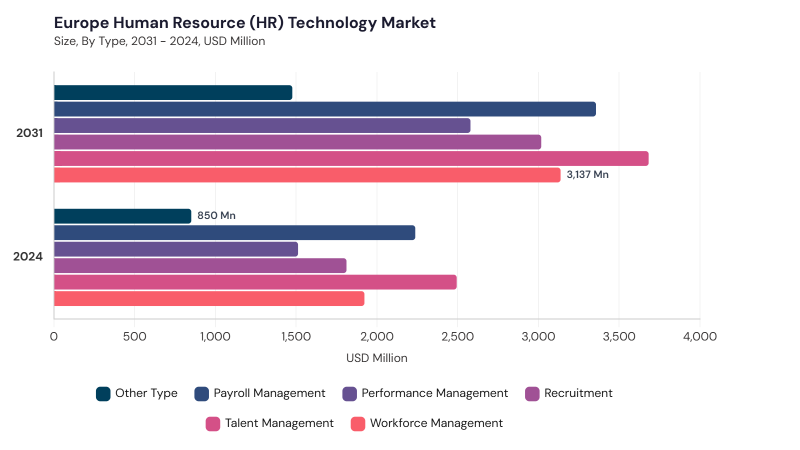
Based on Type, the market is segmented into Talent Management, Payroll Management, Workforce Management, Recruitment, Performance Management, and Other Type. Talent Management supports learning, succession planning, employee engagement, skills development, career progression, and increasingly AI-enabled workforce insights. Payroll Management automates salary processing, taxation, benefits, statutory reporting, and multi-country compensation administration, while Workforce Management addresses scheduling, attendance, labor forecasting, absence management, and productivity optimization.
Recruitment technologies streamline candidate sourcing, applicant tracking, AI-enabled screening, virtual hiring, and onboarding, whereas Performance Management supports continuous feedback, goal setting, appraisal, competency assessment, and organizational alignment. Other Type includes employee experience, benefits administration, HR analytics, compliance management, wellness platforms, and other specialized technologies addressing emerging workforce requirements.
Free Valuable Insights: The Worldwide Human Resource Technology Market is projected to reach USD 78.0 Billion billion by 2033, at a CAGR of 7.9%
Based on Country, the market is segmented into Germany, UK, France, Russia, Spain, Italy, and Rest of Europe. The Germany market dominated the Europe Human Resource (HR) Technology Market by Country in 2025, and would continue to be a dominant market till 2033; thereby, achieving a market value of USD 3.4 billion by 2031, growing at a CAGR of 6.2 % during the forecast period. The UK market is expected to witness a CAGR of 6.5% during (2026 - 2033). Additionally, The France market is expected to witness a CAGR of 8.2% during (2026 - 2033).
Across Europe, HR technology adoption reflects differences in labor regulation, digital maturity, workforce structures, localization requirements, and enterprise technology readiness. Germany emphasizes AI-driven recruitment, hybrid workforce management, continuous skills development, strong privacy controls, and integration with local labor requirements, while the UK focuses on predictive analytics, employee wellbeing, compliance, cybersecurity, and user-centric HR platforms. France combines AI-enabled recruitment, digital employee experience, labor-law compliance, cloud infrastructure, and localized payroll capabilities, whereas Russia emphasizes AI-based talent management, cloud platforms, localized compliance, data security, and workforce analytics. Spain focuses on automated recruitment, employee experience, cloud-based delivery, mobile accessibility, and localized labor compliance, while Italy emphasizes AI-enabled recruitment, modular cloud solutions, employee engagement, advanced analytics, and alignment with domestic labor requirements. Rest of Europe continues to develop cloud-native, multilingual, AI-enabled, compliance-focused, and modular platforms suited to diverse national regulations, workforce models, and organizational scales.

By Enterprise Size
By Deployment
By Industry
By Type
By Country
Set to reach $17.2 Billion by 2031, growing at 7.5% CAGR during 2026-2033.
Germany leads with $3.4 billion by 2031, growing at a CAGR of 6.2% during 2026-2033.
Cloud deployment dominates, reaching $12.2 billion by 2031, with a 7.6% CAGR during 2026-2033.
Large Enterprises will achieve $10.2 billion by 2031, growing at a 7.1% CAGR during 2026-2033.
The UK market is expected to witness a CAGR of 6.5% during 2026-2033.
The France market is expected to witness a CAGR of 8.2% during 2026-2033.
Our team of dedicated experts can provide you with attractive expansion opportunities for your business.




 Unique Offerings
