The Asia Pacific Human Resource (HR) Technology Market is expected to reach USD 15.9 billion by 2030, growing at a CAGR of 8.5% during (2026 - 2033).
The Asia Pacific Human Resource Technology Market evolved from basic payroll processing and employee record-management applications toward integrated digital platforms supporting recruitment, talent management, performance monitoring, workforce planning, and employee engagement. Initial adoption was concentrated among large enterprises in technologically advanced economies, while cloud computing, mobile applications, and software-as-a-service delivery progressively expanded access across organizations of different sizes. Advanced analytics, artificial intelligence, machine learning, and employee self-service capabilities further transformed HR systems from administrative tools into strategic workforce platforms. Current development emphasizes integrated digital ecosystems, real-time workforce insights, localized compliance, mobile-first access, and scalable technology capable of supporting diverse and geographically dispersed workforces.
Artificial intelligence, cloud adoption, employee experience, workforce analytics, localization, and regulatory compliance are shaping current market development. Organizations increasingly use AI for candidate screening, skills assessment, predictive workforce planning, employee engagement, personalized learning, and performance analysis, while cloud platforms support distributed and hybrid workforces with scalable access to HR functions. Mobile-enabled applications and employee self-service are expanding usability, particularly across digitally growing economies and SME environments. Vendors are also strengthening multilingual interfaces, localized labor-law compliance, cybersecurity, data-governance capabilities, and integration with enterprise systems. However, fragmented privacy regulations, legacy-system integration, high implementation costs, digital infrastructure disparities, cybersecurity concerns, and differences in technological maturity continue to affect regional adoption.
Based on Enterprise Size, the market is segmented into Large Enterprise and Small and Medium Enterprises (SMEs). The Large Enterprise market dominated the Asia Pacific Human Resource (HR) Technology Market by Enterprise Size in 2025, and would continue to be a dominant market till 2033; thereby, achieving a market value of USD 9.5 billion by 2030, growing at a CAGR of 8.1 % during the forecast period. The Small and Medium Enterprises (SMEs) market is expected to witness a CAGR of 9.1% during (2026 - 2033).
Large Enterprise adoption centers on integrated HR platforms combining recruitment, talent development, workforce analytics, performance management, employee engagement, compliance, and cross-border workforce administration. AI-enabled skills intelligence, predictive analytics, cloud migration, employee self-service, and digital workforce planning are strengthening modernization among major employers. Small and Medium Enterprises (SMEs) increasingly adopt affordable cloud subscriptions, mobile-first applications, and modular solutions covering payroll, attendance, recruitment, and employee administration. Simplified implementation, lower infrastructure requirements, scalable pricing, government-led digitalization initiatives, and growing startup ecosystems are making HR technology increasingly accessible to smaller organizations.
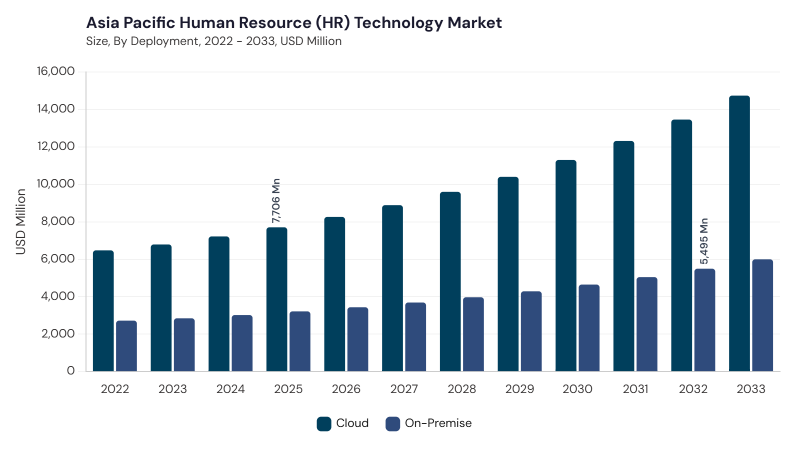
Based on Deployment, the market is segmented into Cloud and On-Premise. The Cloud market dominated the Asia Pacific Human Resource (HR) Technology Market by Deployment in 2025, and would continue to be a dominant market till 2033; thereby, achieving a market value of USD 11.3 billion by 2030, growing at a CAGR of 8.6 % during the forecast period. Additionally, The On-Premise market is expected to witness highest CAGR of 8.3% during (2026 - 2033).
Cloud deployment supports payroll, recruitment, talent management, employee engagement, analytics, and self-service functions through remotely hosted environments that facilitate real-time access across distributed workforces. Expansion of cloud infrastructure, AI-enabled analytics, mobile applications, cybersecurity capabilities, and remote work models continues to strengthen adoption across regional economies. On-Premise remains relevant among selected organizations requiring direct control of workforce databases, extensive system customization, close integration with legacy applications, and alignment with internal information-security requirements. Banking, manufacturing, government, and other regulated environments continue to sustain demand where data sovereignty, system control, and localized deployment remain important considerations.
Based on Industry, the market is segmented into BFSI, IT & Telecommunication, Manufacturing, Retail, Government, Healthcare, and Other Industry. BFSI uses HR technology for recruitment, compliance, workforce analytics, secure employee-data management, learning, and talent retention, while IT & Telecommunication emphasizes AI-based hiring, skills development, engagement, project workforce management, and cloud-based collaboration.
Manufacturing prioritizes scheduling, attendance, labor productivity, training, safety compliance, and workforce readiness, whereas Retail relies on high-volume recruitment, frontline scheduling, payroll, employee engagement, and multi-location workforce coordination. Government adoption focuses on personnel records, benefits administration, compliance, transparency, and public-sector modernization, while Healthcare emphasizes credential tracking, shift coordination, training, staffing, and employee wellbeing. Other Industry includes logistics, education, hospitality, transportation, construction, and business services adopting HR platforms for varied workforce requirements.
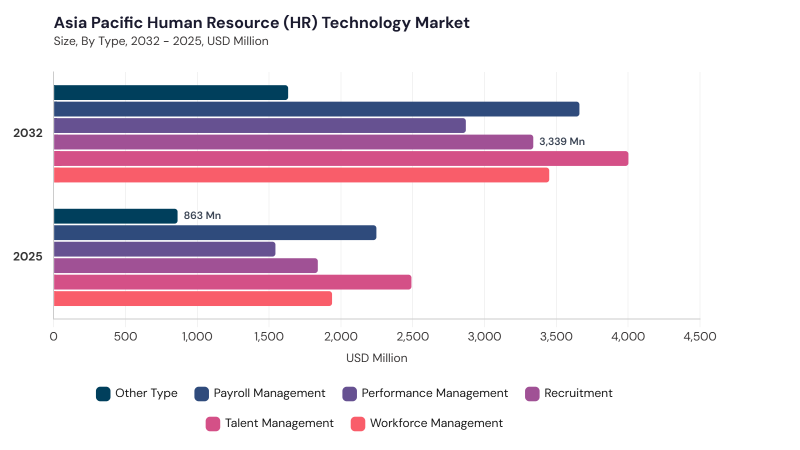
Based on Type, the market is segmented into Talent Management, Payroll Management, Workforce Management, Recruitment, Performance Management, and Other Type. Talent Management platforms support learning, succession planning, competency mapping, career development, internal mobility, and AI-enabled workforce insights, while Payroll Management automates salary processing, statutory compliance, tax administration, benefits, and employee compensation workflows. Workforce Management addresses scheduling, attendance, absence management, labor forecasting, capacity planning, and workforce optimization across complex operating environments.
Recruitment technologies streamline applicant tracking, candidate sourcing, AI-assisted screening, digital assessment, video interviewing, and onboarding, whereas Performance Management supports continuous feedback, goal tracking, appraisal, coaching, and employee development. Other Type includes workforce analytics, employee wellness, engagement platforms, benefits applications, compliance management, and other specialized HR technologies.
Free Valuable Insights: Human Resource Technology Market is Predicted to reach USD 78.0 Billion billion by 2033, at a CAGR of 7.9%
Based on Country, the market is segmented into China, Japan, India, South Korea, Singapore, Malaysia, and Rest of Asia Pacific. The China market dominated the Asia Pacific Human Resource (HR) Technology Market by Country in 2025, and would continue to be a dominant market till 2033; thereby, achieving a market value of USD 4.2 billion by 2030, growing at a CAGR of 6.5 % during the forecast period. The Japan market is expected to witness a CAGR of 7.9% during (2026 - 2033). Additionally, The India market is expected to witness a CAGR of 9.1% during (2026 - 2033).
Across Asia Pacific, HR technology adoption reflects differences in workforce demographics, digital maturity, regulatory structures, cloud readiness, and localization requirements. China emphasizes AI-driven talent analytics, workforce planning, localized compliance, cybersecurity, and integration with domestic digital ecosystems, while Japan focuses on AI-enabled talent matching, reskilling, workforce planning, localization, and solutions addressing labor shortages. India is advancing cloud-native, mobile-first HR systems, AI-supported recruitment, employee wellness, analytics, and platforms suited to SMEs and geographically dispersed workforces, whereas South Korea emphasizes AI-based recruitment, employee engagement, integrated enterprise systems, cybersecurity, and locally adapted digital HR. Singapore focuses on AI, employee experience, compliance automation, cloud-native architecture, and advanced workforce analytics, while Malaysia emphasizes cloud adoption, AI-enabled hiring, mobile accessibility, localized compliance, multilingual support, and scalable subscription-based solutions. Rest of Asia Pacific continues to develop cloud-based, mobile-enabled, AI-driven, multilingual, compliance-focused, and modular HR platforms adapted to varying levels of workforce digitalization and regulatory maturity.

By Enterprise Size
By Deployment
By Industry
By Type
By Country
Set to reach $15.9 Billion by 2030, growing at 8.5% CAGR during 2026-2033.
China leads with a market value of USD 4.2 billion by 2030, growing at 6.5% CAGR during 2026-2033.
Rising adoption of cloud solutions, with the cloud segment reaching USD 11.3 billion by 2030 at 8.6% CAGR.
Large enterprises will achieve a market value of USD 9.5 billion by 2030, growing at 8.1% CAGR during 2026-2033.
India is expected to witness a CAGR of 9.1% during 2026-2033.
SMEs are expected to witness a CAGR of 9.1% during 2026-2033.
Our team of dedicated experts can provide you with attractive expansion opportunities for your business.




 Unique Offerings
