The sample copy of this report is available for access.
“Global Healthcare API Market to reach a market value of USD 1,902.39 Million by 2033 growing at a CAGR of 5.2%”
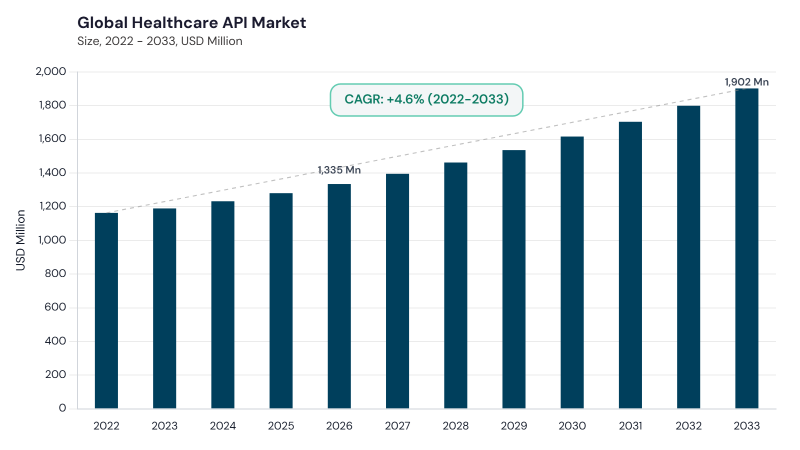
The Global Healthcare API Market is expected to reach USD 1902.4 million by 2033, growing at a CAGR of 5.2% during (2026 - 2033).
Growing need for seamless healthcare data exchange, interoperable clinical systems, digitally connected patient services, and secure access to electronic health information is driving the Healthcare API Market across hospitals, clinics, insurers, pharmacies, laboratories, and health technology platforms. Adoption is further strengthened by digital health expansion, cloud-based healthcare solutions, telehealth, remote patient services, standardized interoperability frameworks, consent management, scalable API architectures, and integration with clinical and administrative workflows.
Increasing regulatory demand for interoperability, rising EHR penetration, expanding telehealth, and the growing role of connected medical devices are driving Healthcare API Market growth. Healthcare organizations are adopting APIs to reduce data silos, improve clinical coordination, automate claims and payments, support patient-facing applications, and enable real-time access to health information. FHIR-based APIs, SMART on FHIR, HL7 messaging, RESTful architectures, cloud-native repositories, API gateways, and secure consent frameworks are becoming central to digital health ecosystems. AI-enabled APIs are also expanding the market by supporting predictive analytics, clinical decision support, regulatory automation, and personalized care delivery.
The competitive environment is interoperability-led and moderately fragmented, with EHR vendors, cloud platform companies, healthcare transaction providers, API integration specialists, and payer-focused interoperability firms competing across the market. Epic Systems leads through open.epic, Epic on FHIR, and Care Everywhere, while Oracle strengthens its position through Oracle Health and Millennium interoperability capabilities. UnitedHealth Group participates through Optum and Change Healthcare-related payer-provider transaction infrastructure, while InterSystems, Redox, Microsoft, Rhapsody, Google, Salesforce, and 1upHealth add competitive depth through FHIR repositories, cloud healthcare APIs, normalized healthcare data models, API management, clinical integration, payer compliance, and AI-ready healthcare data infrastructure.

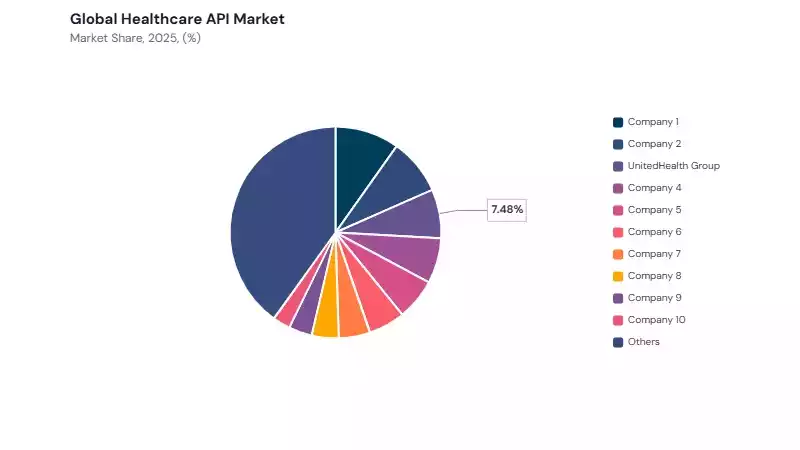
The global Healthcare API Market reflects a moderately fragmented and interoperability-centric competitive landscape, with participation from EHR platform providers, healthcare interoperability specialists, payer technology companies, cloud infrastructure providers, API management vendors, and digital health integration platforms. Epic Systems maintains strong leadership through its extensive EHR ecosystem, FHIR-based connectivity, and Care Everywhere network, while Oracle strengthens the market through Oracle Health, clinical data exchange, and large-scale healthcare infrastructure integration. UnitedHealth Group, InterSystems, Redox, Microsoft, Rhapsody, Google, Salesforce, and 1upHealth compete through payer-provider connectivity, FHIR repositories, cloud-native healthcare APIs, HL7 integration, API-first workflows, patient access, prior authorization, and analytics-ready data exchange.
Based on Deployment, the market is segmented into Cloud Based and On-Premise. The Cloud Based market dominated the Global Healthcare API Market by Deployment in 2025, and would continue to be a dominant market till 2033; thereby, achieving a market value of USD 1426.6 million by 2033, growing at a CAGR of 5.4 % during the forecast period. The On-Premise market is expected to witness a CAGR of 4.7% during (2026 - 2033).
Cloud Based deployment remains the leading model as healthcare organizations increasingly prefer scalable, remotely accessible, and faster-to-integrate API infrastructure. Cloud-based APIs support EHR connectivity, telehealth platforms, patient portals, analytics tools, mobile health applications, and digital health ecosystems without heavy upfront infrastructure investment. On-Premise deployment remains important for hospitals, public health systems, regulated providers, and organizations that require direct control over sensitive health data, internal infrastructure, security policies, and data governance. Hybrid models are also becoming relevant as healthcare organizations balance cloud scalability with compliance, privacy, and control requirements.
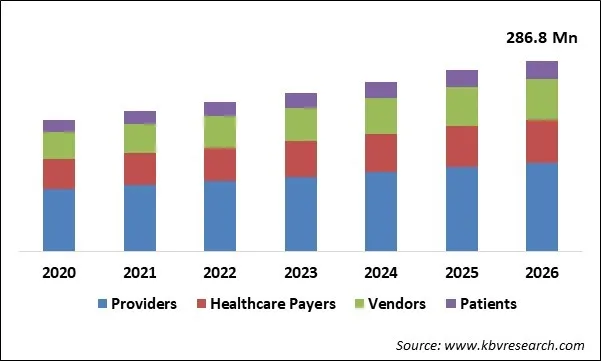
Based on End Use, the market is segmented into Healthcare Providers, Healthcare Payers, Healthcare Vendors, and Patients. The Healthcare Providers market dominated the Global Healthcare API Market by End Use in 2025, and would continue to be a dominant market till 2033; thereby, achieving a market value of USD 802.3 million by 2033, growing at a CAGR of 4.6 % during the forecast period. The Healthcare Payers market is expected to witness a CAGR of 5.4% during (2026 - 2033). Additionally, The Healthcare Vendors market is expected to witness highest CAGR of 5.9% during (2026 - 2033).
Healthcare Providers remain the leading end-use segment because hospitals, clinics, laboratories, and physician groups rely on APIs for EHR integration, care coordination, clinical data exchange, telehealth, and workflow automation. Healthcare Payers use APIs for claims processing, eligibility verification, member data exchange, prior authorization, value-based care workflows, and payer-provider connectivity. Healthcare Vendors depend on APIs to integrate digital health applications, medical devices, analytics platforms, and software solutions with broader healthcare systems. Patients represent a growing end-use category as APIs enable access to health records, appointment scheduling, mobile health apps, wearable data, patient portals, and personalized digital care services.
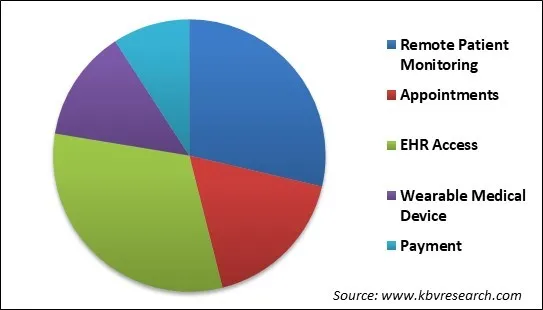
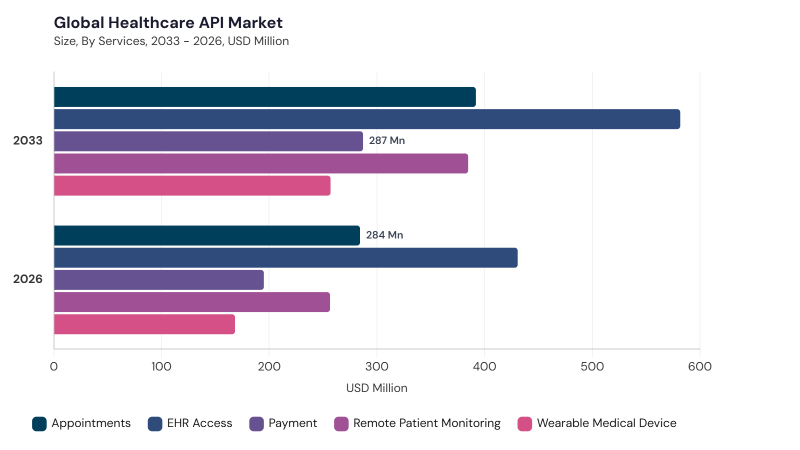
Based on Services, the market is segmented into EHR Access, Appointments, Remote Patient Monitoring, Payment, and Wearable Medical Device. The EHR Access market dominated the Global Healthcare API Market by Services in 2025, and would continue to be a dominant market till 2033; thereby, achieving a market value of USD 581.6 million by 2033, growing at a CAGR of 4.4 % during the forecast period. The Appointments market is expected to witness a CAGR of 4.7% during (2026 - 2033). Additionally, The Remote Patient Monitoring market is expected to witness highest CAGR of 6% during (2026 - 2033).
EHR Access remains the core service segment because healthcare organizations require secure, standardized, and real-time access to electronic health information across providers, payers, and applications. Appointments APIs improve patient scheduling, reminders, cancellations, telehealth booking, and provider calendar synchronization. Remote Patient Monitoring APIs support continuous health data transfer from home-based devices, IoT systems, and clinical platforms. Payment APIs streamline billing, claims, eligibility checks, patient payments, and revenue cycle workflows, while Wearable Medical Device APIs connect activity, biometric, and physiological data with healthcare systems for preventive care, chronic disease management, and personalized monitoring.
Free Valuable Insights: Healthcare API Market Size to reach $1902.4 Million by 2033
Region-wise, the Healthcare API Market is analyzed across North America, Europe, Asia Pacific, and LAMEA. The North America market dominated the Global Healthcare API Market by Region in 2025, and would continue to be a dominant market till 2033; thereby, achieving a market value of USD 691.7 million by 2033, growing at a CAGR of 4.7 % during the forecast period. The Europe market is expected to witness a CAGR of 4.8% during (2026 - 2033). Additionally, The Asia Pacific market is expected to witness a CAGR of 5.8% during (2026 - 2033).
North America leads the global market due to strong EHR adoption, interoperability mandates, cloud healthcare infrastructure, payer-provider data exchange, telehealth maturity, and extensive digital health investment. Europe benefits from GDPR-driven privacy requirements, national digital health programs, secure data-sharing initiatives, and growing use of FHIR-based interoperability. Asia Pacific is expanding through healthcare digitization, rising telehealth adoption, growing mobile health usage, government-backed health IT modernization, and demand for scalable APIs across China, Japan, India, South Korea, Australia, and Malaysia. LAMEA is developing steadily as healthcare systems adopt digital platforms, cloud infrastructure, patient engagement tools, remote care models, and secure healthcare data-exchange frameworks.
| Report Attribute | Details |
|---|---|
| Market size value in 2026 | USD 1334.8 million |
| Market size forecast in 2033 | USD 1902.4 million |
| Base Year | 2025 |
| Historical Period | 2022 to 2024 |
| Forecast Period | 2026 to 2033 |
| Revenue Growth Rate | CAGR of 5.2% from 2026 to 2033 |
| Number of Pages | 503 |
| Tables | 660 |
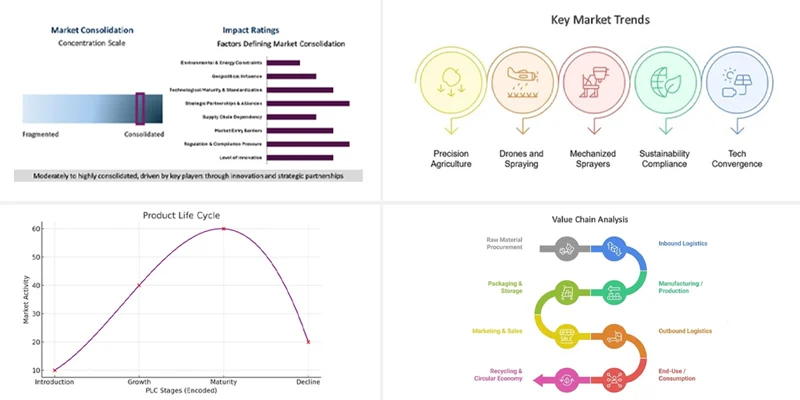
| Report Coverage | Market Trends, Revenue Estimation and Forecast, Segmentation Analysis, Regional and Country Breakdown, Competitive Landscape, Market Share Analysis, Company Profiling, Companies Strategic Developments, SWOT Analysis, Product Life Cycle Analysis, Value Chain Analysis, Market Consolidation Analysis, Key Customer Criteria, Pandemic Impact Analysis, and Winning Imperatives |
| Segments Covered | Deployment, End Use, Services, and Geography |
| Country Scope |
|
| Companies Included | Epic Systems Corporation; Oracle Corporation; UnitedHealth Group; InterSystems Corporation; Redox, Inc.; Microsoft Corporation; Rhapsody; Google LLC; Salesforce, Inc.; 1upHealth, Inc. |
By Deployment
By End Use
By Services
By Geography
Expected to reach USD 1902.4 million by 2033, growing at 5.2% CAGR during 2026-2033.
Public cloud tops the chart, projected to hit $188.02 billion by 2033.
Epic Systems, Oracle, UnitedHealth, InterSystems, Redox, Microsoft, Rhapsody, Google, Salesforce, 1upHealth.
North America leads at $111.24 billion by 2033; Asia Pacific grows at 13.1% CAGR during 2026-2033.
Enhanced interoperability and regulatory compliance are key growth drivers for healthcare APIs.
The global market size is expected to reach USD 1902.4 million by 2033 at 5.2% CAGR during 2026-2033.
Our team of dedicated experts can provide you with attractive expansion opportunities for your business.








 Unique Offerings