The sample copy of this report is available for access.
The Asia Pacific Healthcare API Market is expected to reach USD 426.6 million by 2030, growing at a CAGR of 5.8% during (2026 - 2033).
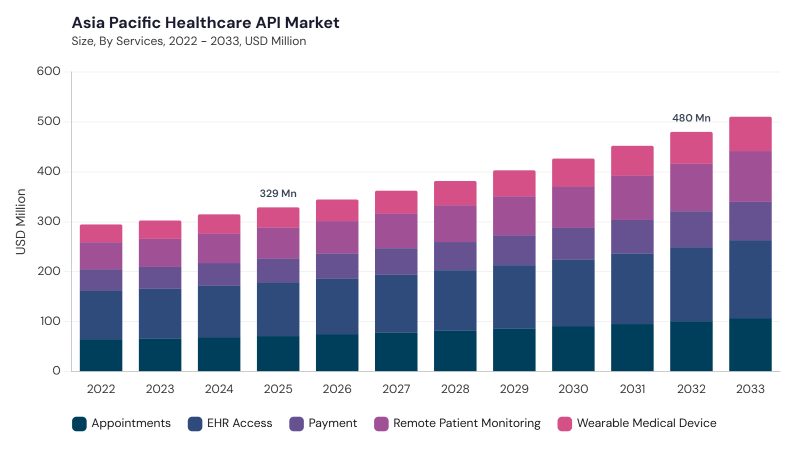
The Asia Pacific Healthcare API Market evolved alongside rapid healthcare digitization, progressing from fragmented hospital information systems and basic electronic data exchange toward interoperable API-driven healthcare ecosystems. Expansion of electronic health records, telemedicine, mobile health applications, cloud infrastructure, and connected medical platforms increased the need for secure and scalable data exchange. Adoption of interoperability standards, digital health initiatives, and advanced analytics further strengthened integration across healthcare stakeholders. Current development increasingly emphasizes cloud-native APIs, AI-enabled clinical applications, remote care, secure patient-data access, digital payments, wearable connectivity, and standardized health information exchange across diverse regional healthcare systems.
Healthcare digitization, cloud adoption, interoperability, AI integration, and connected-care expansion are shaping current market development. Providers are increasingly using APIs to link EHRs, laboratories, pharmacy systems, telemedicine platforms, remote monitoring solutions, billing systems, mobile health applications, and wearable devices. Growing investments in cloud infrastructure, FHIR-compatible data exchange, cybersecurity, automated workflows, and real-time analytics are improving healthcare connectivity and operational efficiency. However, fragmented regulations, uneven digital infrastructure, legacy healthcare systems, cybersecurity concerns, data-localization requirements, interoperability gaps, and high implementation costs continue to influence adoption across developed and emerging Asia Pacific economies.
Based on Deployment, the market is segmented into Cloud Based and On-Premise. The Cloud Based market dominated the Asia Pacific Healthcare API Market by Deployment in 2025, and would continue to be a dominant market till 2033; thereby, achieving a market value of USD 318.8 million by 2030, growing at a CAGR of 5.9 % during the forecast period. The On-Premise market is expected to witness a CAGR of 5.3% during (2026 - 2033).
Cloud Based deployment enables hospitals, clinics, telehealth providers, and health-tech companies to connect EHRs, diagnostic systems, mobile applications, analytics platforms, and patient-engagement tools through scalable infrastructure. Flexible capacity, centralized updates, remote accessibility, and support for AI-enabled services strengthen cloud adoption. On-Premise deployment remains relevant among organizations prioritizing internal control of sensitive healthcare data, customized IT environments, and integration with established legacy systems. Data-localization requirements, cybersecurity considerations, governance preferences, and national privacy regulations continue to sustain selective on-premise deployment, while hybrid architectures increasingly combine local control with cloud flexibility.
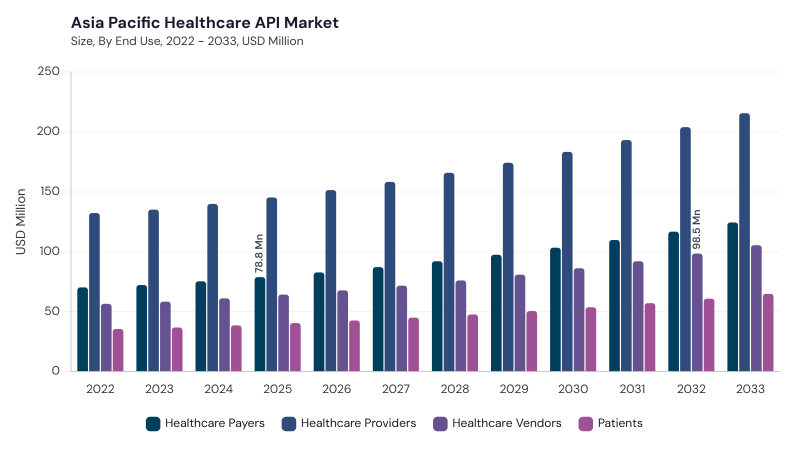
Based on End Use, the market is segmented into Healthcare Providers, Healthcare Payers, Healthcare Vendors, and Patients. The Healthcare Providers market dominated the Asia Pacific Healthcare API Market by End Use in 2025, and would continue to be a dominant market till 2033; thereby, achieving a market value of USD 183.3 million by 2030, growing at a CAGR of 5.2 % during the forecast period. The Healthcare Payers market is expected to witness a CAGR of 6% during (2026 - 2033). Additionally, The Healthcare Vendors market is expected to witness highest CAGR of 6.5% during (2026 - 2033).
Healthcare Providers use APIs for clinical data exchange, EHR connectivity, telemedicine, diagnostics, patient monitoring, and care coordination. Healthcare Payers apply APIs across claims processing, eligibility verification, fraud detection, member management, reimbursement, and analytics-driven risk assessment. Healthcare Vendors develop interoperable platforms, API management tools, telehealth solutions, healthcare software, and analytics applications adapted to diverse regional systems. Patients increasingly use API-enabled portals, mobile health applications, personal health records, telemedicine platforms, and connected devices to access information and participate more actively in healthcare management.
Based on Services, the market is segmented into EHR Access, Appointments, Remote Patient Monitoring, Payment, and Wearable Medical Device. EHR Access APIs enable secure retrieval, updating, and exchange of patient records across hospitals, laboratories, clinics, and digital health platforms. Appointments APIs support online booking, reminders, rescheduling, provider availability, teleconsultations, and patient journey coordination.
Remote Patient Monitoring APIs connect biometric devices and home-based monitoring solutions with clinical systems to support chronic disease management and decentralized care. Payment APIs facilitate billing, insurance transactions, claims, and digital patient payments, while Wearable Medical Device APIs connect smart health devices and physiological monitoring tools with healthcare applications and clinical data environments.
Free Valuable Insights: Healthcare API Market is Predicted to reach USD 1902.4 Million billion by 2033, at a CAGR of 5.2%
Based on Country, the market is segmented into China, Japan, India, South Korea, Australia, Malaysia, and Rest of Asia Pacific. The China market dominated the Asia Pacific Healthcare API Market by Country in 2025, and would continue to be a dominant market till 2033; thereby, achieving a market value of USD 102.1 million by 2030, growing at a CAGR of 3.6 % during the forecast period. The Japan market is expected to witness a CAGR of 5.1% during (2026 - 2033). Additionally, The India market is expected to witness a CAGR of 6.4% during (2026 - 2033).
Across Asia Pacific, healthcare API adoption is being shaped by digital health modernization, interoperability, AI integration, regulatory development, and secure healthcare data exchange. China emphasizes digital healthcare infrastructure, automation, data integration, regulatory compliance, and increasingly sophisticated health technology ecosystems, while Japan focuses on secure interoperability, localized data governance, advanced healthcare systems, automation, and digitally supported care. India is advancing digital health integration, scalable platforms, automation, interoperability, and patient-facing services, whereas South Korea emphasizes AI-enabled healthcare, data security, connected care, digital infrastructure, and localization. Australia focuses on FHIR-based interoperability, real-time health information exchange, AI analytics, cybersecurity, and remote care integration, while Malaysia is developing interoperable platforms, AI-enabled APIs, cloud infrastructure, cybersecurity, and integrated public-private healthcare systems. Rest of Asia Pacific continues to adopt standardized APIs, cloud-based healthcare platforms, remote monitoring, secure data exchange, mobile health services, and scalable digital health infrastructure suited to varied levels of healthcare maturity.

By Deployment
By End Use
By Services
By Country
Set to reach $426.6 Million by 2030, growing at 5.8% CAGR during 2026-2033.
China leads with $102.1 million by 2030, growing at a CAGR of 3.6% during 2026-2033.
Cloud-based deployment will reach $318.8 million by 2030, growing at a CAGR of 5.9% during 2026-2033.
Healthcare providers will reach $183.3 million by 2030, growing at a CAGR of 5.2% during 2026-2033.
India's market is expected to grow at a CAGR of 6.4% during 2026-2033.
Our team of dedicated experts can provide you with attractive expansion opportunities for your business.




 Unique Offerings