The sample copy of this report is available for access.
The Europe Healthcare API Market is expected to reach USD 483.4 million by 2031, growing at a CAGR of 4.8% during (2026 - 2033).
The Europe Healthcare API Market evolved alongside the digital transformation of regional healthcare systems, progressing from fragmented and proprietary data exchanges toward standardized, interoperable API-based architectures. Expansion of electronic health records, cloud computing, patient portals, telehealth, and digitally connected care accelerated the need for secure information exchange across healthcare stakeholders. Adoption of interoperability standards such as FHIR further improved connectivity between clinical applications, diagnostic systems, and third-party platforms. Current development increasingly emphasizes cloud-native integration, AI-enabled healthcare services, patient data portability, regulatory compliance, cybersecurity, real-time information exchange, and scalable digital ecosystems adapted to Europe’s diverse healthcare infrastructure.
Interoperability, cloud migration, patient-centric digital services, regulatory compliance, and AI integration are shaping current market development. Healthcare organizations are increasingly using APIs to connect EHR platforms, appointment systems, remote patient monitoring tools, payment workflows, wearable devices, telehealth applications, and analytics platforms. Growing emphasis on GDPR-aligned data protection, secure authentication, standardized information exchange, cloud-based healthcare infrastructure, and automated clinical workflows is strengthening adoption. However, fragmented national healthcare systems, legacy technology, cybersecurity risks, integration complexity, data-sovereignty concerns, and evolving regulatory requirements continue to influence deployment and scalability across Europe.
Based on Deployment, the market is segmented into Cloud Based and On-Premise. The Cloud Based market dominated the Europe Healthcare API Market by Deployment in 2025, and would continue to be a dominant market till 2033; thereby, achieving a market value of USD 361.7 million by 2031, growing at a CAGR of 5 % during the forecast period. The On-Premise market is expected to witness a CAGR of 4.4% during (2026 - 2033).
Cloud Based deployment enables hospitals, clinics, digital health providers, and technology vendors to connect EHRs, patient portals, diagnostic platforms, telehealth services, and analytics applications through scalable infrastructure. Faster deployment, flexible capacity, simplified updates, and support for AI and remote care strengthen its adoption. On-Premise deployment remains important among institutions requiring tighter control over clinical data, internally managed infrastructure, and localized governance. Privacy, cybersecurity, data residency, regulatory compliance, and legacy-system requirements continue to sustain selective on-premise adoption, while hybrid models increasingly combine internal control with cloud-enabled interoperability.
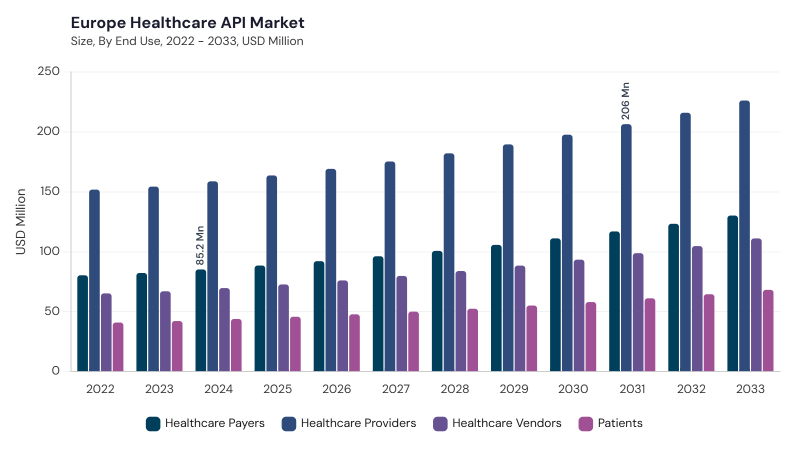
Based on End Use, the market is segmented into Healthcare Providers, Healthcare Payers, Healthcare Vendors, and Patients. The Healthcare Providers market dominated the Europe Healthcare API Market by End Use in 2025, and would continue to be a dominant market till 2033; thereby, achieving a market value of USD 206.4 million by 2031, growing at a CAGR of 4.2 % during the forecast period. The Healthcare Payers market is expected to witness a CAGR of 5.1% during (2026 - 2033). Additionally, The Healthcare Vendors market is expected to witness highest CAGR of 5.6% during (2026 - 2033).
Healthcare Providers use APIs for EHR connectivity, clinical information exchange, telemedicine, patient monitoring, diagnostic integration, and coordinated care workflows. Healthcare Payers apply APIs to reimbursement, coverage administration, claims processing, member information, risk assessment, and financial data exchange. Healthcare Vendors develop interoperable software, API gateways, developer platforms, and connected health applications supporting providers and payers. Patients increasingly interact with API-enabled portals, mobile health applications, personal health records, appointment platforms, and connected devices, supporting greater access to information and participation in healthcare management.
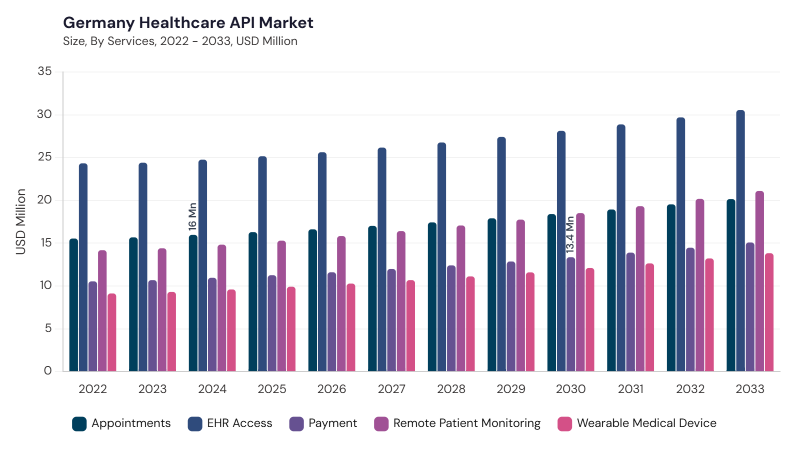
Based on Services, the market is segmented into EHR Access, Appointments, Remote Patient Monitoring, Payment, and Wearable Medical Device. EHR Access APIs facilitate standardized retrieval, exchange, and updating of electronic medical records across providers and applications. Appointments APIs support digital booking, referral coordination, reminders, and integration with patient portals and telehealth platforms.
Remote Patient Monitoring APIs connect home-based monitoring devices and clinical systems to support chronic care and decentralized treatment models. Payment APIs streamline billing, reimbursements, claims, and patient financial interactions, while Wearable Medical Device APIs connect smartwatches, biosensors, and medical-grade devices with healthcare platforms to incorporate continuously generated health information into broader clinical workflows.
Free Valuable Insights: The Worldwide Healthcare API Market is projected to reach USD 1902.4 Million billion by 2033, at a CAGR of 5.2%
Based on Country, the market is segmented into Germany, UK, France, Russia, Spain, Italy, and Rest of Europe. The Germany market dominated the Europe Healthcare API Market by Country in 2025, and would continue to be a dominant market till 2033; thereby, achieving a market value of USD 93.6 million by 2031, growing at a CAGR of 3.4 % during the forecast period. The UK market is expected to witness a CAGR of 3.9% during (2026 - 2033). Additionally, The France market is expected to witness a CAGR of 5.6% during (2026 - 2033).
Across Europe, healthcare API adoption is being shaped by digital health modernization, interoperability standards, privacy regulation, cloud adoption, and AI-enabled care. Germany emphasizes secure digital ecosystems, cloud-based integration, regulatory compliance, data management, and interoperable healthcare infrastructure, while the UK focuses on FHIR-based connectivity, NHS digital transformation, cloud platforms, AI-enabled services, and patient-centered applications. France is advancing HL7 FHIR adoption, national healthcare data integration, telemedicine, AI analytics, and secure patient-data access, whereas Russia emphasizes digitalization, localized healthcare infrastructure, automation, data integration, and technology modernization. Spain focuses on cloud-based APIs, AI-driven analytics, interoperability, patient-centric platforms, and regulatory modernization, while Italy emphasizes real-world data integration, cloud-native architectures, pharmaceutical and healthcare workflow connectivity, and AI-enabled services. Rest of Europe continues to develop interoperable healthcare platforms, digital health integration, secure data exchange, cloud-based systems, advanced analytics, and standardized API architectures adapted to varied national healthcare environments.

By Deployment
By End Use
By Services
By Country
Set to reach $483.4 Million by 2031, growing at 4.8% CAGR during 2026-2033.
Germany leads with a market value of $93.6 million by 2031, growing at 3.4% CAGR during the forecast period.
The Cloud Based segment dominates, reaching $361.7 million by 2031, at 5% CAGR during the forecast period.
Healthcare Providers segment hits $206.4 million by 2031, growing at 4.2% CAGR during 2026-2033.
The UK market is expected to witness a CAGR of 3.9% during 2026-2033.
The France market is expected to witness a CAGR of 5.6% during 2026-2033.
Our team of dedicated experts can provide you with attractive expansion opportunities for your business.




 Unique Offerings