The sample copy of this report is available for access.
The Europe Vibe Coding Market is expected to reach USD 3,449.61 million by 2031, growing at a CAGR of 16.6% during 2026 - 2033.
The Germany and UK led the Europe Vibe Coding Market by Country with a market share of 24.1% and 18% in 2025.The Italy market is expected to witness a CAGR of 18.3% during throughout the forecast period.
The Europe Vibe Coding Market originated from the emergence of AI-assisted software development paradigms that shifted programming away from traditional line-by-line coding toward natural language-driven interactions with intelligent coding assistants. Initially developed through experimental AI models focused on code generation and automation, vibe coding gained traction across European technology hubs seeking faster software development and innovation cycles. Advances in natural language processing, machine learning, and cloud-native development environments have transformed vibe coding into a powerful software creation methodology that enables developers and non-technical users to generate applications through conversational prompts.
The market is driven by increasing enterprise demand for faster software development, growing adoption of AI-assisted development platforms, rising shortages of skilled software developers, and expanding investments in digital transformation initiatives. Organizations across banking, healthcare, manufacturing, retail, and telecommunications are increasingly integrating vibe coding platforms into their development workflows to improve productivity, accelerate deployment cycles, and reduce development costs. At the same time, Europe’s strong emphasis on ethical AI, transparency, cybersecurity, and regulatory compliance is encouraging the development of secure and governance-focused vibe coding solutions.
Leading companies are focusing on enhancing AI model accuracy, expanding contextual code generation capabilities, integrating security and compliance frameworks, and strengthening cloud-native development environments. Strategic collaborations with cloud providers, research institutions, cybersecurity firms, and enterprise software vendors continue to support innovation and market expansion across Europe.
Based on Programming Paradigm, the Europe Vibe Coding Market is segmented into Object-Oriented Vibe Coding, Reactive Vibe Coding, Procedural Vibe Coding, Functional Vibe Coding, and Hybrid Paradigms.
The Object-Oriented Vibe Coding market dominated the Europe Vibe Coding Market by Programming Paradigm in 2025, and would continue to be a dominant market till 2033; thereby, achieving a market value of USD 1,006.67 million by 2031, growing at a CAGR of 15.3 % during the forecast period. The Reactive Vibe Coding market is expected to witness a CAGR of 16.9% during (2026 - 2033). The Hybrid Paradigms market is expected to witness a CAGR of 17.8% during (2026 - 2033).
The Object-Oriented Vibe Coding segment garnered the highest revenue share in the market owing to increasing demand for scalable, modular, and reusable software architectures supporting enterprise application development. Reactive Vibe Coding also recorded a significant share due to growing adoption of real-time and event-driven applications.
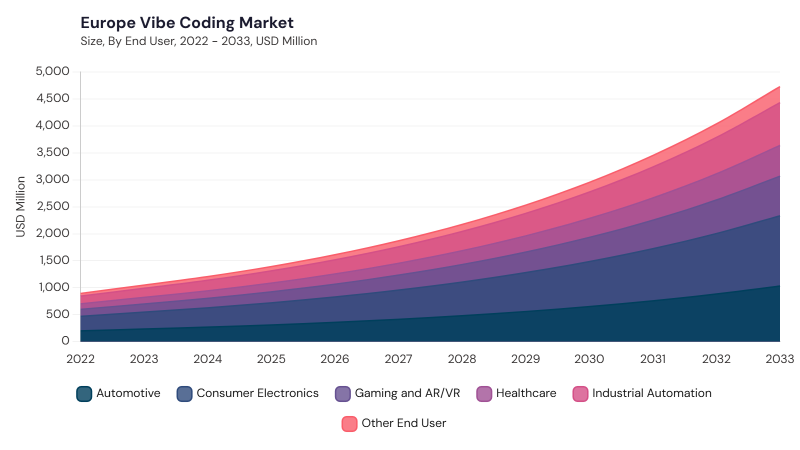
Based on End User, the Europe Vibe Coding Market is segmented into Consumer Electronics, Automotive, Industrial Automation, Gaming and AR/VR, Healthcare, and Other End User.
The Consumer Electronics market dominated the Europe Vibe Coding Market by End User in 2025, and would continue to be a dominant market till 2033; thereby, achieving a market value of USD 966.95 million by 2031, growing at a CAGR of 15.6 % during the forecast period. The Automotive market is expected to witness a CAGR of 16.4% during (2026 - 2033).
The Consumer Electronics segment garnered the highest revenue share in the market owing to increasing integration of intelligent software experiences across connected devices, wearables, and smart consumer products. The Automotive segment also recorded a significant share supported by growing implementation of AI-assisted development in connected and autonomous vehicle systems. Meanwhile, Industrial Automation, Gaming and AR/VR, Healthcare, and Other End User segments continue to expand through increasing adoption of AI-driven software development technologies.
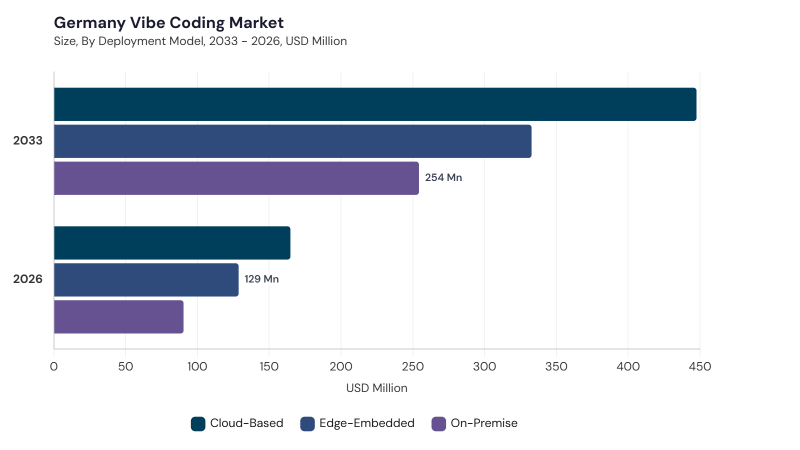
Based on Deployment Model, the Europe Vibe Coding Market is segmented into Cloud-Based, Edge-Embedded, and On-Premise. The Cloud-Based segment garnered the highest revenue share in the market owing to growing adoption of scalable cloud infrastructures, collaborative development environments, and centralized AI-powered coding platforms. The Edge-Embedded segment also recorded a significant share due to increasing demand for real-time processing and low-latency application deployment. Meanwhile, the On-Premise segment continues to witness adoption among enterprises prioritizing security, compliance, and infrastructure control.
Based on Product, the Europe Vibe Coding Market is segmented into Haptic Feedback Integrated Circuits, Vibe Pattern Encoders, Resonance Signal Transducers, and Integrated Vibe Development Kits. The Haptic Feedback Integrated Circuits segment garnered the highest revenue share in the market owing to growing demand for advanced tactile interaction technologies across consumer electronics, automotive systems, and industrial devices. The Vibe Pattern Encoders segment also recorded a significant share driven by increasing demand for customized sensory experiences. Meanwhile, Resonance Signal Transducers and Integrated Vibe Development Kits continue to gain adoption through expanding innovation in haptic and interactive technologies.
Free Valuable Insights: The Worldwide Vibe Coding Market is projected to reach USD 19,810.36 Million billion by 2033, at a CAGR of 16.9%
Based on Country, the Europe Vibe Coding Market is segmented into Germany, United Kingdom, France, Russia, Spain, Italy, and Rest of Europe. The Germany market dominated the Europe Vibe Coding Market by Country in 2025, and would continue to be a dominant market till 2033; thereby, achieving a market value of USD 774.58 million by 2031, growing at a CAGR of 15.2 % during the forecast period. The UK market is expected to witness a CAGR of 15.5% during (2026 - 2033). Addtionally, The France market is expected to witness a CAGR of 17.5% during (2026 - 2033).
Germany acquired a major share of the market owing to its strong software engineering ecosystem, growing enterprise digital transformation initiatives, and increasing adoption of AI-assisted development platforms. The United Kingdom and France also recorded significant market shares supported by strong innovation ecosystems, expanding AI investments, and increasing enterprise adoption of intelligent software development tools. Meanwhile, Russia, Spain, Italy, and the Rest of Europe are benefiting from expanding AI adoption, growing demand for software automation, and increasing investments in advanced development technologies.

By Programming Paradigm
By End User
By Deployment Model
By Product
By Country
Set to reach $3,449.61 Million by 2031, growing at 16.6% CAGR during 2026-2033.
Germany leads with a market share of 24.1% in 2025, reaching $774.58 million by 2031 at 15.2% CAGR.
Rising demand in Consumer Electronics, reaching $966.95 million by 2031 at 15.6% CAGR.
Expected to reach $1,006.67 million by 2031, growing at 15.3% CAGR during the forecast period.
Italy is expected to witness a CAGR of 18.3% throughout the forecast period.
The Reactive Vibe Coding market is expected to witness a CAGR of 16.9% during 2026-2033.
Our team of dedicated experts can provide you with attractive expansion opportunities for your business.




 Unique Offerings