The sample copy of this report is available for access.
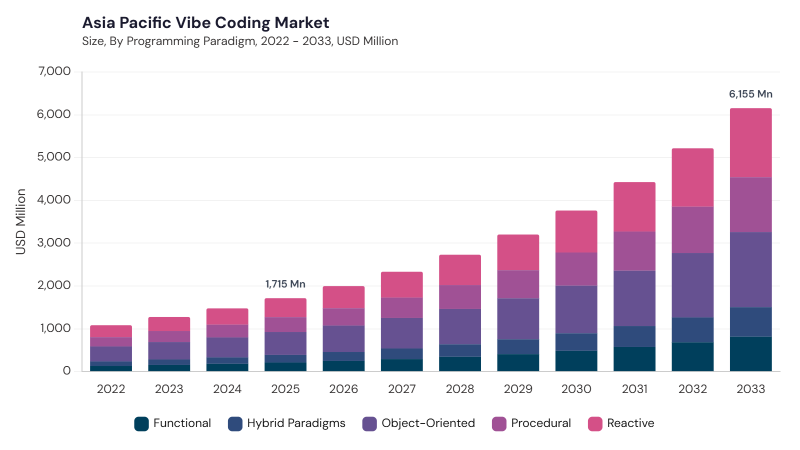
The Asia Pacific Vibe Coding Market is expected to reach USD 4,427.97 million by 2030, growing at a CAGR of 17.4% during 2026 - 2033.
The Asia Pacific Vibe Coding Market emerged from the broader transformation of software development toward AI-assisted and natural language-driven programming. Traditional software development in the region relied heavily on skilled programmers, but advances in artificial intelligence, machine learning, and large language models enabled a shift toward conversational software creation. Early adoption was driven by technology hubs in China, Japan, India, South Korea, Singapore, and Australia, where enterprises sought faster software development cycles and improved developer productivity.
The market is primarily driven by accelerating digital transformation initiatives, increasing adoption of AI-powered software development tools, rising demand for rapid application deployment, and a growing shortage of skilled software developers across the region. Enterprises are increasingly leveraging vibe coding platforms to reduce development timelines, improve operational efficiency, and democratize software creation among technical and non-technical users. Furthermore, governments across Asia Pacific are actively promoting AI innovation through funding programs, digital economy initiatives, and workforce development strategies, creating favorable conditions for market growth.
Key industry participants continue investing in advanced AI models, multilingual natural language processing capabilities, cloud-native development environments, cybersecurity integration, and regional customization. Strategic partnerships between AI vendors, cloud service providers, educational institutions, and enterprise software companies are further strengthening the market ecosystem while accelerating adoption across diverse industries.
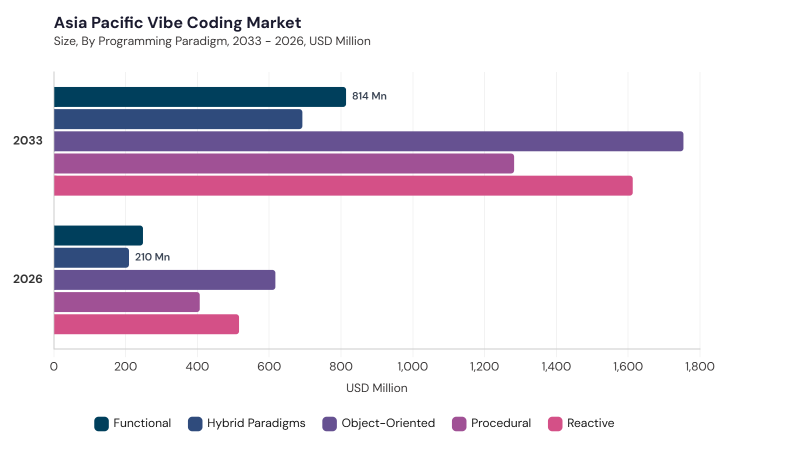
Based on Programming Paradigm, the Asia Pacific Vibe Coding Market is segmented into Object-Oriented Vibe Coding, Reactive Vibe Coding, Procedural Vibe Coding, Functional Vibe Coding, and Hybrid Paradigms.
The Object-Oriented Vibe Coding market dominated the Asia Pacific Vibe Coding Market by Programming Paradigm in 2025, and would continue to be a dominant market till 2033; thereby, achieving a market value of USD 1,111.05 million by 2030, growing at a CAGR of 16.1 % during the forecast period. The Reactive Vibe Coding market is expected to witness a CAGR of 17.7% during (2026 - 2033). The Hybrid Paradigms market is expected to witness a CAGR of 18.6% during (2026 - 2033).
The Object-Oriented Vibe Coding segment garnered the highest revenue share in the market owing to increasing demand for scalable, modular, and reusable software architectures capable of supporting complex enterprise applications. Reactive Vibe Coding also recorded a significant share due to growing adoption of real-time applications, IoT ecosystems, and event-driven software environments. Procedural Vibe Coding, Functional Vibe Coding, and Hybrid Paradigms continue gaining traction as organizations seek flexibility, efficiency, and reliability in AI-assisted software development workflows.
Based on End User, the Asia Pacific Vibe Coding Market is segmented into Consumer Electronics, Automotive, Industrial Automation, Gaming and AR/VR, Healthcare, and Other End User.
The Consumer Electronics market dominated the Asia Pacific Vibe Coding Market by End User in 2025, and would continue to be a dominant market till 2033; thereby, achieving a market value of USD 1,063.95 million by 2030, growing at a CAGR of 16.4 % during the forecast period. The Automotive market is expected to witness a CAGR of 17.2% during (2026 - 2033).
The Consumer Electronics segment garnered the highest revenue share in the market owing to Asia Pacific's position as a global manufacturing hub for smartphones, wearables, tablets, gaming devices, and smart home technologies. The Automotive segment also recorded a significant share due to increasing adoption of connected vehicles, intelligent mobility solutions, and advanced driver assistance systems. Industrial Automation, Gaming and AR/VR, Healthcare, and Other End User segments continue to expand as organizations integrate AI-assisted software development into digital transformation initiatives.
Based on Deployment Model, the Asia Pacific Vibe Coding Market is segmented into Cloud-Based, Edge-Embedded, and On-Premise.
The Cloud-Based market dominated the Asia Pacific Vibe Coding Market by Deployment Model in 2025, and would continue to be a dominant market till 2033; thereby, achieving a market value of USD 1,634.39 million by 2030, growing at a CAGR of 17.6 % during the forecast period. The Edge-Embedded market is expected to witness a CAGR of 16.8% during (2026 - 2033).
The Cloud-Based segment garnered the highest revenue share in the market owing to increasing demand for scalable development environments, collaborative software workflows, and AI-powered cloud platforms. The Edge-Embedded segment also recorded a significant share due to rising deployment of low-latency applications, IoT devices, and real-time sensory computing systems. Meanwhile, the On-Premise segment continues to witness adoption among enterprises prioritizing data security, regulatory compliance, and infrastructure control.
Based on Product, the Asia Pacific Vibe Coding Market is segmented into Haptic Feedback Integrated Circuits, Vibe Pattern Encoders, Resonance Signal Transducers, and Integrated Vibe Development Kits. The Haptic Feedback Integrated Circuits segment garnered the highest revenue share in the market owing to strong demand for tactile interaction technologies across smartphones, gaming devices, automotive systems, and industrial equipment. The Vibe Pattern Encoders segment also recorded a significant share driven by increasing demand for personalized vibration experiences and enhanced sensory communication. Resonance Signal Transducers and Integrated Vibe Development Kits continue to gain adoption as organizations invest in advanced haptic technologies and interactive application development.
Free Valuable Insights: Vibe Coding Market is Predicted to reach USD 19,810.36 Million billion by 2033, at a CAGR of 16.9%
Based on Country, the Asia Pacific Vibe Coding Market is segmented into China, Japan, India, South Korea, Singapore, Malaysia, and Rest of Asia Pacific. The China market dominated the Asia Pacific Vibe Coding Market by Country in 2025, and would continue to be a dominant market till 2033; thereby, achieving a market value of USD 1,051.69 million by 2030, growing at a CAGR of 15.4 % during the forecast period.The Japan market is expected to witness a CAGR of 16.6% during (2026 - 2033). Additionally, The India market is expected to witness a CAGR of 18.2% during (2026 - 2033).
China acquired a major share of the market owing to its strong AI ecosystem, large developer base, extensive digital transformation initiatives, and growing adoption of AI-native software development platforms. Japan and South Korea also recorded significant market shares supported by advanced technology infrastructure, strong enterprise digitization, and increasing investment in AI-powered software development tools.

By Programming Paradigm
By End User
By Deployment Model
By Product
By Country
Set to reach $4,427.97 Million by 2030, growing at 17.4% CAGR during 2026-2033.
China leads with $1,051.69 million by 2030, growing at 15.4% CAGR during the forecast period.
Rising demand in the Consumer Electronics sector, reaching $1,063.95 million by 2030 at 16.4% CAGR.
Cloud-Based segment hits $1,634.39 million by 2030, growing at 17.6% CAGR during the forecast period.
India is expected to grow at 18.2% CAGR during 2026-2033.
Hybrid Paradigms market is expected to witness a CAGR of 18.6% during 2026-2033.
Our team of dedicated experts can provide you with attractive expansion opportunities for your business.




 Unique Offerings