The sample copy of this report is available for access.
“Global Clear Aligners Market to reach a market value of USD 17,225.26 Million by 2033 growing at a CAGR of 14.9%”
The Global Clear Aligners Market is expected to reach USD 1.7 billion by 2033, growing at a CAGR of 14.9% during (2026 – 2033).

Clear aligners market is expanding because of increasing consumer preference for rising demand for cosmetic dentistry, increased consumer preference for discreet orthodontic treatments, broader use of personalized aligner manufacturing, and expanding adoption of digital dentistry. The clear aligners market is further benefiting from AI-enabled treatment planning, 3D scanning, rising adoption among teenagers and adults, and direct-to-consumer orthodontic models. Early adoption was limited by treatment predictability, scanning accuracy, and clinician skepticism. CAD/CAM technology, 3D imaging, software-driven treatment planning, and material science enhanced aligner precision and comfort.
Clear aligners market is expanding as patients largely prefer removable, clear, and comfortable orthodontic solutions over traditional braces. Rising adult orthodontic treatment adoption, surging awareness of dental aesthetics, and expanding digital dentistry infrastructure are supporting the market expansion. Cloud-based treatment planning, intraoral scanners, AI-supported diagnostics, and 3D printing are enhancing clinic productivity and treatment accuracy. Hybrid and direct-to-consumer treatment models are also enhancing accessibility, convenience, and patient engagement across multiple regions.
Competitive landscape of market is innovation driven, defined by specialized orthodontic solution providers, digital aligner manufacturers, and global dental technology companies across the market. Companies differentiate through advanced aligner materials, proprietary software, clinician networks, AI-enabled treatment planning, global distribution systems, and intraoral scanner integration. Global market players focus on clinical validation and brand credibility, while regional vendors are positioning themselves ahead through digital workflows, localized pricing, and tailored service models. Moreover, market competition is anticipated to center on remote monitoring, 3D printing, AI, patient-centric orthodontic delivery, and material innovation.


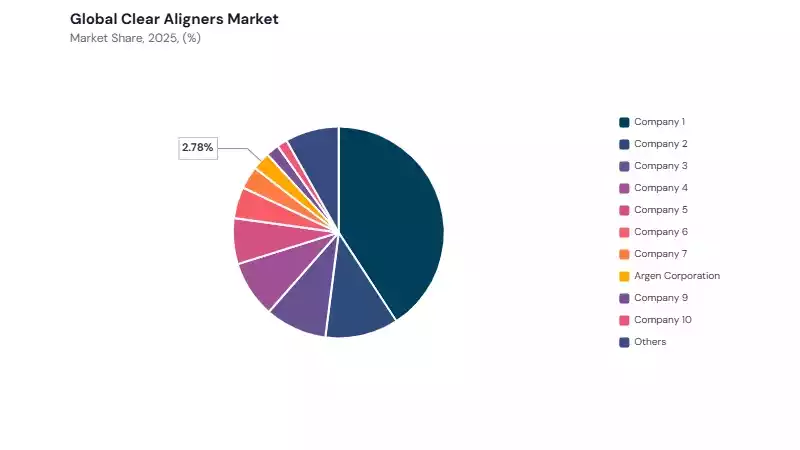
Clear aligners market represents a largely competitive and innovation-led landscape, shaped by well-established orthodontic technology providers, digital clear aligner manufacturers, and dental solution companies. Envista, Straumann, TP Orthodontics, Argen, Henry Schein, and SCHEU-DENTAL further support market competition through digital workflows, advanced materials, regional orthodontic solutions, and customized aligner systems. Market competition is predicted to be driven by material innovation, AI-enabled treatment planning, patient-centric orthodontic care, and manufacturing automation.
Based on Age, the market is segmented into Adults and Teens. The Adults market dominated the Global Clear Aligners Market by Age in 2025, and would continue to be a dominant market till 2033; thereby, achieving a market value of USD 11.2 billion by 2033, growing at a CAGR of 14.5 % during the forecast period. The Teens market is expected to witness a CAGR of 15.8% during (2026 - 2033).
Adults dominate due to increasing demand for aesthetic orthodontic treatment, higher disposable income, and rising awareness of oral health among working professionals and older patients. This group prefers discreet and removable orthodontic solutions that fit professional and social lifestyles. Teens are gaining adoption due to early orthodontic intervention, improved customized aligner solutions, and greater parental acceptance of removable appliances. Teen-focused aligners also benefit from comfort, hygiene advantages, and reduced lifestyle restrictions compared to traditional braces.
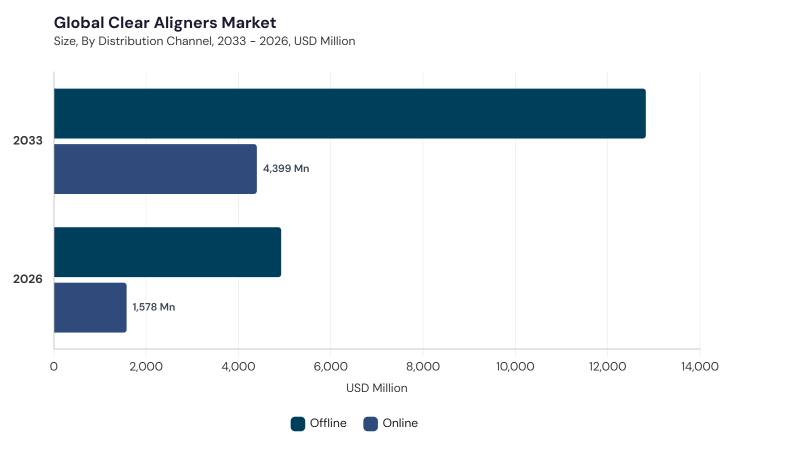
Based on Distribution Channel, the market is segmented into Offline and Online. The Offline market dominated the Global Clear Aligners Market by Distribution Channel in 2025, and would continue to be a dominant market till 2033; thereby, achieving a market value of USD 12.8 billion by 2033, growing at a CAGR of 14.7 % during the forecast period. The Online market is expected to witness a CAGR of 15.8% during (2026 - 2033).
Offline channels dominate due to the need for dental consultations, professional diagnosis, digital impressions, treatment planning, and continuous clinical monitoring. Dental clinics, orthodontic offices, and specialist practices remain central to patient trust and treatment supervision. Online channels are expanding with direct-to-consumer aligner services, virtual consultations, digital impression kits, and remote patient monitoring. The online model is gaining relevance among consumers seeking convenience, affordability, and fewer clinic visits.
Based on Material, the market is segmented into Polyurethane, Plastic Polyethylene Terephthalate Glycol, and Other Material. The Polyurethane market dominated the Global Clear Aligners Market by Material in 2025, and would continue to be a dominant market till 2033; thereby, achieving a market value of USD 7.0 billion by 2033, growing at a CAGR of 14.3 % during the forecast period. The Plastic Polyethylene Terephthalate Glycol market is expected to witness a CAGR of 15.2% during (2026 - 2033). Additionally, The Other Material market is expected to witness highest CAGR of 15.8% during (2026 - 2033).
Polyurethane dominates due to its flexibility, durability, transparency, and ability to deliver consistent orthodontic force during treatment. Plastic Polyethylene Terephthalate Glycol remains widely used because of its clarity, stain resistance, dimensional stability, and ease of thermoforming for customized aligner production. Other materials are gaining attention through innovations focused on comfort, biomechanical performance, sustainability, and treatment efficiency. Material innovation remains an important differentiator as manufacturers improve patient comfort and clinical predictability.
Based on End Use, the market is segmented into Stand-Alone Practices, Group Practices, Hospitals, and Other End Use. The Stand-Alone Practices market dominated the Global Clear Aligners Market by End Use in 2025, and would continue to be a dominant market till 2033; thereby, achieving a market value of USD 7.3 billion by 2033, growing at a CAGR of 14.3 % during the forecast period. The Group Practices market is expected to witness a CAGR of 15.1% during (2026 - 2033). Additionally, The Hospitals market is expected to witness highest CAGR of 15.7% during (2026 - 2033).
Stand-Alone Practices dominate due to the strong role of independent dental clinics and specialized orthodontists in providing personalized aligner therapy. These practices benefit from digital scanning, tailored treatment planning, and direct patient engagement. Group Practices are growing through multi-specialty dental networks, standardized workflows, and broader access to advanced orthodontic technologies. Hospitals and other end-use settings support complex orthodontic needs, integrated dental care services, academic institutions, community dental centers, and specialized oral healthcare facilities.
Free Valuable Insights: Clear Aligners Market Size to reach $17.2 Billion by 2033
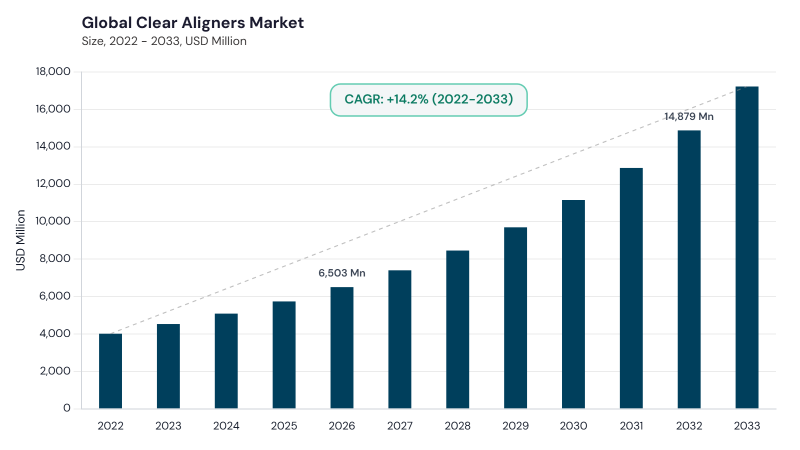
Region-wise, the Clear Aligners Market is analyzed across North America, Europe, Asia Pacific, and LAMEA. Clear aligners market is anticipated to grow at a highest rate in 2025, by capturing a market value of USD 7.5 billion by 2033, with a CAGR of 14.5%. The Europe market is estimated to grow at a CAGR of 14.7% during the forecast period. Further, Asia Pacific is predicted to expand at a CAGR of 15.6% during 2026-2033.
North America region dominated the market supported by strong digital orthodontic adoption, advanced dental infrastructure, and the presence of key market players. Europe market is driven by selected reimbursement support, minimally invasive orthodontic demand, and investment in digital dentistry. Asia Pacific is expanding through expanding dental care access, rising awareness of aesthetic orthodontics. Further, LAMEA market is anticipated to expand by enhancing dental infrastructure, gradual expansion of orthodontic services, and oral health awareness.
| Report Attribute | Details |
|---|---|
| Market size value in 2026 | USD 6.5 billion |
| Market size forecast in 2033 | USD 17.2 billion |
| Base Year | 2025 |
| Historical Period | 2022 to 2024 |
| Forecast Period | 2026 to 2033 |
| Revenue Growth Rate | CAGR of 14.9% from 2026 to 2033 |
| Number of Pages | 572 |
| Tables | 690 |
| Report Coverage | Market Trends, Revenue Estimation and Forecast, Segmentation Analysis, Regional and Country Breakdown, Competitive Landscape, Market Share Analysis, Company Profiling, Companies Strategic Developments, SWOT Analysis, Product Life Cycle Analysis, Value Chain Analysis, Market Consolidation Analysis, Key Customer Criteria, Pandemic Impact Analysis, and Winning Imperatives |
| Segments Covered | Age, Distribution Channel, Material, End Use, and Geography |
| Country Scope |
|
| Companies Included | Align Technology, Inc.; Institut Straumann AG; Envista Holdings Corporation; Angelalign Technology Inc.; Dentsply Sirona Inc.; 3M Company; Henry Schein, Inc.; Argen Corporation; TP Orthodontics, Inc.; SCHEU-DENTAL GmbH |
By Age
By Distribution Channel
By Material
By End Use
By Geography
Expected to reach USD 17.2 billion by 2033, growing at 14.9% CAGR during 2026-2033.
Adults lead, projected to hit USD 11.2 billion by 2033.
Align Technology, Institut Straumann, Envista Holdings, Angelalign Technology, Dentsply Sirona, 3M, Henry Schein, Argen Corporation, TP Orthodontics, SCHEU-DENTAL.
Offline channels dominate, reaching USD 12.8 billion by 2033.
North America leads, projected at USD 7.5 billion by 2033.
Polyurethane leads, expected to reach USD 7.0 billion by 2033.
Our team of dedicated experts can provide you with attractive expansion opportunities for your business.






 Unique Offerings
