The sample copy of this report is available for access.
The Europe Clear Aligners Market is expected to reach USD 3.3 billion by 2031, growing at a CAGR of 14.7% during (2026 – 2033).
The Europe Clear Aligners Market originated from the gradual shift in orthodontics from metal braces toward aesthetic, removable, and comfortable dental correction solutions. Early aligner adoption was supported by digital imaging, 3D modeling, and customized thermoplastic appliances, but remained limited due to cost and clinical familiarity barriers. Over time, CAD/CAM systems, intraoral scanners, high-resolution 3D printing, and advanced polymers improved treatment precision and patient comfort. Clinical evidence and professional acceptance further helped clear aligners move from niche use to mainstream orthodontic care. Today, the market reflects a strong digital orthodontics ecosystem supported by patient demand for discreet treatment and efficient workflows.
The current Europe Clear Aligners Market is shaped by digital dentistry, AI-assisted treatment planning, teleorthodontics, material innovation, and growing demand for personalized smile correction. Dental clinics and orthodontists are using intraoral scanning, remote monitoring, and digital treatment simulation to improve patient engagement and treatment predictability. Manufacturers are focusing on durable, transparent, and comfortable aligner materials to improve clinical performance. Online channels are expanding through virtual consultations and digital platforms, while offline treatment remains central due to clinical supervision needs. These trends are strengthening clear aligners as a preferred orthodontic solution across Europe.
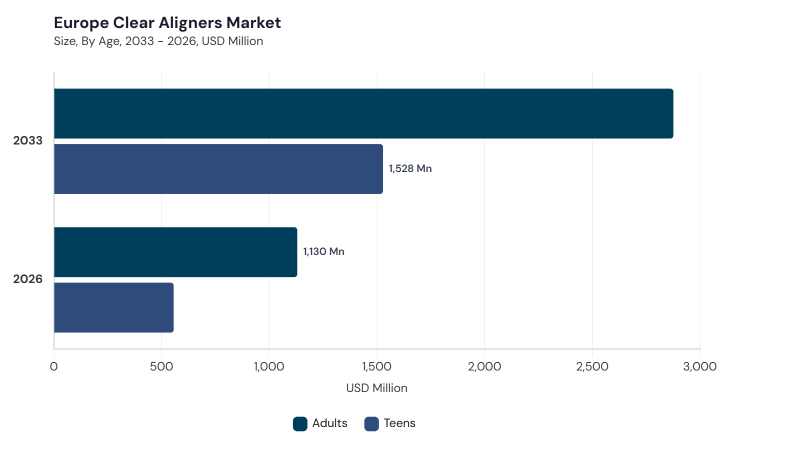
Based on Age, the market is segmented into Adults and Teens. The Adults market dominated the Europe Clear Aligners Market by Age in 2025, and would continue to be a dominant market till 2033; thereby, achieving a market value of USD 2.2 billion by 2031, growing at a CAGR of 14.3 % during the forecast period. The Teens market is expected to witness a CAGR of 15.5% during (2026 - 2033).
Adults lead due to rising awareness of aesthetic dentistry, increasing acceptance of minimally visible orthodontic treatments, and greater spending on elective dental procedures across Western Europe. Clear aligners appeal to adults because they support professional appearance, convenience, comfort, and discreet treatment. Teens are also witnessing healthy adoption as orthodontists recommend removable aligners for mild to moderate corrections, improved oral hygiene, and better lifestyle flexibility. Digital progress tracking and patient engagement tools are helping improve compliance among younger users.
Based on Distribution Channel, the market is segmented into Offline and Online. The Offline market dominated the Europe Clear Aligners Market by Distribution Channel in 2025, and would continue to be a dominant market till 2033; thereby, achieving a market value of USD 2.5 billion by 2031, growing at a CAGR of 14.4 % during the forecast period. The Online market is expected to witness a CAGR of 15.6% during (2026 - 2033).
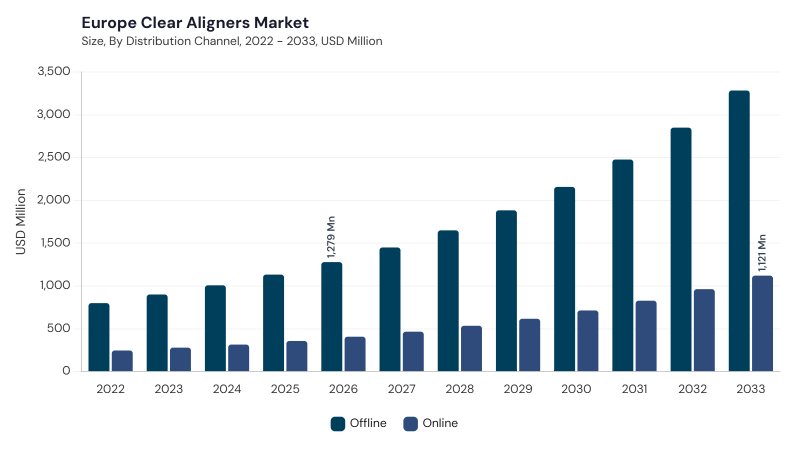
Offline channels lead because clear aligner therapy requires professional diagnosis, intraoral scanning, treatment planning, clinical supervision, and periodic progress evaluation. Europe’s strong base of private dental clinics, specialist orthodontic practices, and trained dental professionals reinforces this channel. Online channels are expanding with virtual consultations, remote patient monitoring, direct-to-consumer models, and digital engagement platforms. These models improve convenience and access for suitable cases while increasingly operating alongside clinician-led treatment pathways.
Based on Material, the market is segmented into Polyurethane, Plastic Polyethylene Terephthalate Glycol, and Other Materials. Polyurethane leads due to its elasticity, transparency, durability, stain resistance, and ability to deliver controlled orthodontic force during treatment. It is widely used in aligners that require a balance of comfort, strength, and effective tooth movement.
Plastic Polyethylene Terephthalate Glycol remains important because of its optical clarity, dimensional stability, thermoforming suitability, and cost-effectiveness. Other materials include emerging polymers, hybrid composites, and sustainable alternatives designed to improve comfort, wear resistance, biocompatibility, and environmental performance.
Based on End Use, the market is segmented into Stand-Alone Practices, Group Practices, Hospitals, and Other End Use. Stand-alone practices lead due to the strong presence of independent orthodontists and specialist dental clinics offering personalized clear aligner therapy supported by digital scanning. These practices maintain close patient interaction and are important for routine adult and teen orthodontic cases.
Group practices are expanding through multi-clinic networks, standardized protocols, and investments in advanced digital equipment. Hospitals support complex orthodontic and multidisciplinary dental cases, while other end-use settings include university dental centers, community clinics, specialized oral healthcare institutions, and teledentistry platforms.
Free Valuable Insights: The Worldwide Clear Aligners Market is projected to reach USD 17.2 Billion billion by 2033, at a CAGR of 14.9%
Based on Country, the market is segmented into Germany, UK, France, Russia, Spain, Italy, and Rest of Europe. The Germany market dominated the Europe Clear Aligners Market by Country in 2025, and would continue to be a dominant market till 2033; thereby, achieving a market value of USD 589.4 million by 2031, growing at a CAGR of 12.9 % during the forecast period. The UK market is expected to witness a CAGR of 13.6% during (2026 - 2033). Additionally, The France market is expected to witness a CAGR of 15.5% during (2026 - 2033).
Germany leads due to strong dental technology adoption, digital orthodontic workflows, patient preference for minimally visible treatment, and strict medical device quality standards. The UK supports growth through wider availability of aligners across general dentistry, in-office scanning, digital treatment planning, and patient demand for aesthetic care. France is driven by intraoral scanning, AI-based planning, teleorthodontics, and regulatory focus on safety and quality. Russia, Spain, and Italy contribute through rising consumer awareness, localized service models, digital workflows, and clear aligner acceptance, while Rest of Europe adds demand through expanding access and growing private dental care adoption.

By Age
By Distribution Channel
By Material
By End Use
By Country
Set to reach $3.3 Billion by 2031, growing at 14.7% CAGR during 2026-2033.
Germany leads with $589.4 million by 2031, growing at a CAGR of 12.9% during the forecast period.
Rising demand among adults, with the segment reaching $2.2 billion by 2031 at 14.3% CAGR during 2026-2033.
The Teens segment is expected to witness a CAGR of 15.5% during 2026-2033.
The UK market is expected to witness a CAGR of 13.6% during 2026-2033.
The Online market is expected to witness a CAGR of 15.6% during 2026-2033.
Our team of dedicated experts can provide you with attractive expansion opportunities for your business.




 Unique Offerings