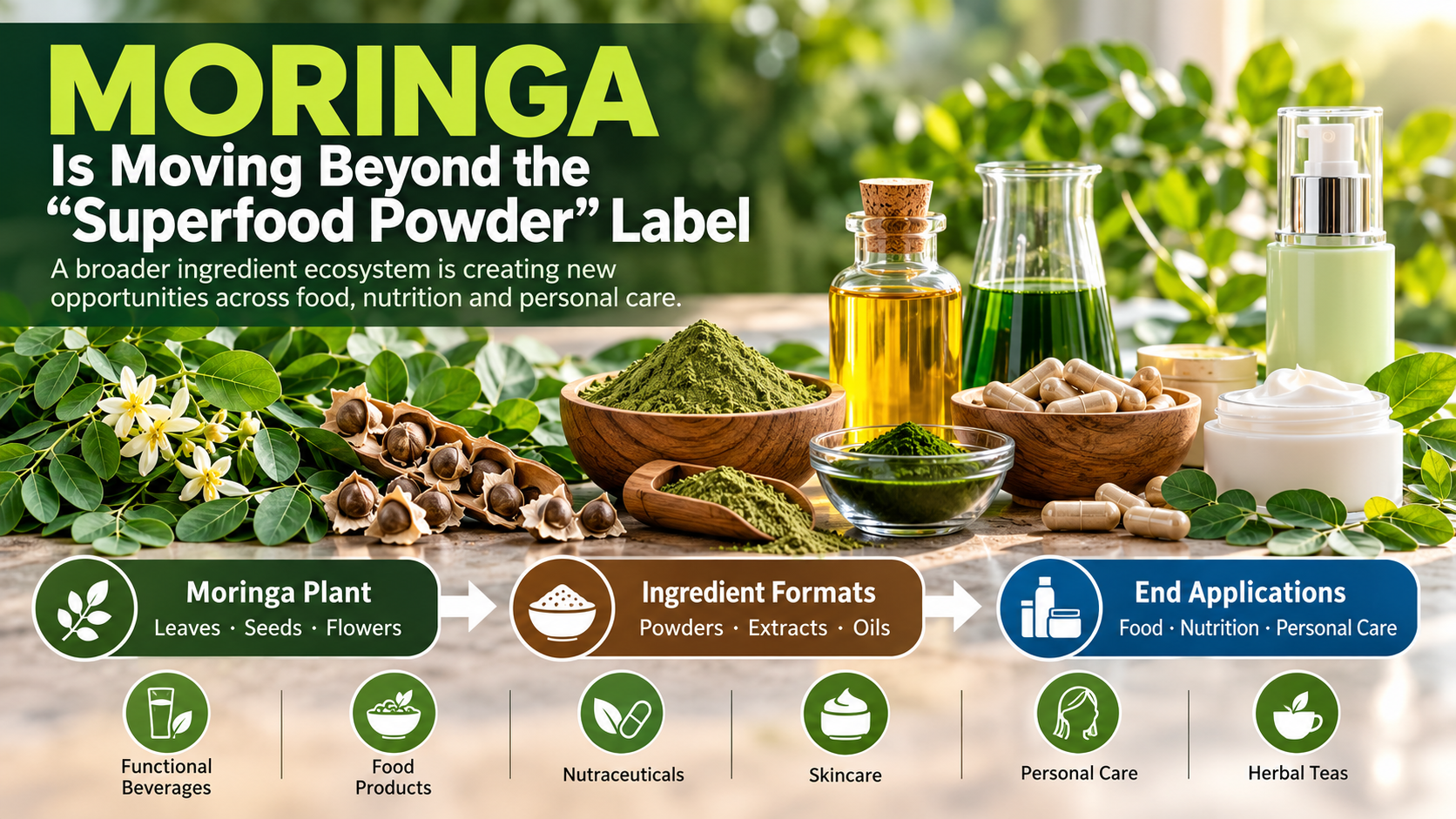
Moringa has spent years building recognition as a plant-based nutritional ingredient, particularly through leaf powders and dietary supplements. The next phase of the market is becoming considerably more diverse. Food manufacturers, nutraceutical companies, botanical processors and personal-care formulators are exploring different parts of the plant and different processing formats. The result is an expanding ingredient ecosystem involving powders, oils, extracts, teas, capsules and specialized formulations.
This transition changes where value can be created. The conventional model of cultivating leaves, drying them and selling powder remains important, but suppliers increasingly have opportunities to differentiate through processing, quality, certification and application-specific formats.
Leaves can support powders, teas, extracts and nutritional formulations. Seeds can create moringa oil and other processed ingredients. Flowers and additional plant components can serve herbal, food and specialized applications. Instead of depending on one format, processors can build portfolios that address several industries and price points.
That diversification is already visible in the market. KBV Research identifies seed oils, teas, extracts, capsules, protein ingredients, skincare formulations, beverages and customized ingredient blends as part of the widening commercial landscape. This makes processing capability increasingly important because different formats require different controls and buyer specifications.
Food and beverage applications represent an important component of the Moringa Ingredients Market. The attraction is linked to wider interest in natural, plant-derived and functionally positioned ingredients. Manufacturers are experimenting with botanical inputs across beverages, fortified foods, teas, snacks and nutritional formulations.
Successful commercialization, however, requires more than consumer awareness. Food developers must consider taste, color, texture, dispersibility, processing stability and compatibility with other ingredients. A botanical material that works in a capsule may need substantial formulation work before it performs well in a beverage or bakery product. This is where ingredient suppliers can move from being commodity sellers to technical partners.
Moringa seeds provide another route for market expansion. Seed oil can enter cosmetics and personal-care formulations, connecting the moringa value chain with skincare, haircare and natural beauty. This creates a different competitive environment from the powdered-supplement market.
Personal-care buyers may evaluate oil quality, stability, purity, odor, sourcing credentials and documentation. Suppliers that can meet those requirements can participate in higher-value applications rather than depending entirely on bulk nutritional ingredients. KBV Research projects the seed segment to grow at an 11.1% CAGR during 2026-2033, reflecting the widening use of seed-derived ingredients.
Organic sourcing is another area shaping development. Consumers increasingly associate botanical products with natural and sustainable positioning, while manufacturers may require certification and supply-chain documentation to substantiate claims. For suppliers, organic production can therefore become part of a wider value proposition incorporating traceability and responsible farming.
KBV Research expects organic moringa ingredients to register an 11.3% CAGR during 2026-2033, faster than conventional ingredients. The opportunity is particularly relevant for premium nutraceuticals, herbal wellness products, natural cosmetics and traceable botanical portfolios where sourcing credentials can influence procurement.
The more sophisticated the application, the greater the need for consistency. Botanical ingredients can vary according to growing conditions, harvesting, drying, storage and processing. Buyers therefore need assurance that materials meet defined specifications.
Microbial testing, pesticide controls, ingredient purity, certification, standardized processing and traceability can influence supplier selection. KBV Research also highlights these factors in its competitive analysis. In a fragmented market, the ability to deliver repeatable quality can be more defensible than competing only on price.
Selling minimally processed agricultural material limits differentiation. Turning that material into specialized oils, extracts, proteins or customized blends provides additional ways to create value. Recent food-science research is moving in the same direction by examining proteins, polyphenols, polysaccharides and other fractions rather than focusing only on whole-leaf powder.
This does not mean every research concept will reach commercial scale. Safety evaluation, regulatory requirements, sensory performance, processing cost and consumer acceptance remain important. But the direction of development is clear: the moringa ingredient landscape is becoming more technically diverse.
Asia Pacific remains central to the global moringa ecosystem because of cultivation, traditional familiarity and established botanical-product industries. KBV Research reports that Asia Pacific led the market in 2025. At the same time, international demand for functional foods, botanical supplements and natural personal-care ingredients creates opportunities for suppliers in producing regions to connect with global buyers.
That opportunity raises the bar for export compliance, documentation, certification and reliable processing. Growth alone does not guarantee supplier success. Companies that can connect agricultural sourcing with internationally acceptable quality systems are more likely to participate in higher-value global chains.
Moringa's established nutritional reputation gives the industry a useful foundation. The next stage is likely to be defined by what companies build on top of it: diversified processing, stronger quality systems, application-specific formulations, organic and traceable sourcing, and closer technical collaboration with manufacturers.
The Global Moringa Ingredients Market is valued by KBV Research at USD 9.38 billion in 2026 and is projected to reach USD 19.31 billion by 2033, representing a 10.9% CAGR. Those headline figures matter, but the underlying structural story is more useful: moringa is gradually shifting from a single recognizable superfood format to a multi-application botanical ingredient platform.