The sample copy of this report is available for access.
“Global Telecom Network Densification Market to reach a market value of USD 18,795.5 Million by 2033 growing at a CAGR of 11.2%”
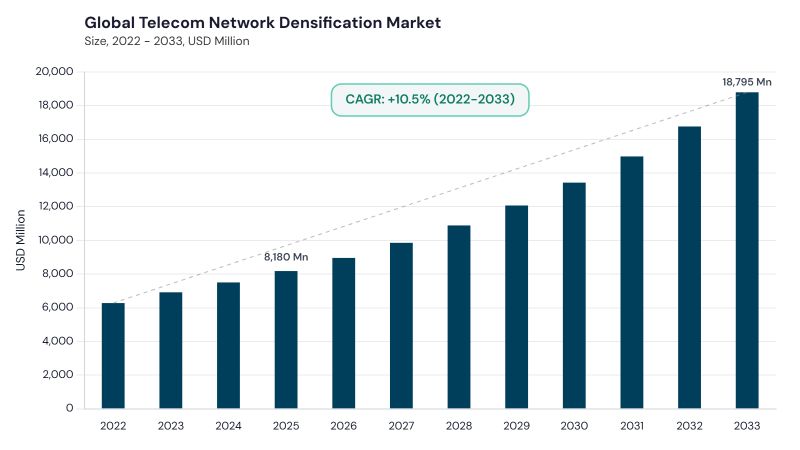
The Global Telecom Network Densification Market size is expected to reach USD 18,795.5 Million by 2033, rising at a market growth of 11.2% CAGR during the forecast period.
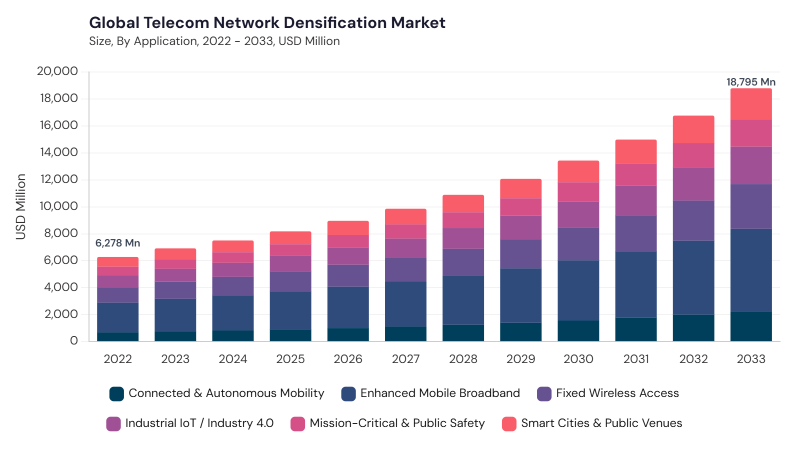
The market growth is driven by increasing deployment of 5G infrastructure, rising mobile data traffic, growing adoption of IoT devices, expansion of edge computing environments, and increasing demand for low-latency high-capacity communication networks. Telecom operators are aggressively investing in small cells, distributed antenna systems (DAS), cloud-native RAN architectures, and fiber backhaul infrastructure to improve coverage, network efficiency, and spectrum utilization.
The market has evolved from traditional macro-cell expansion toward intelligent multi-layer heterogeneous network architectures integrating small cells, Open RAN, AI-driven traffic optimization, edge computing, and mmWave deployments. Telecom network densification is enabling telecom providers to deliver enhanced network capacity, ultra-low latency connectivity, and seamless user experiences across urban, industrial, and enterprise environments.
The Telecom Network Densification Market is undergoing rapid transformation as telecom providers increasingly shift toward highly distributed network architectures to support next-generation connectivity requirements. The integration of AI-powered optimization, cloud-native orchestration, and edge intelligence is significantly improving network scalability, operational efficiency, and service reliability.
Furthermore, growing demand for ultra-reliable low-latency communication, industrial IoT deployments, smart city initiatives, and autonomous mobility ecosystems is accelerating deployment of dense telecom infrastructure globally.

The Telecom Network Densification Market demonstrates a competitive landscape characterized by strong participation from telecom infrastructure vendors, networking technology providers, and telecom operators. Major companies are increasingly investing in AI-powered network orchestration, cloud-native architectures, Open RAN solutions, and intelligent traffic management platforms.
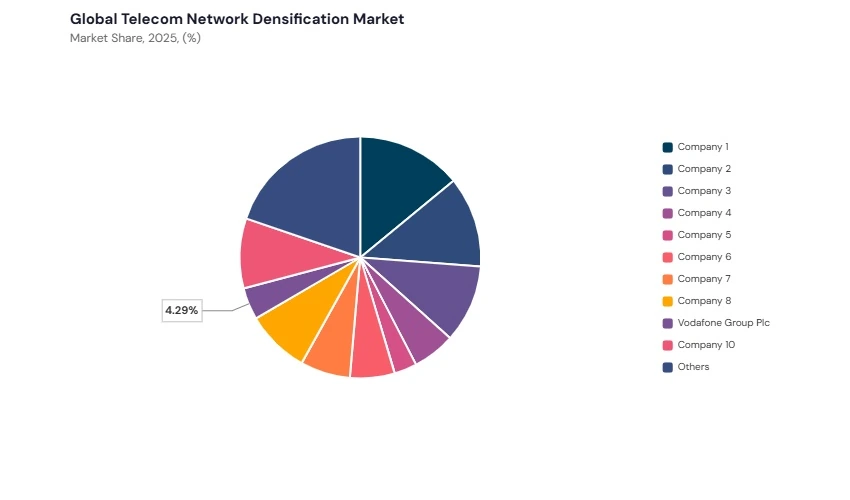
Huawei Technologies Co., Ltd. accounted for approximately 18.6% market share in 2025 supported by its strong 5G infrastructure portfolio, extensive telecom operator partnerships, and leadership in radio access network deployments. Ericsson and Nokia Corporation collectively strengthened their market positioning through AI-enabled Open RAN solutions, cloud-native telecom platforms, and intelligent network automation capabilities.
Other major market participants include Samsung Electronics Co., Ltd., ZTE Corporation, Cisco Systems Inc., NEC Corporation, Fujitsu Limited, CommScope Holding Company, Inc., and American Tower Corporation. These companies are increasingly focusing on advanced small cell infrastructure, fiber backhaul optimization, edge-enabled connectivity, and private 5G deployment strategies to strengthen competitive positioning.
Based on Spectrum Band, the market is segmented into Sub-6 GHz, Hybrid, and mmWave (24–71 GHz). The Sub-6 GHz segment dominated the market in 2025 owing to its extensive deployment across commercial telecom infrastructure and superior coverage capabilities. The segment is projected to attain a market value of USD 8,362.3 Million by 2033 supported by increasing deployment of mid-band 5G infrastructure and rising demand for scalable network coverage solutions. Meanwhile, the Hybrid segment is expected to witness strong growth during 2026-2033 driven by increasing integration of Sub-6 GHz and mmWave deployments for balanced coverage and network capacity optimization across dense urban environments.
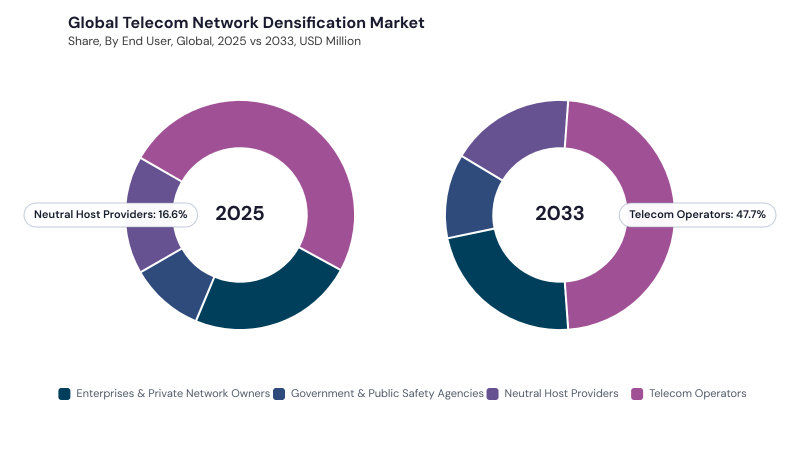
Based on End User, the market is segmented into Telecom Operators, Enterprises & Private Network Owners, Neutral Host Providers, and Government & Public Safety Agencies. The Telecom Operators segment accounted for the largest revenue share in 2025 owing to rising investments in nationwide 5G densification projects, Open RAN deployment, and AI-driven network optimization initiatives. In addition, the Government & Public Safety Agencies segment is anticipated to register the highest CAGR of 13.0% during the forecast period supported by increasing investments in mission-critical communication infrastructure, smart surveillance systems, and emergency response communication networks globally.
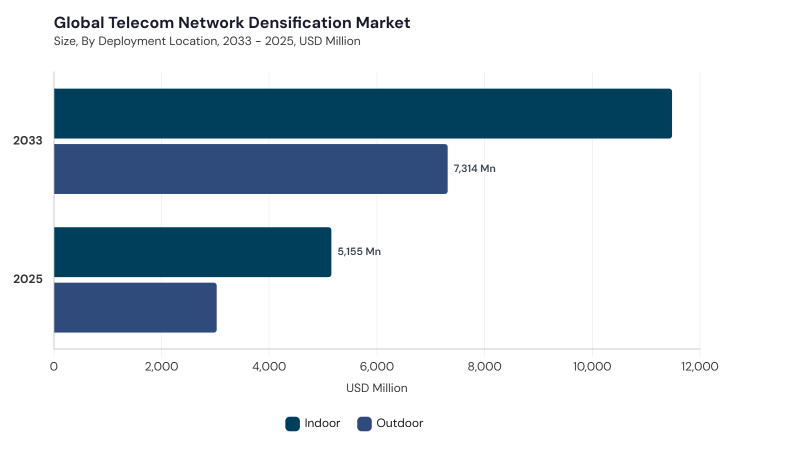
Based on Deployment Location, the market is segmented into Indoor and Outdoor. The Indoor deployment segment dominated the market in 2025 accounting for a major share due to increasing deployment of in-building wireless systems, enterprise connectivity infrastructure, and smart commercial building solutions. The segment is projected to reach USD 11,481.1 Million by 2033 driven by rising adoption of private 5G networks, smart workplaces, and connected indoor environments. Meanwhile, the Outdoor segment is expected to witness robust growth owing to increasing deployment of smart city infrastructure, urban small cell networks, transportation connectivity systems, and large-scale outdoor 5G densification projects.
Based on Application, the market is segmented into Enhanced Mobile Broadband, Fixed Wireless Access, Industrial IoT / Industry 4.0, Smart Cities & Public Venues, Connected & Autonomous Mobility, and Mission-Critical & Public Safety. The Enhanced Mobile Broadband segment dominated the market in 2025 owing to increasing mobile video consumption, cloud gaming, and rising smartphone penetration globally. However, the Connected & Autonomous Mobility segment is expected to register a CAGR of 12.3% during 2026-2033 supported by increasing deployment of intelligent transportation systems, connected vehicle infrastructure, V2X communication platforms, and autonomous mobility ecosystems.
Free Valuable Insights: Telecom Network Densification Market Size to reach $18,795.5 Million by 2033
Region-wise, the market is analyzed across North America, Europe, Asia Pacific, and LAMEA. North America dominated the market in 2025 owing to strong telecom infrastructure investments, aggressive 5G rollout strategies, and rapid adoption of advanced network technologies. The region continues to witness increasing deployment of AI-enabled network optimization, cloud-native RAN infrastructure, and edge computing environments.
Asia Pacific is expected to witness the fastest growth during the forecast period due to large-scale telecom expansion, increasing smartphone penetration, government-led digital transformation initiatives, and rising demand for high-speed connectivity across China, India, Japan, and South Korea. Europe continues to witness strong growth driven by increasing Open RAN adoption, sustainability-focused telecom modernization programs, and rising investments in smart connectivity ecosystems. Meanwhile, LAMEA is gradually expanding supported by improving digital infrastructure and growing investments in next-generation telecom networks.
The Telecom Network Densification Market is highly innovation-driven and technologically intensive. Competition is centered around Open RAN integration, AI-driven network optimization, cloud-native telecom infrastructure, edge-enabled connectivity, and intelligent traffic orchestration platforms.
Major market participants are increasingly differentiating themselves through advanced small cell technologies, private 5G deployment capabilities, AI-powered network automation, and distributed telecom infrastructure platforms. Strategic collaborations among telecom operators, cloud service providers, infrastructure vendors, and edge computing companies are reshaping long-term competitive dynamics across the industry.
| Report Attribute | Details |
|---|---|
| Market size value in 2026 | USD 8,959.4 Million |
| Market size forecast in 2033 | USD 18,795.5 Million |
| Base Year | 2025 |
| Historical Period | 2022 to 2024 |
| Forecast Period | 2026 to 2033 |
| Revenue Growth Rate | CAGR of 11.2% from 2026 to 2033 |
| Number of Pages | 681 |
| Tables | 780 |
| Report Coverage | Market Trends, Revenue Estimation and Forecast, Segmentation Analysis, Regional and Country Breakdown, Competitive Landscape, Market Share Analysis, Porter’s Five Forces Analysis, Company Profiling, Strategic Developments |
| Segments Covered | Spectrum Band, End User, Deployment Location, Application, Region |
| Country Scope | North America (US, Canada, Mexico, Rest of North America); Europe (Germany, UK, France, Russia, Spain, Italy, Rest of Europe); Asia Pacific (China, Japan, India, South Korea, Singapore, Malaysia, Rest of Asia Pacific); LAMEA (Brazil, Argentina, UAE, Saudi Arabia, South Africa, Nigeria, Rest of LAMEA) |
| Companies Included | Huawei Technologies Co., Ltd.; Ericsson; Nokia Corporation; Samsung Electronics Co., Ltd.; ZTE Corporation; Cisco Systems Inc.; NEC Corporation; Fujitsu Limited; CommScope Holding Company, Inc.; American Tower Corporation |
By Spectrum Band
By End User
By Deployment Location
By Application
By Geography
Our team of dedicated experts can provide you with attractive expansion opportunities for your business.







 Unique Offerings