The sample copy of this report is available for access.
The Europe Telecom Network Densification Market size is projected to reach USD 3,671.0 million by 2031, growing at a CAGR of 10.5% during the forecast period (2026-2033).
The Europe Telecom Network Densification Market is witnessing strong growth owing to accelerated 5G deployment, increasing mobile data consumption, and the rising demand for seamless high-capacity connectivity across urban and suburban regions. Telecom operators throughout Europe are increasingly investing in small cells, distributed antenna systems (DAS), fiber backhaul infrastructure, and advanced radio access technologies to improve network performance, capacity, and latency. The rapid expansion of IoT ecosystems, cloud computing, AI-driven applications, and bandwidth-intensive services such as UHD video streaming and immersive digital experiences is significantly driving demand for dense telecom infrastructure throughout the region.
In addition, Europe’s focus on smart city initiatives, digital transformation programs, and sustainable telecom infrastructure development is further supporting market expansion. The growing adoption of Open RAN architectures, software-defined networking (SDN), and network function virtualization (NFV) technologies is enabling operators to improve scalability and operational efficiency. Regulatory support for infrastructure sharing and spectrum allocation across European countries is also accelerating deployment activities, strengthening the long-term growth outlook of the Europe Telecom Network Densification Market.
Based on Spectrum Band, the market is segmented into Sub-6 GHz, Hybrid, and mmWave (24–71 GHz). The Sub-6 GHz segment dominated the Europe Telecom Network Densification Market in 2025 and is projected to reach USD 1,650.2 million by 2031. The segment benefits from its broad coverage capability and strong indoor penetration, making it highly suitable for widespread 5G deployments across Europe. The Hybrid segment is also gaining considerable traction as telecom operators increasingly combine Sub-6 GHz and mmWave deployments to optimize both coverage and capacity. Meanwhile, the mmWave segment is expanding steadily in dense urban zones and transportation hubs where ultra-high-speed connectivity is required.
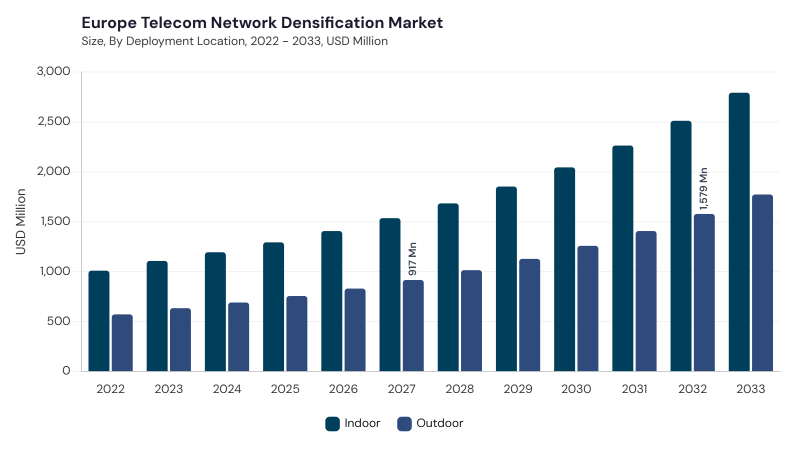
Based on Deployment Location, the market is segmented into Indoor and Outdoor. The Indoor segment accounted for the largest revenue share in 2025 and is expected to reach USD 2,263.3 million by 2031. Increasing deployment of indoor small cells and DAS solutions across airports, shopping malls, office buildings, stadiums, and public infrastructure is driving segment growth. The Outdoor segment is also witnessing healthy expansion owing to increasing installation of street-level telecom infrastructure and urban small cell networks to improve outdoor coverage and reduce network congestion.
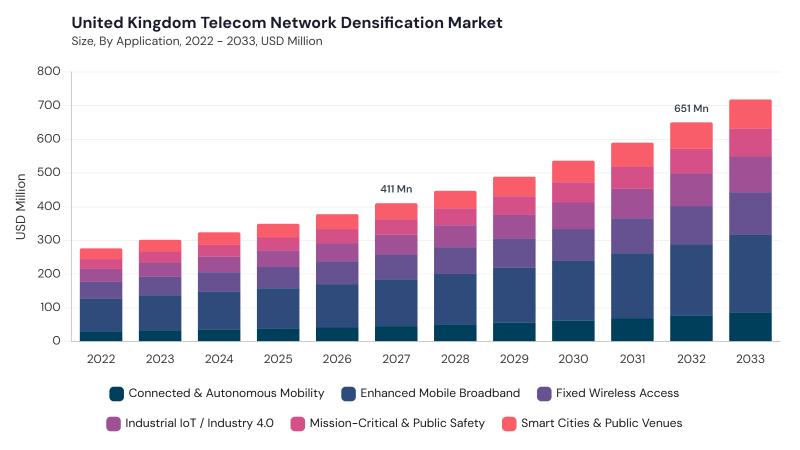
Based on Application, the market is segmented into Enhanced Mobile Broadband, Fixed Wireless Access, Industrial IoT / Industry 4.0, Smart Cities & Public Venues, Connected & Autonomous Mobility, and Mission-Critical & Public Safety. The Enhanced Mobile Broadband segment dominated the Europe Telecom Network Densification Market in 2025 and is projected to attain USD 1,212.7 million by 2031 due to rising mobile internet usage and increasing demand for high-speed digital services. The Industrial IoT / Industry 4.0 segment is gaining substantial momentum owing to rapid industrial automation and private 5G adoption across manufacturing facilities. Additionally, Connected & Autonomous Mobility applications are expanding significantly with increasing investments in intelligent transportation systems and connected vehicle ecosystems across Europe.
Based on End User, the market is segmented into Telecom Operators, Enterprises & Private Network Owners, Neutral Host Providers, and Government & Public Safety Agencies. Telecom Operators held the dominant market share in 2025 due to substantial investments in 5G infrastructure modernization and network expansion initiatives across major European countries. Enterprises & Private Network Owners are increasingly adopting densified private wireless networks to support automation, secure enterprise communication, and industrial digitalization. Neutral Host Providers are also witnessing growing demand due to increasing adoption of shared telecom infrastructure models that improve deployment efficiency and reduce operational costs.
Germany, the UK, France, Italy, and Spain are among the leading contributors to the Europe Telecom Network Densification Market due to extensive 5G rollout activities and strong investments in fiber infrastructure modernization. Increasing regulatory support for infrastructure sharing, urban connectivity enhancement, and digital transformation programs is further supporting regional market growth. Moreover, rising deployment of AI-enabled telecom infrastructure, edge computing solutions, and advanced network automation technologies is expected to continue driving telecom network densification across Europe throughout the forecast period.

By Spectrum Band
By Deployment Location
By Application
By End User
By Country
Our team of dedicated experts can provide you with attractive expansion opportunities for your business.




 Unique Offerings