“Global Tele-monitoring Services Market to reach a market value of 91.10 Billion by 2032 growing at a CAGR of 17.9%”
The Global Tele-monitoring Services Market size is estimated at $28.80 billion in 2025 and is expected to reach $91.10 billion by 2032, rising at a market growth of 17.9% CAGR during the forecast period (2025-2032). This growth is driven by rising chronic disease prevalence, increasing adoption of remote patient monitoring, and advancements in digital health technologies. Expanding telehealth infrastructure, supportive government initiatives, and demand for cost-effective care solutions further accelerate market expansion justifying the growth.
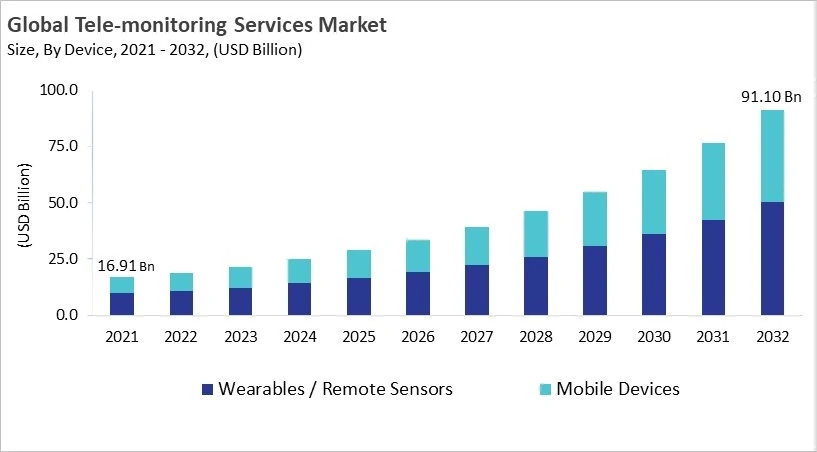
The tele-monitoring services market has developed into a sophisticated digital healthcare ecosystem, propelled by advancements in wearable devices, communication technologies, cloud computing, and biosensors. These innovations have allowed continuous monitoring, real-time health data collection, and remote clinical decision-making, substantially enhancing patient engagement, especially for chronic disease management. The use of AI and predictive analytics, as well as integration with e-health records have further strengthened care quality, allowing personalized treatment and early intervention. Tele-monitoring services have become a core component of modern healthcare delivery, supported by rising demand for home-based care because of the aging population and favourable regulatory frameworks.
The tele-monitoring services market is shaped by factors including rising focus on data security and privacy, widespread adoption of IoT-enabled wearables, and a strong push towards interoperability across healthcare systems. Enterprises compete through strategic partnerships, innovation, and compliance with regulatory standards, along with leveraging AI and cloud-based platforms to deliver cost-effective and scalable solutions. The competitive landscape includes technology firms, medical device manufacturers, and telehealth providers, seeking to improve integration, functionality, and user-experience. The tele-monitoring services market remains innovation-driven, with continued investment in partnerships and R&D supporting growth and enhancing healthcare outcomes.
The major strategies followed by the market participants are Partnership as the key developmental strategy to keep pace with the changing demands of end users. For instance, In February, 2024, GE HealthCare partnered with Biofourmis to offer virtual care-at-home solutions, extending patient monitoring beyond hospitals. The collaboration leverages AI-guided algorithms and wearable devices to support remote care, aiming to reduce readmissions, ease staffing shortages, and improve patient outcomes. Moreover, In April, 2025, OMRON Healthcare partnered with Tricog Health to launch KeeboHealth, an AI-powered remote cardiac care platform using home ECG and monitoring devices. The solution enhances heart failure management, reducing hospital readmissions and improving treatment adherence through personalized, tele-monitored interventions in India.
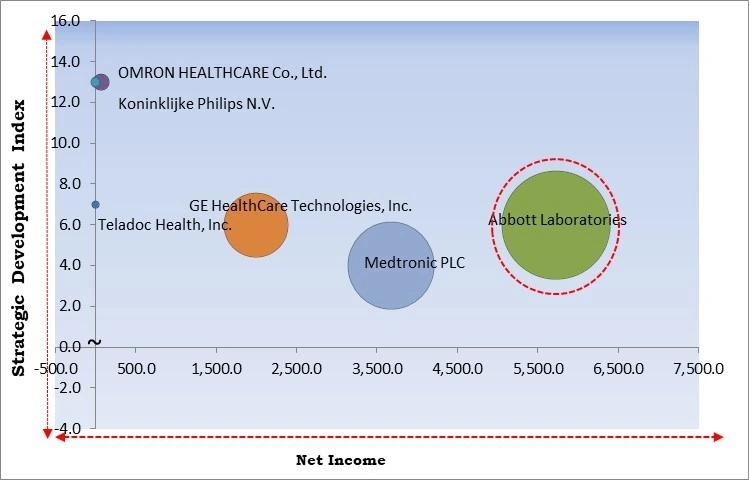
Based on the Analysis presented in the KBV Cardinal matrix; Abbott Laboratories is the forerunners in the Tele-monitoring Services Market. In August, 2024, Abbott partnered with Medtronic to integrate its FreeStyle Libre CGM technology with Medtronic’s insulin delivery systems, enhancing automated diabetes care. This global collaboration expands remote monitoring options, supporting better glucose management and improving outcomes for millions managing insulin-dependent diabetes. Companies such as Medtronic PLC and GE HealthCare Technologies, Inc. are some of the key innovators in Tele-monitoring Services Market.
The COVID-19 pandemic sped up the growth of the tele-monitoring services market by quickly changing how healthcare is delivered to models that are remote and use technology. A lot of people started using tele-monitoring to keep track of vital signs, manage chronic conditions, and do virtual follow-ups because they needed to limit physical interactions while still getting care. This surge was helped by more relaxed rules, more reimbursements, and more telehealth integration across healthcare systems. The pandemic also showed that traditional care has gaps, especially for people in rural areas and those who are vulnerable. This made it even more important to use remote monitoring to make care more accessible and involve patients more. There were some problems that came up, like problems with technology, privacy of data, and lack of digital literacy, but they didn't stop the market from growing very much. The use of advanced technologies like artificial intelligence and data analytics has also made the foundation for more personalized and predictive healthcare solutions stronger.

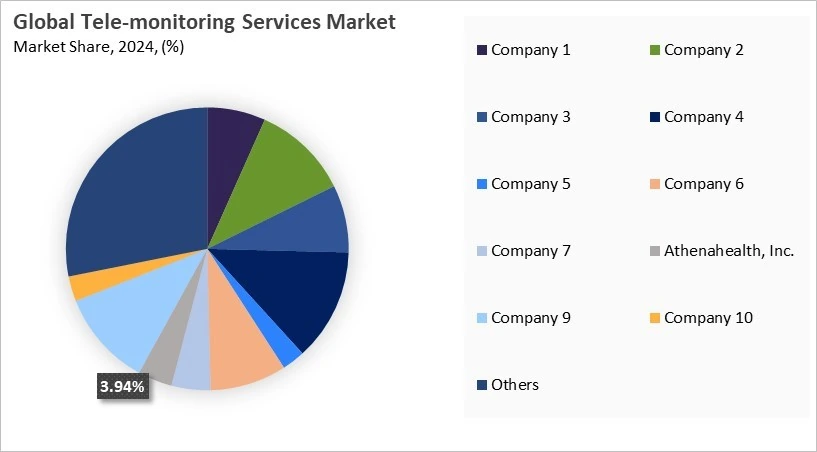
The leading players in the market are competing with diverse innovative offerings to remain competitive in the market. The above illustration shows the percentage of revenue shared by some of the leading companies in the market. The leading players of the market are adopting various strategies in order to cater demand coming from the different industries. The key developmental strategies in the market are Acquisitions, and Partnerships & Collaborations.
Based on Device, the market is segmented into Wearables / Remote Sensors and Mobile Devices. The mobile devices segment attained 43% revenue share in the tele-monitoring services market in 2024. These devices serve as a central platform for collecting, transmitting, and analyzing patient health data, enabling seamless communication between patients and healthcare providers. Mobile devices facilitate remote consultations, health tracking, medication reminders, and access to telehealth services, making healthcare more accessible and convenient.
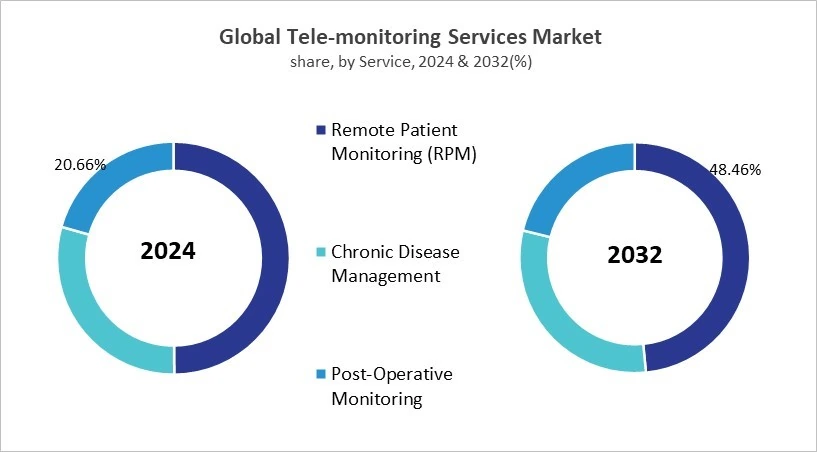
Based on Service, the market is segmented into Remote Patient Monitoring (RPM), Chronic Disease Management and Post-Operative Monitoring. The chronic disease management segment recorded 29% revenue share in the tele-monitoring services market in 2024. The chronic disease management segment focuses on monitoring and managing long-term conditions such as diabetes, cardiovascular diseases, and respiratory disorders. Tele-monitoring services in this segment enable continuous tracking of patient health and support proactive treatment adjustments. These solutions help improve patient adherence to treatment plans through regular monitoring, alerts, and virtual consultations.
Free Valuable Insights: Tele-monitoring Services Market Size to reach $91.10 by 2032
Region-wise, the tele-monitoring services market is analyzed across North America, Europe, Asia Pacific, and LAMEA. The North America segment recorded 34% revenue share in the tele-monitoring services market in 2024. In North America and Europe regions, the tele-monitoring services market is estimated to experience significant growth. The market is driven by strong digital adoption, advanced healthcare infrastructure, and supportive regulatory frameworks. North America’s market is growing due to widespread use of remote patient monitoring, high healthcare spending, and favorable reimbursement policies that support telehealth adoption. The presence of major healthcare companies and technology providers, alongside early integration of cloud-based and AI platforms, further surges the market expansion. Moreover, Europe tele-monitoring services market is growing, propelled by an increasing elderly population raising the need for chronic disease management, and government-backed digital health initiatives. The region’s focus on interoperability and data privacy standards which promote standardized and secure tele-monitoring solutions across healthcare systems.
The tele-monitoring services market is anticipated to grow at a substantial rate in the Asia Pacific and LAMEA region. The market is driven by increasing smartphone penetration, enhancing healthcare infrastructure, and rising awareness of remote healthcare solutions. Asia Pacific is experiencing strong growth supported by rising chronic disease burden, large patient populations, and government initiatives promoting digital health. Mobile health platforms and cost-effective tele-monitoring solutions are influential in underserved areas. Furthermore, the LAMEA tele-monitoring services market is expanding at a steady pace. This is because of investment in telecommunication infrastructure and healthcare modernization efforts. Also, the region showcases noticeable growth opportunities because of the rising demand for affordable and accessible healthcare solutions.
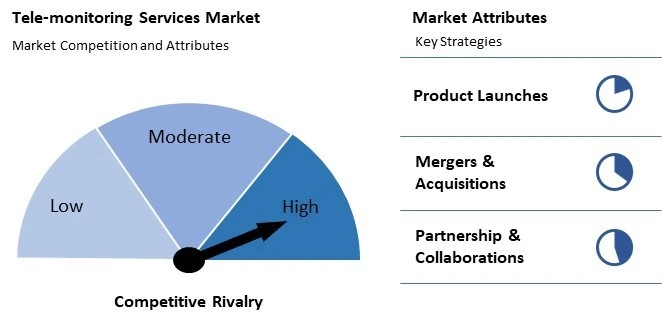
The tele-monitoring services market is very competitive and changes quickly because of new technologies and growing healthcare needs. Providers stand out by offering better service, more reliable platforms, better data security, and better ways to connect with existing healthcare systems. The market is always changing, with better remote patient monitoring tools and easier-to-use interfaces. Strategic partnerships, geographic growth, and tailoring services for chronic disease management all make competition even tougher. At the same time, following the rules and protecting patient data are still very important competitive factors.
| Report Attribute | Details |
|---|---|
| Market size value in 2025 | USD 28.80 Billion |
| Market size forecast in 2032 | USD 91.10 Billion |
| Base Year | 2024 |
| Historical period | 2021 to 2023 |
| Forecast Period | 2025 to 2032 |
| Revenue Growth Rate | CAGR of 17.9% from 2025 to 2032 |
| Number of Pages | 749 |
| Tables | 645 |
| Report Coverage | Market Trends, Revenue Estimation and Forecast, Segmentation Analysis, Regional and Country Breakdown, Competitive Landscape, Market Share Analysis, Porter’s 5 Forces Analysis, Company Profiling, Companies Strategic Developments, SWOT Analysis, Winning Imperatives |
| Segments Covered | Device, Service, Payment Model, End Use, Application, Facility, Region |
| Country Scope |
|
| Companies Included | OMRON HEALTHCARE Co., Ltd. (Omron Corporation), Koninklijke Philips N.V., Teladoc Health, Inc., Twilio, Inc., Medtronic PLC, GE HealthCare Technologies, Inc., American Well Corporation (Amwell), Athenahealth, Inc., Abbott Laboratories, and MDLive, Inc. |
By Device
By Service
By Payment Model
By End Use
By Application
By Facility
By Geography
Valued at USD 28.80 billion in 2025, reaching USD 91.10 billion by 2032 at 17.9% CAGR during 2025-2032.
Wearables and Remote Sensors registered maximum revenue, achieving $50.3 billion by 2032.
OMRON HEALTHCARE Co., Ltd., Koninklijke Philips N.V., and Teladoc Health, Inc. hold dominant positions.
North America leads with $29.5 billion by 2032. Europe grows at 17.7% CAGR during 2025-2032.
Insurance Reimbursement captured maximum revenue, reaching $29.4 billion by 2032.
Primary Care led with maximum revenue, achieving $23.3 billion by 2032.
Our team of dedicated experts can provide you with attractive expansion opportunities for your business.








 Unique Offerings