The Asia Pacific Tele-monitoring Services Market is expected to reach $14.92 billion by 2029 and would witness market growth of 18.5% CAGR during the forecast period (2025-2032).
The China market dominated the Asia Pacific Tele-monitoring Services Market by Country in 2024, and would continue to be a dominant market till 2032; thereby, achieving a market value of $7,203.2 million by 2032. The Japan market is registering a CAGR of 17.7% during (2025 - 2032). Additionally, The India market would showcase a CAGR of 19.4% during (2025 - 2032). The China and Japan led the Asia Pacific Tele-monitoring Services Market by Country with a market share of 32.4% and 19.2% in 2024. The Singapore market is expected to witness a CAGR of 20.6% during throughout the forecast period.
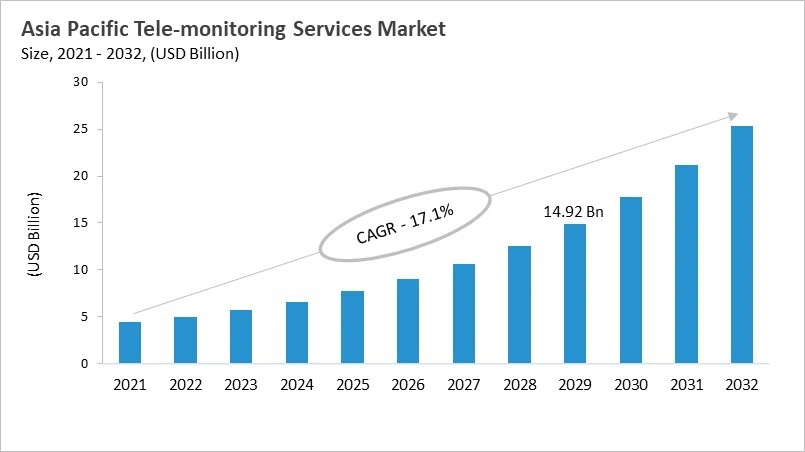
The Asia Pacific tele-monitoring services market has changed a lot since it first started with simple remote patient monitoring. Now, it includes a full digital healthcare ecosystem that helps with managing chronic diseases, post-operative care, and the health of older people. Rising healthcare costs, widespread use of mobile and internet technologies, and strong government efforts to make healthcare more accessible in remote areas are all driving this change. Advanced solutions that use wearable devices, mobile apps, and cloud-based platforms now make it possible to keep an eye on patients all the time and assess their health in real time. Also, combining artificial intelligence and machine learning makes predictive analytics and personalized treatment better, which leads to better patient outcomes, fewer hospital readmissions, and lower overall healthcare costs.
The market is being shaped by a number of important trends, such as the quick adoption of mHealth platforms, the growing use of AI-driven analytics, and the growth of telehealth infrastructure, which are backed by government policies. To get a stronger foothold in the market, players are focusing on new ideas, strategic partnerships, and customizing their services for different regions. Working with telecom companies, healthcare providers, and insurers is making services easier to access and more affordable. The competitive landscape is still changing, with both global and local companies competing on technology, scalability, and user experience. They are also forming partnerships to reach more people. In general, the market is a good mix of innovation and collaboration, with the goal of improving healthcare delivery and access across the Asia Pacific region.
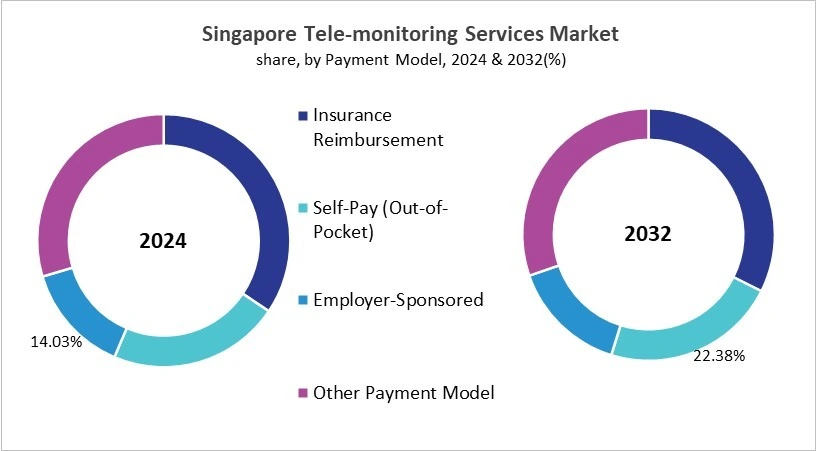
Based on Payment Model, the market is segmented into Insurance Reimbursement, Self-Pay (Out-of-Pocket), Employer-Sponsored and Other Payment Model. The Insurance Reimbursement market segment dominated the Singapore Tele-monitoring Services Market by Payment Model is expected to grow at a CAGR of 19.7 % during the forecast period thereby continuing its dominance until 2032. Also, The Employer-Sponsored market is anticipated to grow as a CAGR of 21.6 % during the forecast period during (2025 - 2032).
Based on Application, the market is segmented into Primary Care, Cardiology, Mental Health, Dermatology and Other Application. Among various China Tele-monitoring Services Market by Application; The Primary Care market achieved a market size of USD $586.3 Million in 2024 and is expected to grow at a CAGR of 15.5 % during the forecast period. The Mental Health market is predicted to experience a CAGR of 17% throughout the forecast period from (2025 - 2032).
Free Valuable Insights: Tele-monitoring Services Market is Predicted to reach USD 91.10 billion by 2032, at a CAGR of 17.9%
China Tele-monitoring Services has changed from simple remote healthcare solutions to a high-tech digital health ecosystem. This change started with the need to make healthcare more accessible in rural areas and sped up a lot with the COVID-19 pandemic. Improvements in IoMT, AI, cloud computing, and big data analytics have made it easier to monitor things in real time, make predictions about illnesses, and give personalized care. Some important trends are the use of AI to get useful information, regulatory changes that help, and new uses of blockchain to keep data safe. Market leaders are solidifying their positions by investing in research and development, forming strategic partnerships, and building scalable cloud infrastructure. At the same time, they are following government initiatives and meeting compliance requirements. The competitive landscape is still changing, with different players focusing on innovation, clinical effectiveness, and ecosystem integration to achieve long-term growth and better patient outcomes.

By Device
By Service
By Payment Model
By End Use
By Application
By Facility
By Country
Market will reach $14.92 billion by 2029, growing at 18.5% CAGR during 2025-2032.
China leads the market with $7,203.2 million by 2032 and holds 32.4% market share in 2024.
Aging populations and increasing chronic disease prevalence across the region fuel market expansion.
Japan's market grows at 17.7% CAGR during 2025-2032 with 19.2% regional share in 2024.
India shows the fastest regional growth at 19.4% CAGR during 2025-2032.
China's primary care segment reached $586.3 million in 2024, growing at 15.5% CAGR during the forecast period.
Our team of dedicated experts can provide you with attractive expansion opportunities for your business.




 Unique Offerings