The sample copy of this report is available for access.
“Global Smart Shopping Cart Market to reach a market value of USD 3,005.5 Million by 2033 growing at a CAGR of 24.1%”
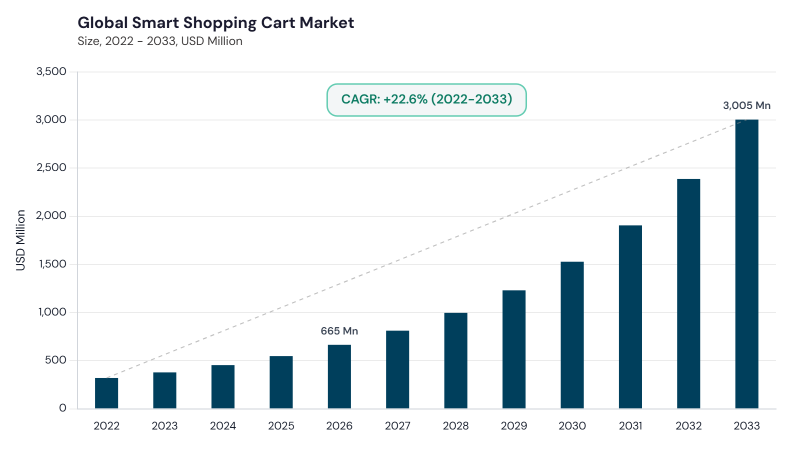
The Global Smart Shopping Cart Market is expected to reach USD 3005.5 million by 2033, growing at a CAGR of 24.1% during 2026 - 2033.
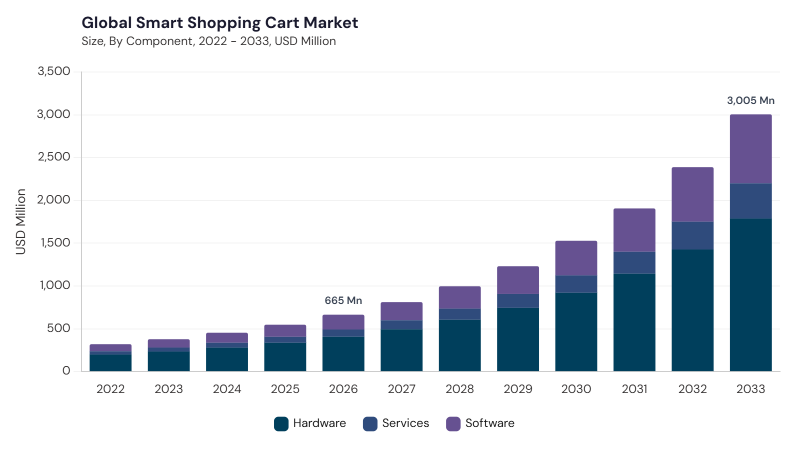
The Global Smart Shopping Cart Market is witnessing significant growth driven by increasing adoption of retail automation technologies, rising demand for frictionless and contactless shopping experiences, and growing integration of artificial intelligence, Internet of Things (IoT), and digital payment systems across retail ecosystems. Retailers are increasingly investing in intelligent shopping infrastructure to improve operational efficiency, strengthen customer engagement, reduce checkout times, and support data-driven retail strategies.
The Smart Shopping Cart Market is increasingly positioned at the intersection of retail automation, artificial intelligence, customer analytics, and connected commerce ecosystems. The integration of advanced sensors, computer vision technologies, AI-driven product recognition, real-time inventory monitoring, and cloud-based retail analytics is significantly reshaping innovation across the market.
The market is additionally benefiting from rising consumer demand for seamless and contactless shopping experiences, growing adoption of digital payment systems, and increasing focus on operational efficiency among retailers. Expansion of organized retail infrastructure, rising urbanization, growing smartphone penetration, and evolving omnichannel retail strategies are supporting sustained market expansion across both developed and emerging economies.
The major strategies adopted by leading companies include AI-driven technology innovation, strategic retailer partnerships, smart retail ecosystem expansion, cloud-based analytics integration, modular smart cart deployment, and personalized customer engagement solutions. Companies are increasingly emphasizing automated checkout, frictionless shopping experiences, retail data analytics, and scalable smart cart infrastructure to strengthen competitive positioning globally.

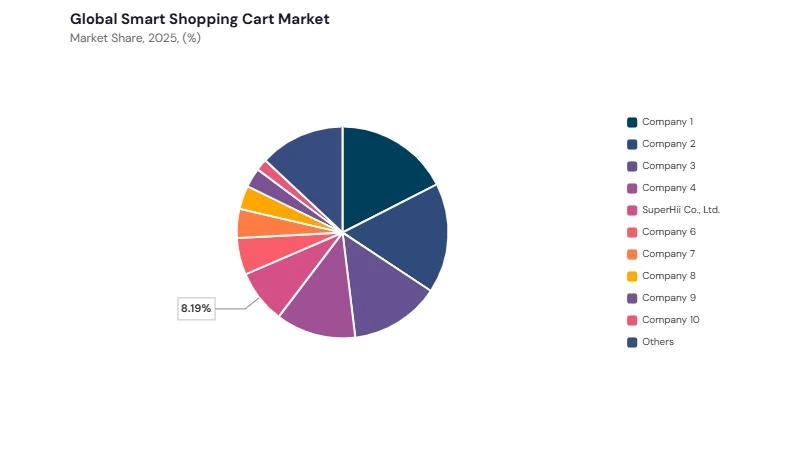
Amazon, Instacart, A2Z Cust2Mate, Shopic, and Caper AI maintain strong market positions supported by AI-powered retail automation technologies, advanced computer vision capabilities, and large-scale retailer partnerships. Companies such as Toshiba Tec Corporation, NCR Voyix Corporation, Zebra Technologies Corporation, SuperHii, and Shopreme strengthen market competition through smart retail infrastructure innovation, automated checkout systems, and modular smart cart deployment strategies.
Leading players continue maintaining strong market presence through retail automation innovation, strategic partnerships, AI-powered analytics, and expansion of connected commerce ecosystems.
Based on Deployment, the Smart Shopping Cart Market is segmented into Cloud and On-premise.
The Cloud market dominated the Global Smart Shopping Cart Market by Deployment in 2025, and would continue to be a dominant market till 2033; thereby, achieving a market value of USD 2055.1 million by 2033, growing at a CAGR of 24.3% during the forecast period. The On-premise market is expected to witness a CAGR of 23.6% during (2026 - 2033).
Retailers are increasingly implementing cloud-based smart shopping cart systems to improve operational efficiency, enable centralized monitoring, support remote software updates, and strengthen customer engagement through connected retail environments. The scalability, flexibility, and accessibility associated with cloud deployment models are further accelerating adoption across supermarkets, hypermarkets, and organized retail chains globally. The On-premise segment is also witnessing steady growth supported by increasing concerns related to data privacy, operational control, cybersecurity, and secure management of customer transaction information. Retailers are increasingly adopting on-premise smart shopping cart systems to maintain stronger infrastructure control and ensure uninterrupted in-store operational performance.
Based on Component, the Smart Shopping Cart Market is segmented into Hardware, Software, and Services.
The Hardware market dominated the Global Smart Shopping Cart Market by Component in 2025, and would continue to be a dominant market till 2033; thereby, achieving a market value of USD 1787.8 million by 2033, growing at a CAGR of 23.6 % during the forecast period. The Software market is expected to witness a CAGR of 24.6% during (2026 - 2033).
The Software segment is witnessing significant growth driven by rising implementation of AI-powered analytics platforms, automated billing systems, personalized recommendation engines, customer engagement solutions, and retail inventory management applications. The Services segment is also gaining traction due to increasing demand for installation, maintenance, integration, consulting, and technical support services associated with deployment of smart retail ecosystems and intelligent shopping technologies.
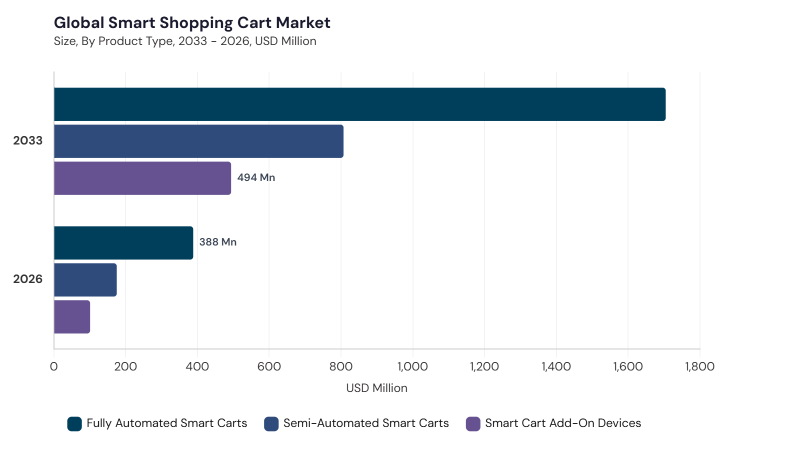
Based on Product Type, the Smart Shopping Cart Market is segmented into Fully Automated Smart Carts, Semi-Automated Smart Carts, and Smart Cart Add-On Devices.
The Fully Automated Smart Carts market dominated the Global Smart Shopping Cart Market by Product Type in 2025, and would continue to be a dominant market till 2033; thereby, achieving a market value of USD 1704.5 million by 2033, growing at a CAGR of 23.5 % during the forecast period. The Semi-Automated Smart Carts market is expected to witness a CAGR of 24.4% during (2026 - 2033). The Smart Cart Add-On Devices market is expected to witness a CAGR of 25.4% during (2026 - 2033).
The Semi-Automated Smart Carts segment is witnessing growth supported by increasing adoption of hybrid retail automation solutions that combine manual shopping experiences with intelligent digital functionalities. Retailers are increasingly implementing semi-automated smart carts to improve operational efficiency while maintaining cost-effective deployment strategies.
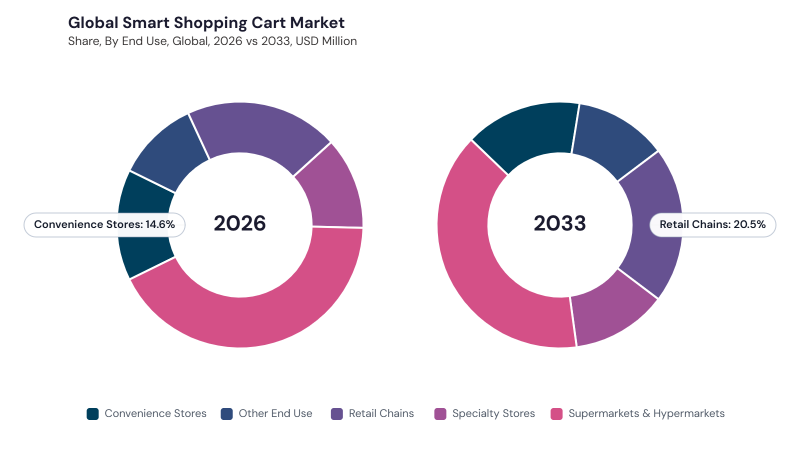
Based on End Use, the Smart Shopping Cart Market is segmented into Supermarkets & Hypermarkets, Retail Chains, Convenience Stores, Specialty Stores, and Other End Use.
The Supermarkets & Hypermarkets market dominated the Global Smart Shopping Cart Market by End Use in 2025, and would continue to be a dominant market till 2033; thereby, achieving a market value of USD 1182.2 million by 2033, growing at a CAGR of 22.8% during the forecast period. The Retail Chains market is expected to witness a CAGR of 24.4% during (2026 - 2033).
The Retail Chains segment is also witnessing substantial growth supported by rising investments in retail automation and growing adoption of AI-powered shopping technologies across organized retail networks. Convenience Stores are increasingly adopting compact and efficient smart cart systems to improve operational efficiency and support seamless shopping experiences within limited retail spaces.
Free Valuable Insights: Smart Shopping Cart Market Size to reach $3,005.5 Million by 2033
Region-wise, the Smart Shopping Cart Market is analyzed across North America, Europe, Asia Pacific, and LAMEA.
The North America market dominated the Global Smart Shopping Cart Market by Region in 2025, and would continue to be a dominant market till 2033; thereby, achieving a market value of USD 1,276.13 million by 2033, growing at a CAGR of 24.8% during the forecast period. The Europe market is expected to witness a CAGR of 23.6% during (2026 - 2033).
Asia Pacific is emerging as a highly promising market due to rapid expansion of organized retail infrastructure, increasing digitalization of retail operations, rising smartphone penetration, and growing adoption of AI-powered shopping technologies across emerging economies. The LAMEA market is also witnessing gradual growth supported by increasing awareness regarding retail automation technologies, expansion of modern retail infrastructure, and rising investments in digital retail transformation initiatives across retail ecosystems.
Smart Shopping Cart Market Coverage:
| Report Attribute | Details |
|---|---|
| Market size value in 2026 | USD 664.8 Million |
| Market size forecast in 2033 | USD 3,005.5 Million |
| Base Year | 2025 |
| Historical period | 2022 to 2024 |
| Forecast Period | 2026 to 2033 |
| Revenue Growth Rate | CAGR of 24.1% from 2026 to 2033 |
| Number of Pages | 654 |
| Tables | 750 |
| Report Coverage | Market Trends, Revenue Estimation and Forecast, Segmentation Analysis, Regional and Country Breakdown, Competitive Landscape, Market Share Analysis, Company Profiling, Companies Strategic Developments, SWOT Analysis, Winning Imperatives |
| Segments Covered | Deployment, Component, Product Type, End Use, Region |
| Country Scope |
|
| Companies Included | Amazon, Instacart, A2Z Cust2Mate Solutions Corp., Shopic Ltd., Toshiba Tec Corporation, NCR Voyix Corporation, Zebra Technologies Corporation, SuperHii, Shopreme GmbH, Caper AI |
By Deployment
By Component
By Product Type
By End Use
By Geography
Expected to reach USD 3,005.5 million by 2033, growing at 24.1% CAGR during 2026-2033.
The Cloud segment will dominate, achieving USD 2,055.1 million by 2033, with a 24.3% CAGR during 2026-2033.
Amazon, Instacart, A2Z Cust2Mate Solutions Corp., Shopic Ltd., and Toshiba Tec Corporation are key players.
North America leads, reaching USD 1,276.13 million by 2033, with a 24.8% CAGR during 2026-2033.
Enhanced consumer experience through digital technologies and demand for data analytics optimize retail operations.
Fully Automated Smart Carts dominate, reaching USD 1,704.5 million by 2033, with a 23.5% CAGR during 2026-2033.
Our team of dedicated experts can provide you with attractive expansion opportunities for your business.








 Unique Offerings