The sample copy of this report is available for access.
The North America Smart Shopping Cart Market is expected to reach USD 1,018.85 million by 2032, growing at a CAGR of 23.5% during 2026 - 2033.
The US market dominated the North America Smart Shopping Cart Market by Country in 2025, and would continue to be a dominant market till 2033; thereby, achieving a market value of USD 693.01 million by 2032, growing at a CAGR of 22.7% during the forecast period. The Canada market is expected to witness a CAGR of 26.3% during (2026 - 2033).
The North America Smart Shopping Cart Market is expected to witness substantial growth during the forecast period owing to increasing adoption of retail automation technologies, rising demand for contactless shopping experiences, growing integration of AI and IoT within retail infrastructure, and increasing emphasis on enhancing customer convenience and operational efficiency.
Over time, technological advancements in RFID, AI, IoT connectivity, and cloud computing transformed shopping carts into intelligent retail platforms capable of automated checkout, personalized recommendations, inventory tracking, and real-time shopper analytics. Key turning points included the integration of AI-powered computer vision technologies, cloud-based analytics platforms, and contactless payment systems, which enabled retailers to improve operational efficiency and support cashier-less shopping experiences.
Growing consumer preference for frictionless, contactless, and personalized shopping experiences is significantly driving demand for advanced smart shopping cart solutions across North America. Further, increasing integration of AI, machine learning, IoT connectivity, cloud analytics, and digital payment technologies is transforming the market into a highly connected and data-driven retail ecosystem.
Based on Deployment, the market is segmented into Cloud and On-premise. The Cloud segment dominated the North America Smart Shopping Cart Market by Deployment in 2025, and would continue to remain the dominant segment till 2033 owing to increasing adoption of cloud-based retail infrastructure, growing implementation of AI-powered retail analytics, and rising demand for scalable and centrally managed smart shopping cart solutions across supermarkets and retail chains.
The On-premise segment recorded a significant revenue share in the North America Smart Shopping Cart Market in 2025. The segment is witnessing steady growth due to increasing concerns regarding data privacy, cybersecurity, and operational control among retailers handling sensitive consumer and transaction data.
Based on Component, the market is segmented into Hardware, Software, and Services. The Hardware market dominated the North America Smart Shopping Cart Market by Component in 2025, and would continue to be a dominant market till 2033; thereby, achieving a market value of USD 606.40 million by 2032, growing at a CAGR of 23% during the forecast period. The Software market is expected to witness a CAGR of 24% during (2026 - 2033).
The Software segment recorded a notable revenue share in the North America Smart Shopping Cart Market in 2025. Growing implementation of AI-powered retail analytics, customer engagement platforms, inventory optimization tools, and automated billing systems continues supporting strong growth within this segment.
The Services segment witnessed considerable market presence owing to increasing demand for installation, maintenance, integration, consulting, and technical support services associated with smart shopping cart deployment across connected retail environments.
Based on Product Type, the market is segmented into Fully Automated Smart Carts, Semi-Automated Smart Carts, and Smart Cart Add-On Devices.
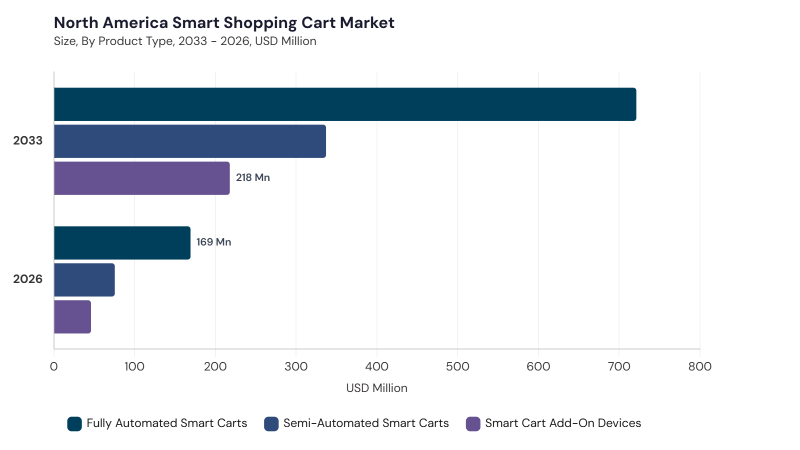
The Fully Automated Smart Carts market dominated the North America Smart Shopping Cart Market by Product Type in 2025, and would continue to be a dominant market till 2033; thereby, achieving a market value of USD 578.28 million by 2032, growing at a CAGR of 23% during the forecast period.
The Semi-Automated Smart Carts segment recorded a significant revenue share in the North America Smart Shopping Cart Market in 2025. Retailers are increasingly adopting semi-automated smart carts to support inventory tracking, digital engagement, and operational efficiency while maintaining cost-effective deployment strategies.
Based on End Use, the market is segmented into Supermarkets & Hypermarkets, Retail Chains, Convenience Stores, Specialty Stores, and Other End Use.
The Supermarkets & Hypermarkets segment dominated the North America Smart Shopping Cart Market by End Use in 2025, and would continue to remain the dominant segment till 2033 owing to increasing implementation of automated retail technologies, growing demand for contactless checkout systems, and rising investments in connected retail infrastructure.
The Retail Chains segment recorded a significant revenue share in the North America Smart Shopping Cart Market in 2025. Growing deployment of AI-powered shopping systems and increasing focus on enhancing customer engagement and operational visibility continue supporting segment growth.
Free Valuable Insights: The Global Smart Shopping Cart Market will hit USD 3,005.5 Million billion by 2033, at a CAGR of 24.1%
Based on Country, the market is segmented into US, Canada, Mexico, and Rest of North America.
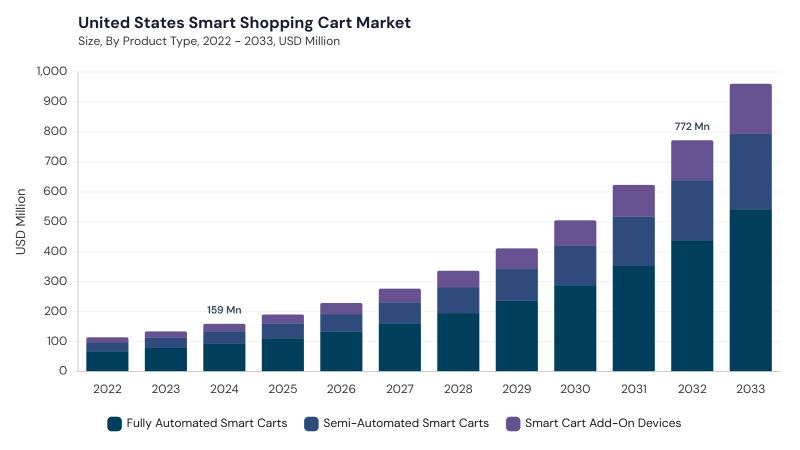
The US market dominated the North America Smart Shopping Cart Market by Country in 2025, and would continue to be a dominant market till 2033; thereby, achieving a market value of USD 772.14 million by 2032, growing at a CAGR of 22.7% during the forecast period. The Canada market is expected to witness a CAGR of 26.3% during (2026 - 2033).
Canada continues witnessing substantial growth supported by increasing implementation of connected retail technologies, rising consumer preference for personalized shopping experiences, and growing investments in smart retail automation.

By Deployment
By Component
By Product Type
By End Use
By Country
Set to reach $1,018.85 Million by 2032, growing at 23.5% CAGR during 2026-2033.
The US leads with $772.14 million by 2032, growing at 22.7% CAGR during the forecast period.
The Fully Automated Smart Carts segment will reach $578.28 million by 2032, growing at 23% CAGR.
Hardware will achieve $606.40 million by 2032, growing at 23% CAGR during the forecast period.
Canada is expected to witness a CAGR of 26.3% during 2026-2033.
Our team of dedicated experts can provide you with attractive expansion opportunities for your business.




 Unique Offerings