The sample copy of this report is available for access.
“Global Reach Stacker Market to reach a market value of USD 4,500.58 Million by 2033 growing at a CAGR of 6.3%”
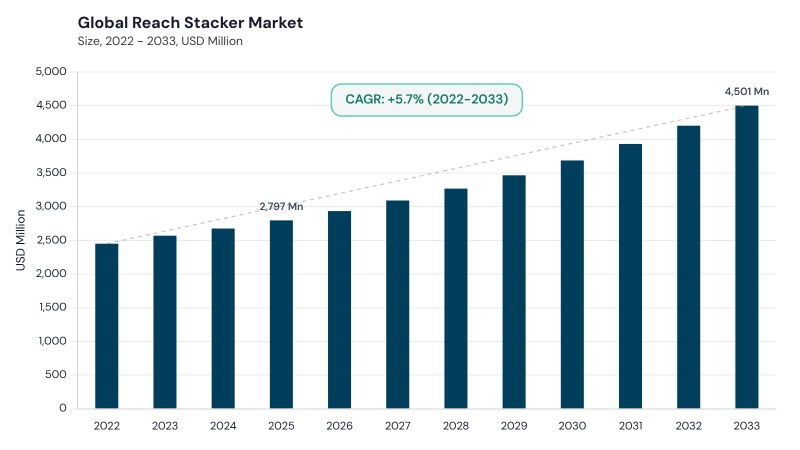
The Global Reach Stacker Market is expected to reach USD 4.5 Billion by 2033, growing at a CAGR of 6.3% during (2026 - 2033).
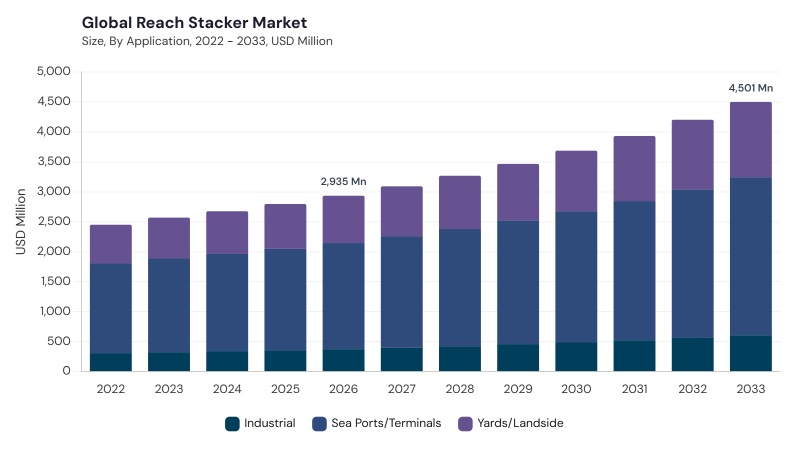
The Global Reach Stacker Market is witnessing steady growth, driven by expanding port operations, rising containerized trade, intermodal logistics development, and increasing demand for efficient heavy-load handling equipment. The market originated as a response to the need for faster and more flexible container movement within ports, terminals, and logistics yards. Early reach stackers were designed as robust container-handling vehicles with basic hydraulic controls and limited lifting capabilities, while modern reach stackers have evolved into highly specialized equipment equipped with advanced hydraulics, stronger chassis structures, ergonomic cabins, electronic controls, safety systems, and digital monitoring features.
The Reach Stacker Market is witnessing sustained expansion as global trade, port modernization, intermodal freight movement, and industrial logistics continue to increase demand for flexible cargo handling equipment. Reach stackers are preferred for their ability to move, stack, and transport containers efficiently in environments where maneuverability, lifting strength, and operational reliability are essential. The market is also benefiting from growing adoption of smart monitoring systems, telematics, remote diagnostics, intelligent control features, and safety technologies that help improve equipment utilization and reduce downtime.
The Reach Stacker Market is characterized by a moderately consolidated yet regionally diverse competitive environment consisting of global heavy equipment manufacturers, specialized cargo handling equipment providers, regional machinery companies, component suppliers, and aftermarket service providers. Competition is centered on lifting performance, machine durability, powertrain efficiency, safety compliance, digital integration, service availability, customization capability, and lifecycle cost efficiency. Global players compete through advanced product portfolios, strong service networks, and research investment in automation and electrification, while regional manufacturers compete through localized support, cost competitiveness, and tailored equipment solutions. Strategic collaborations with port operators, logistics providers, technology firms, and distributors continue to shape the competitive landscape.
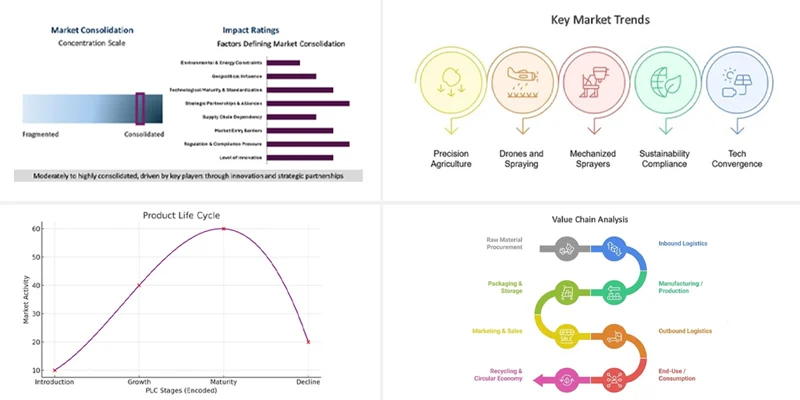

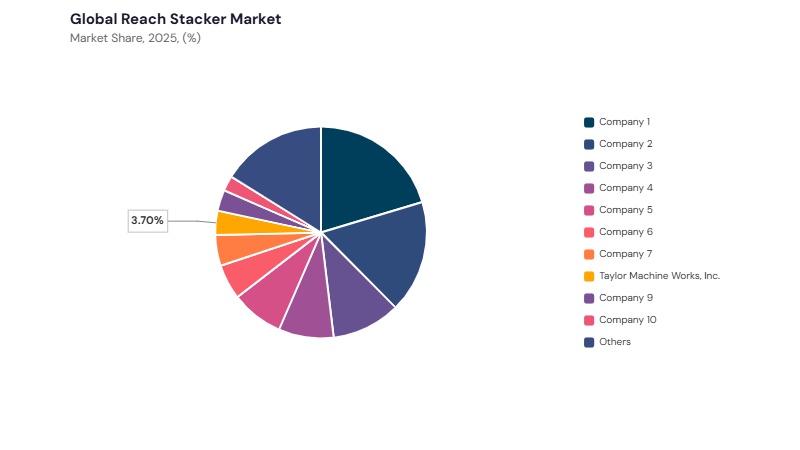
The Reach Stacker Market exhibits a moderately consolidated and technology-driven competitive structure, with established global manufacturers holding strong positions alongside regional and specialized equipment providers. Leading companies compete by offering advanced reach stackers designed for container handling, intermodal logistics, industrial cargo movement, and heavy-duty operations. Kalmar maintains strong relevance through its focus on electrified and eco-efficient reach stacker technologies, while Konecranes strengthens its position through smart container handling solutions, automation support, and digital monitoring capabilities. Hyster remains an important participant through its high-capacity reach stacker portfolio designed for demanding port, rail terminal, and industrial logistics applications. Other major participants include Sany Heavy Industry, Liebherr, Hyster-Yale Materials Handling, Mitsubishi Logisnext, CVS Ferrari, Terex, and Hoist Material Handling.
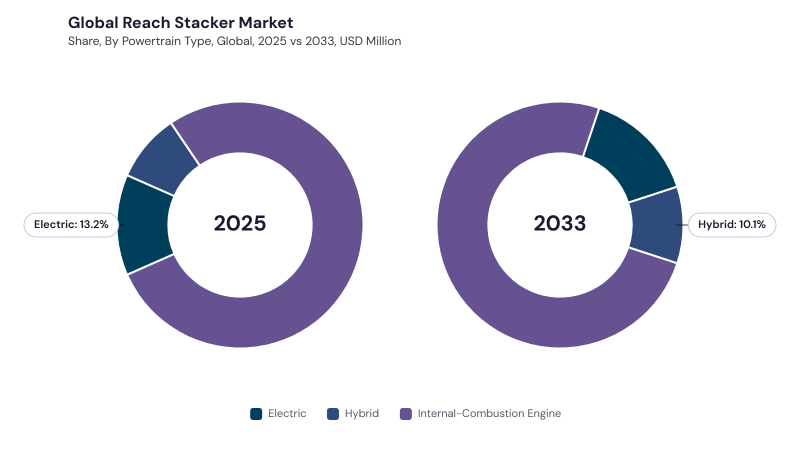
Based on Powertrain Type, the market is segmented into Internal-Combustion Engine, Electric, and Hybrid. The Internal-Combustion Engine market dominated the Global Reach Stacker Market by Powertrain Type in 2025, and would continue to be a dominant market till 2033; thereby, achieving a market value of USD 3.4 Billion by 2033, growing at a CAGR of 5.8 % during the forecast period. The Electric market is expected to witness a CAGR of 7.8% during (2026 - 2033). Additionally, The Hybrid market is expected to witness highest CAGR of 7.8% during (2026 - 2033).
These machines remain widely preferred where high uptime, fast refueling, heavy-load performance, and established maintenance infrastructure are critical. Electric reach stackers are gaining adoption as operators increasingly prioritize emissions reduction, lower noise, improved energy efficiency, and sustainability compliance. Hybrid reach stackers are supported by their ability to combine conventional engine power with improved fuel efficiency and reduced emissions, making them attractive for operators transitioning toward cleaner fleets. Internal-combustion reach stackers remain foundational across heavy-duty cargo handling applications where rugged performance and long operating cycles are essential. Electric models are expanding in ports, intermodal facilities, and industrial environments seeking cleaner equipment and reduced operating emissions. Hybrid models offer an intermediate pathway for operators seeking fuel savings and lower environmental impact without fully shifting to battery-only operations.
Based on Application, the market is segmented into Sea Ports and Terminals, Yards and Landside, and Industrial. The Sea Ports/Terminals market dominated the Global Reach Stacker Market by Application in 2025, and would continue to be a dominant market till 2033; thereby, achieving a market value of USD 2.6 Billion by 2033, growing at a CAGR of 5.9 % during the forecast period. The Yards/Landside market is expected to witness a CAGR of 6.9% during (2026 - 2033). Additionally, The Industrial market is expected to witness highest CAGR of 7.1% during (2026 - 2033).
Yards and Landside applications are gaining demand due to rising container storage, inland freight movement, intermodal transport, and logistics hub expansion. Industrial applications are supported by increasing material handling requirements across manufacturing facilities, heavy industrial sites, mining operations, infrastructure projects, and cargo storage areas. Sea ports and terminals require durable, high-performance reach stackers capable of supporting intensive cargo handling, faster turnaround, and efficient container yard utilization. Yards and landside logistics facilities prioritize maneuverability, operational flexibility, and compatibility with distribution and intermodal workflows. Industrial users require reach stackers capable of handling bulky, dense, or specialized cargo across demanding operating environments.
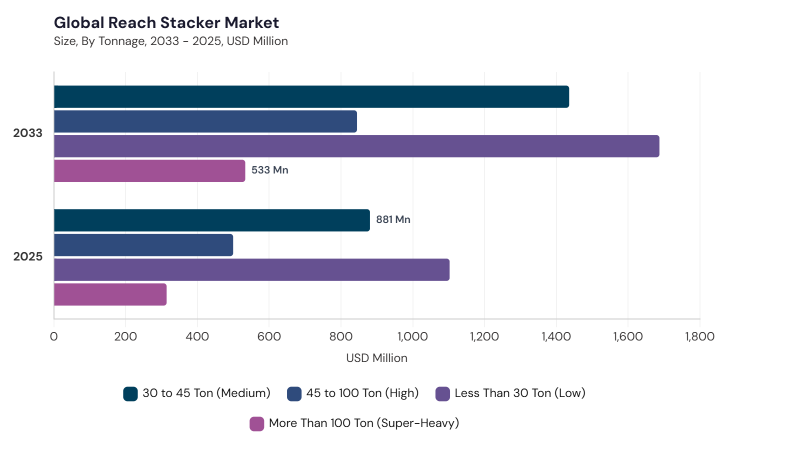
Based on Tonnage, the market is segmented into Low Capacity, Medium Capacity, High Capacity, and Super-Heavy Capacity. The Less Than 30 Ton (Low) market dominated the Global Reach Stacker Market by Tonnage in 2025, and would continue to be a dominant market till 2033; thereby, achieving a market value of USD 1.7 Billion by 2033, growing at a CAGR of 5.6 % during the forecast period. The 30 to 45 Ton (Medium) market is expected to witness a CAGR of 6.5% during (2026 - 2033). Additionally, The 45 to 100 Ton (High) market is expected to witness highest CAGR of 7% during (2026 - 2033).
Medium Capacity reach stackers are widely adopted due to their balance between lifting strength, maneuverability, and operational versatility across container yards and freight terminals. High Capacity reach stackers are supported by demand from high-volume terminals, heavy container handling, and specialized cargo operations. Super-Heavy Capacity reach stackers serve niche applications involving oversized cargo, heavy industrial materials, project cargo, and specialized port operations. Low-capacity machines are preferred where space efficiency, lower ownership burden, and flexible cargo handling are important. Medium-capacity reach stackers support standard container handling and inland logistics workflows where balanced productivity and versatility are required. High-capacity models are designed for demanding environments that involve heavy containers, bulk cargo, and high-intensity operations. Super-heavy models address specialized lifting requirements where exceptional load-handling capability, stability, and advanced safety systems are essential.
Free Valuable Insights: Reach Stacker Market Size to reach $4.5 Billion by 2033
Region-wise, the Reach Stacker Market is analyzed across North America, Europe, Asia Pacific, and LAMEA. The Asia Pacific market dominated the Global Reach Stacker Market by Region in 2025, and would continue to be a dominant market till 2033; thereby, achieving a market value of USD 1.9 Billion by 2033, growing at a CAGR of 6.7 % during the forecast period. The Europe market is expected to witness a CAGR of 5.5% during (2026 - 2033). Additionally, The North America market is expected to witness a CAGR of 6.1% during (2026 - 2033).
Europe remains a major market due to established maritime trade networks, advanced logistics infrastructure, sustainability initiatives, and adoption of efficient material handling technologies. North America is supported by freight transportation growth, intermodal logistics expansion, port modernization, and supply chain optimization. LAMEA is gradually emerging due to infrastructure development, expanding port capacities, increasing trade activities, and investments in cargo handling modernization. Asia Pacific benefits from strong manufacturing activity, port expansion, international trade growth, and modernization of container handling operations. Europe is shaped by environmental regulations, advanced port operations, and demand for low-emission material handling solutions. North America is supported by intermodal freight activity, logistics modernization, and investment in efficient cargo handling systems.
| Report Attribute | Details |
|---|---|
| Market size value in 2026 | USD 2.9 Billion |
| Market size forecast in 2033 | USD 4.5 Billion |
| Base Year | 2025 |
| Historical Period | 2022 to 2024 |
| Forecast Period | 2026 to 2033 |
| Revenue Growth Rate | CAGR of 6.3% from 2026 to 2033 |
| Number of Pages | 540 |
| Tables | 630 |
| Report Coverage | Market Trends, Revenue Estimation and Forecast, Segmentation Analysis, Regional and Country Breakdown, Competitive Landscape, Market Share Analysis, Company Profiling, Companies Strategic Developments, SWOT Analysis, Product Life Cycle Analysis, Value Chain Analysis, Market Consolidation Analysis, Key Customer Criteria, Pandemic Impact Analysis, and Winning Imperatives |
| Segments Covered | Powertrain Type, Application, Tonnage, Region |
| Country Scope |
|
| Companies Included | Kalmar, Konecranes, Hyster, Sany Heavy Industry, Liebherr, Hyster-Yale Materials Handling, Mitsubishi Logisnext, CVS Ferrari, Terex, and Hoist Material Handling |
By Powertrain Type
By Application
By Tonnage
By Geography
The market is valued at USD 2.9 billion in 2026.
Internal-combustion engine reach stackers lead, reaching USD 3.4 billion by 2033.
Kalmar, Konecranes, Hyster, Sany Heavy Industry, and Liebherr are leading companies.
Sea Ports and Terminals dominate, achieving USD 2.6 billion by 2033.
Asia Pacific leads, projected to reach USD 1.9 billion by 2033.
The market is expected to reach USD 4.5 billion by 2033, growing at 6.3% CAGR during 2026-2033.
Our team of dedicated experts can provide you with attractive expansion opportunities for your business.








 Unique Offerings