The sample copy of this report is available for access.
The Asia Pacific Reach Stacker Market is expected to reach USD 1.5 billion by 2030, growing at a CAGR of 6.7% during (2026 – 2033).
The Asia Pacific Reach Stacker Market traces its origins to the growing demand for efficient container handling equipment across the region’s expanding port infrastructure from the late 20th century onward. Initially, reach stackers served as specialized heavy-duty vehicles designed to handle shipping containers with greater maneuverability than traditional forklifts. Over time, mechanical and hydraulic improvements, fuel-efficient engines, automation, safety enhancements, digital controls, and terminal system integration strengthened their role in port and logistics operations. Today, the market reflects a combination of mechanical robustness and advanced technology, aligned with Asia Pacific’s position as a major global trade hub supporting high container throughput.
The growing emphasis on fuel efficiency, sustainability, automation, safety, digitalization, terminal operating system integration, and regional adaptation is shaping the next phase of market growth across Asia Pacific. Manufacturers are increasingly investing in hybrid models, cleaner fuel technologies, autonomous navigation, intelligent control systems, real-time monitoring, telematics, predictive maintenance, IoT-enabled equipment, and cloud-based diagnostics to improve productivity, asset uptime, safety, and operating cost control. Rising container trade, port capacity additions, rapid industrialization, inland logistics development, export-oriented manufacturing, free trade zones, and multimodal freight networks are also supporting improved scalability, service quality, and market expansion.
Based on Powertrain Type, the market is segmented into Internal-Combustion Engine, Electric, and Hybrid. The Internal-Combustion Engine market dominated the Asia Pacific Reach Stacker Market by Powertrain Type in 2025, and would continue to be a dominant market till 2033; thereby, achieving a market value of USD 1.2 billion by 2030, growing at a CAGR of 6.2 % during the forecast period. The Electric market is expected to witness a CAGR of 8.2% during (2026 - 2033). Additionally, The Hybrid market is expected to witness highest CAGR of 8.3% during (2026 - 2033).
Internal-combustion engine reach stackers lead the market due to heavy-duty performance, strong lifting capability, easier refueling, long operating hours, mature maintenance networks, and suitability for demanding ports and logistics yards. These machines remain widely preferred where electric charging infrastructure is still developing or where operators require continuous operation in high-traffic cargo environments. Electric reach stackers are also gaining visibility in advanced ports and sustainability-focused logistics hubs due to cleaner fleets, lower noise, and reduced local emissions. Hybrid reach stackers further support operators seeking fuel savings and lower emissions while retaining operational flexibility in high-use environments.
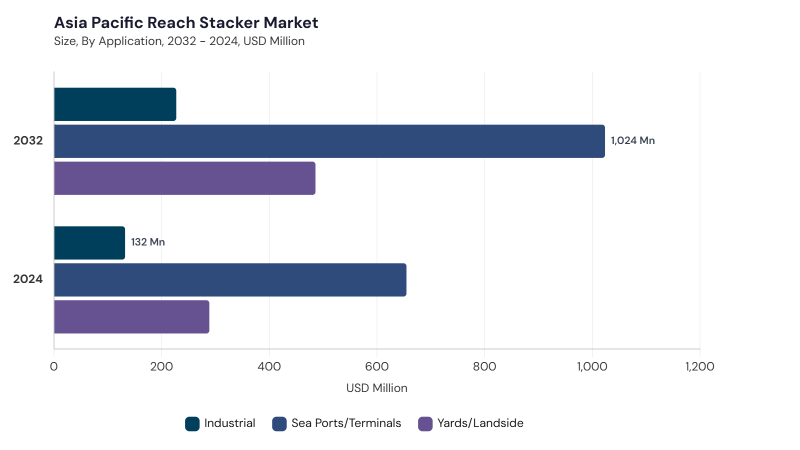
Based on Application, the market is segmented into Sea Ports/Terminals, Yards/Landside, and Industrial. The Sea Ports/Terminals market dominated the Asia Pacific Reach Stacker Market by Application in 2025, and would continue to be a dominant market till 2033; thereby, achieving a market value of USD 898.9 million by 2030, growing at a CAGR of 6.2 % during the forecast period. The Yards/Landside market is expected to witness a CAGR of 7.2% during (2026 - 2033). Additionally, The Industrial market is expected to witness highest CAGR of 7.5% during (2026 - 2033).
Sea ports and terminals lead the market due to Asia Pacific’s strong role in global container trade, export manufacturing, transshipment activity, quay-support movement, truck loading, intermodal transfer, and port expansion projects. Reach stackers are valued in these terminals because they support container stacking, yard reorganization, fast cargo movement, and flexible handling across changing cargo flows. Yards and landside applications are also expanding due to inland container depots, logistics parks, rail freight terminals, bonded warehouses, distribution corridors, rail-road transfer, container repositioning, storage management, and faster cargo circulation between ports and industrial clusters.
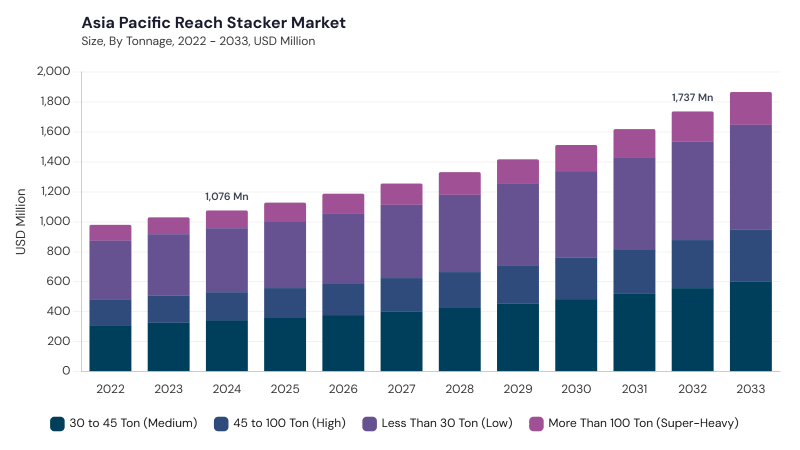
Based on Tonnage, the market is segmented into Less Than 30 Ton (Low), 30 to 45 Ton (Medium), 45 to 100 Ton (High), and More Than 100 Ton (Super-Heavy). Low-tonnage reach stackers lead the market due to broad relevance across smaller yards, inland depots, compact logistics sites, light industrial facilities, and developing freight hubs where maneuverability, affordability, and ease of operation are important. These machines support moderate container handling, lighter cargo loads, and constrained-site operations.
Medium-tonnage reach stackers also hold a major position as they fit standard container-handling requirements across ports, depots, and rail-linked logistics centers. High-tonnage and super-heavy machines serve specialized applications involving heavy containers, dense stacking, oversized project cargo, wind-energy components, steel coils, mining equipment, heavy machinery, and infrastructure-related logistics.
Free Valuable Insights: The Global Reach Stacker Market will hit USD 4.5 Billion billion by 2033, at a CAGR of 6.3%
Based on Country, the market is segmented into China, Japan, India, South Korea, Singapore, Malaysia, and Rest of Asia Pacific. The China market dominated the Asia Pacific Reach Stacker Market by Country in 2025, and would continue to be a dominant market till 2033; thereby, achieving a market value of USD 591.4 million by 2030, growing at a CAGR of 5.3 % during the forecast period. The Japan market is expected to witness a CAGR of 5.3% during (2026 - 2033). Additionally, The India market is expected to witness a CAGR of 7.4% during (2026 - 2033).
China leads through industrial expansion, port modernization, domestic manufacturing, electric and hybrid powertrains, telematics, automation, and logistics modernization. Japan is growing with port activity, industrial automation, eco-friendly machinery, IoT sensors, AI-based load handling, and predictive maintenance. India is supported by manufacturing growth, port activities, e-commerce expansion, inland container depots, infrastructure initiatives, and localized service networks. South Korea, Singapore, Malaysia, and Rest of Asia Pacific add growth through port upgrades, logistics expansion, and demand for advanced handling equipment.

By Powertrain Type
By Application
By Tonnage
By Country
Set to reach USD 1.5 billion by 2033, growing at 6.7% CAGR during 2026-2033.
China leads with USD 591.4 million by 2030, growing at a CAGR of 5.3% during the forecast period.
The electric segment is expected to witness a CAGR of 8.2% during 2026-2033.
Sea ports/terminals segment will reach USD 898.9 million by 2030, growing at a 6.2% CAGR during the forecast period.
The India market is expected to witness a CAGR of 7.4% during 2026-2033.
The hybrid segment is expected to witness the highest CAGR of 8.3% during 2026-2033.
Our team of dedicated experts can provide you with attractive expansion opportunities for your business.




 Unique Offerings